
Ingredient pillar · Weight management / antioxidant
Green tea extract: what the evidence actually says
Green tea catechins, especially EGCG, are the most studied "thermogenic" plant compound on the market. The trial base is real, the effect on body weight is small, and the hepatotoxicity signal at high concentrated doses is the part most marketing pages do not mention.
- EGCG
- epigallocatechin gallate
- green tea catechins
What it is
Green tea extract is a concentrated preparation of polyphenols from Camellia sinensis leaves. The dominant active is epigallocatechin gallate (EGCG), with smaller amounts of EGC, ECG, and EC.
On a supplement label it appears as "green tea extract" with a polyphenol or catechin percentage (typically 50–98%) and an EGCG percentage. A 500 mg capsule standardised to 50% EGCG delivers 250 mg of EGCG.
The "decaffeinated" label matters: a non-decaffeinated standardised extract can deliver clinically relevant caffeine alongside the catechins, which is the source of much of its measured thermogenic effect.
What the marketing claims
The phrasing on a supplement label or sales page tends to recycle a few patterns. Green tea extract (EGCG) usually shows up wearing one of these:
- "Activates brown fat and torches calories."
- "Powerful antioxidant for cellular health."
- "Boosts metabolism without stimulants" — usually written next to a non-decaffeinated extract.
- "Supports liver detoxification."
What the published evidence actually says
The thermogenic mechanism is real: catechins inhibit catechol-O-methyltransferase (COMT), which prolongs the action of norepinephrine on adipocytes. The effect is potentiated by caffeine.
Meta-analyses of green tea catechin trials report a small additional weight loss versus placebo over 12 weeks, typically on the order of 1–1.5 kg. The signal is most consistent in trials that combined catechins with caffeine and that ran in non-Asian populations (where baseline catechin intake from tea is lower).
Higher-quality systematic reviews have repeatedly concluded the effect is "statistically detectable but not clinically important" for weight loss.
Antioxidant biomarker effects are real and reproducible at studied doses. Whether those biomarker shifts translate to disease-relevant outcomes is unsettled.
EGCG has been associated with rare cases of idiosyncratic hepatotoxicity, almost always at concentrated extract doses above 800 mg of EGCG per day, taken on an empty stomach. Multiple national health authorities have published advisories on this.
Effective dose vs typical supplement dose
Trials showing a weight or thermogenic signal generally used 270–400 mg of EGCG per day, often paired with 100–200 mg of caffeine.
European Food Safety Authority guidance flags 800 mg/day of EGCG from concentrated supplements as the threshold above which the hepatotoxicity risk becomes meaningful. The dose for a metabolic effect sits comfortably below that ceiling — but the ceiling is not optional.
In a 1,500–2,000 mg proprietary "metabolism blend" that also contains chlorogenic acid, L-carnitine, L-theanine, and chromium, the EGCG content is almost always well below the 270 mg threshold.
Take with food. Concentrated EGCG on an empty stomach is the most reliable way to drive any liver enzyme signal you might have.
Safety profile
Hepatotoxicity at concentrated doses, primarily on an empty stomach. Stop and seek care for new fatigue, dark urine, abdominal pain, or jaundice on a green tea extract supplement.
Can reduce iron absorption when taken with meals. Anyone iron-deficient should separate the two by a few hours.
May interact with anticoagulants and beta-blockers. The vitamin K content of the extract is low but non-zero.
Pregnancy: limited safety data on concentrated extracts. Drinking moderate green tea is fine; megadose extract is not the same product.
This is general information, not medical advice. Anyone on prescription medication, pregnant or breastfeeding, or managing a chronic condition should bring an ingredient like Green tea extract (EGCG) to their clinician before starting it.
Supplements on this site that contain green tea extract (egcg)
The following reviewed products list green tea extract (egcg) on the label, mention it in the ingredient discussion, or are built around the ingredient category. Verdicts are independent of whether the ingredient is present — a product can include green tea extract (egcg) and still be a "Skeptical" or "Avoid."
Weight Loss
Mitolyn Reviews 2026: Scam or Legit? Mitochondrial Claims Analyzed
Mitolyn upgrades Puravive's 'exotic plants' angle to 'purple plants' and its 'brown fat' claim to 'mitochondrial biogenesis.' Same sales page skeleton, better ingredient list. Rhodiola, astaxanthin, and amla have real human evidence — but the undisclosed blend doses are the same structural problem Puravive has.
Dietary Supplements
Ignitra
A $182 weight-loss supplement sold via ClickBank with a 60-day refund window. The marketing promises metabolic magic, but the price is 3–5× what the same ingredients cost as standalone supplements, and the proprietary blend likely hides underdosed actives.
Dietary Supplements
Liv Pure
Liv Pure ships two of the most legitimate liver-support ingredients in the supplement world — silymarin and berberine — and then hides the actual milligram doses inside 'proprietary blends' that total 712 mg and 285 mg respectively. That's the central problem. The bones of the formula are defensible. The dosing is unverifiable. At $69 a bottle ($49 in the bulk pack) you are paying premium-tier pricing for sub-clinical or potentially clinical doses you have no way to confirm. The rating reflects the gap between what the ingredient list suggests is possible and what the label actually proves you're getting.
Dietary Supplements
Java Burn Reviews 2026: Scam or Legit? We Tested the Metabolism Claims
Real ingredients, real proprietary blend, real pricing problem. Java Burn delivers a handful of metabolism-adjacent compounds at doses you can't verify, for 3–5× the cost of getting them individually from a commodity brand.
Diets & Weight Loss
Morning Fat Melter - NEW Goldmine For Affiliates in 2026
A weight loss program with a supplement component that's more focused on recruiting affiliates than informing buyers. The $74 price tag doesn't match the transparency level. Use the 60-day refund if you're curious, but don't expect a goldmine.
Diets & Weight Loss
SleepLean - The Game-Changing Weight Loss Offer
A weight loss supplement with no public ingredient panel and a recurring billing trap. The 60-day refund window is the only reason to consider it — and only if you cancel the subscription before it renews.
Dietary Supplements
Tea Burn - Following in the footsteps of Java Burn - June 2024
A $146 tea-additive with unverified ingredients, a hidden subscription, and a 60-day refund that's hard to use if you don't read the fine print.
Weight Loss
All Day Slimming Tea Reviews 2026: Scam or Legit? Tea Blend Analysis
All Day Slimming Tea positions itself as a thermogenic tea blend with metabolism-boosting herbs. Green tea catechins and some supporting botanicals have real evidence; the proprietary blend structure obscures doses entirely. The refund guarantee is enforced, but the weight-loss claims exceed what the formula likely delivers.
Weight Loss
Okinawa Flat Belly Tonic Reviews 2026: Scam or Legit? Proprietary Blend Analysis
Okinawa Flat Belly Tonic positions itself as a fermented superfood blend leveraging Okinawan longevity myths. The individual ingredients have some evidence; the proprietary blend structure obscures every dose. The product exists, the refund guarantee is enforced, but the mechanism claims outpace the evidence by a familiar margin.
Diets & Weight Loss
ElectroSlim | Trending Weight Loss Electrolyte Offer
A $70 electrolyte powder with a GLP-1 pitch that the ingredient label won't back up. You're paying for marketing, not a meaningful metabolic effect.
Remedies
Hemochromatosis - Blood Iron Levels
A dietary protocol for iron overload that repackages freely available advice, oversells its uniqueness, and dangerously downplays standard medical care.
Dietary Supplements
Metabo Drops - The Juice is Loose!
A $177 coffee additive with recurring billing, hidden doses, and no published clinical data on the final formula. The refund window is real — use it to read the label, not to hope for magic.
Dietary Supplements
Nagano Tonic - $5 EPCs
No public ingredient label, recurring billing enabled, and a price tag that's mostly funding affiliate commissions. I would not buy this without seeing the formula first.
Dietary Supplements
VolcaBurn - The Hottest Weight Loss Breakthrough!
A $104 supplement with volcano-metabolism marketing and zero ingredient transparency on the sales page. Without a label, there's no way to verify doses or safety. Refund policy is standard ClickBank, but opened bottles usually aren't returnable.
Dietary Supplements
LAVASLIM FR - Weight Loss Offer for FR Market!
A $62 bottle of hope in a capsule. The refund window is the only part of this offer that works as advertised.
Dietary Supplements
LeanBiome - BRAND NEW Weight Loss Offer!!
The marketing promises a gut-health revolution, but without a public ingredient label, you're buying a $127 mystery bottle with a subscription trap. Use the refund window to read the label, then decide.
Diets & Weight Loss
Nicoya PuraTea – The Hottest Weight Loss Offer for the New Year!
An overpriced tea blend with hidden doses, scare-marketing about 'obesogens,' and a guarantee that's only as good as the vendor's word. Not worth the $113.
Dietary Supplements
RELIVER- #1 Highest Converting Liver & Weight Loss Supplement!
A $45 liver supplement with no public ingredient list, sold on affiliate metrics rather than clinical evidence. The 60-day refund makes it a low-risk gamble, but you're betting on a product that refuses to show its hand.
Remedies
The Prostate Protocol - BPH - Blue Heron Health News
A $54 PDF that repackages standard dietary advice for BPH with a 'heal in days' promise it can't keep. The 60-day refund window is real, but the content isn't worth the price.
Women's Health
TrimPure Gold Patch
A $62/month vitamin patch with no evidence that transdermal vitamins cause weight loss. The refund window is real, but you're paying for a delivery method that doesn't hold up to scrutiny.
Dietary Supplements
Cardio Slim Tea
Cardio Slim Tea wraps a generic 15-herb tea blend (hibiscus, green tea, hawthorn, beetroot, ginger, chamomile, dandelion, lemongrass, monk fruit, etc.) in a 'normalize blood pressure to 120/80 and melt belly fat' VSL. Hibiscus and beetroot have published BP-lowering trials. The rest is wellness-store tea-aisle herbs at undisclosed doses. The medical claims (specifically about homocysteine and blood pressure 'normalization') exceed what the FTC tolerates for dietary supplements and what the formula could plausibly deliver.
Dietary Supplements
Ikaria Juice
A $135 powder with a handful of defensible ingredients buried in a proprietary blend at doses that are likely too low to matter. The 60-day refund window makes a no-risk read possible, but standalone supplements cost a third as much and let you control the dose.
Diets & Weight Loss
KEYSLIM DROPS - NEW "Drip & Drop" Weight Loss Offer
A $123 bottle of mystery liquid with no disclosed ingredients, no clinical proof, and marketing that leans hard on the word 'drip.' The refund window is real, but the product inside is a gamble you don't need to take.
Dietary Supplements
Lanta Flat Belly Shake
A $114 powdered shake that leans entirely on marketing, not evidence. The 60-day refund window is your only real protection — and getting your money back means paying return shipping on a used tub.
Diets & Weight Loss
Viva Slim - #1 weight loss liquid drops
A $76 liquid supplement with undisclosed doses and a sales page that reads like an affiliate recruitment flyer. The 60-day refund window is the only safety net.
Dietary Supplements
Neuro Serge
Neuro Serge claims '20+ clinically-proven ingredients' but its public ingredient panel names only six (olive leaf, cinnamon, deglycyrrhizinated licorice, green tea extract, grape seed extract, bilberry extract). The rest live inside an undisclosed proprietary blend. The bonus stack ('Balance Your Blood Sugar Blueprint', 'The Blood Sugar Solution') is the give-away: this is a glucose-management formula re-skinned as a brain product. The video preface labels itself 'Medical Breakthrough Gluco Repair' before the brain pitch begins.
General Health
ZenCortex
ZenCortex is Quietum Plus with a different solvent system and a slightly upgraded antioxidant story. Grape seed OPCs are genuinely well-studied — for cardiovascular oxidative stress and venous insufficiency, not auditory function. The hearing positioning is unsupported by any human trial in the formula or in the ingredient literature. The brain positioning is thinner still.
Dietary Supplements
Leanotox - A Genuine Weight Loss Conversion Monster
A $3 trial bottle whose sales page is written for affiliates, not for your health. The ingredient label is hidden, and the price is a loss leader — expect upsells you didn't ask for.
Dietary Supplements
MannaFlux - 24kt Gold Ormus
Monatomic gold is not a metabolism booster; this $73 bottle of Ormus is a high-priced pseudoscientific supplement with a 180-day refund window as its only safety net.
Dietary Supplements
Metabo Flex - Gigantic Payouts
The vendor's own site is an affiliate recruitment page; the supplement's formula is undisclosed, and the recurring charge is the real profit center. I would not buy this.
Diets & Weight Loss
The Book on Heat
A $10 PDF with a hidden recurring charge, sold on affiliate hype instead of substance. There's no way to know what's inside before you buy — and almost nobody is buying it.
Dietary Supplements
Sync - Sun’s Out, Guns Out!!
A $185 recurring supplement with no publicly disclosed ingredient list, sold on a 'sunlight loophole' marketing hook by a known network of serial supplement launchers. You're paying for a story, not a product you can vet.
Brain / focus
Earth Ritual Brain & Focus Formula
Earth Ritual Brain & Focus Formula uses recognizable cognitive-support ingredients in a broad multinutrient formula. The conditional read is simple: it may fit buyers who want an all-in-one brain-support capsule, while buyers seeking clinical-dose nootropic targeting should compare the full Supplement Facts panel first.
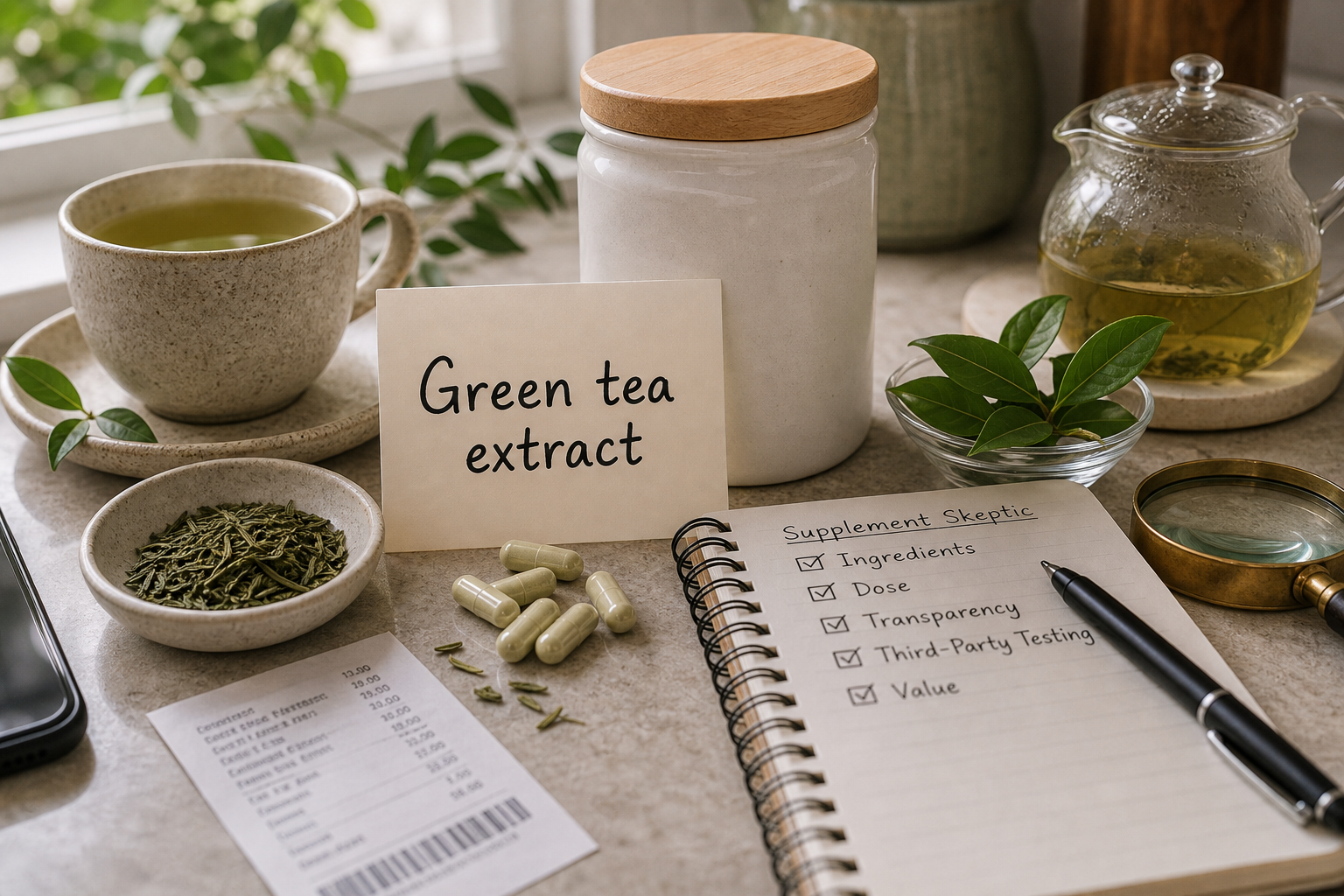
The skeptic's checklist
Before paying for a supplement that lists green tea extract (egcg) on the label, the buyer should be able to answer yes to most of these:
- EGCG mg disclosed. The active is EGCG, not "green tea extract." A real label gives you both the extract weight and the EGCG mg.
- Decaf status. Decide whether you want caffeine in the dose. Many "stimulant-free" products use non-decaf extract anyway.
- Take-with-food guidance. A label that does not say "take with food" for a 200+ mg EGCG dose has skipped the most important safety instruction.
- No proprietary blend. EGCG buried inside a thermogenic blend is the most common version of this ingredient on affiliate labels and the least verifiable.
- Third-party tested. Concentrated catechin extracts are exactly the category where contamination and label-claim mismatch matter.