Review · General Health
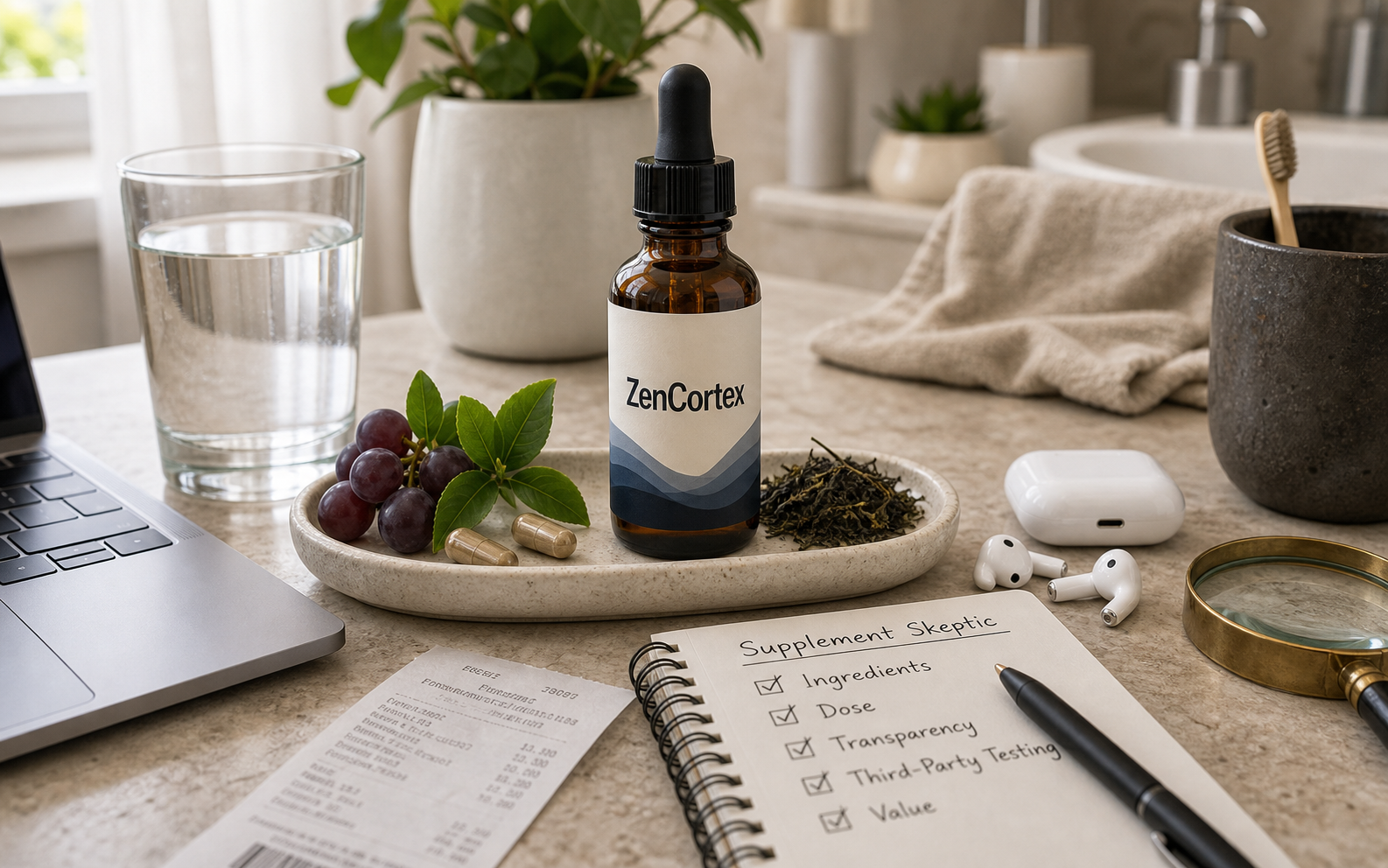
ZenCortex
ZenCortex is Quietum Plus with a different solvent system and a slightly upgraded antioxidant story. Grape seed OPCs are genuinely well-studied — for cardiovascular oxidative stress and venous insufficiency, not auditory function. The hearing positioning is unsupported by any human trial in the formula or in the ingredient literature. The brain positioning is thinner still.
Skeptic read
Avoid2.8/10
ZenCortex is Quietum Plus with a different solvent system and a slightly upgraded antioxidant story. Grape seed OPCs are genuinely well-studied — for cardiovascular oxidative stress and venous insufficiency, not auditory function. The hearing positioning is unsupported by any human trial in the formula or in the ingredient literature. The brain positioning is thinner still.
- Price checked
- From $49 (single bottle $69)
- Dose visibility
- Better than average: key doses are disclosed enough to compare
- Main risk
- Zero published human trials linking any ingredient in this formula to auditory function or tinnitus relief
- Better use case
- No population for whom this is the evidence-based choice for hearing or tinnitus management
- Skip if
- You have tinnitus or hearing concerns and are hoping for meaningful relief — there is no clinical basis for this product's primary claim
- Evidence file
- Source hardening needed
The label — what’s actually in the ZenCortex tincture
ZenCortex is a liquid tincture sold primarily online, positioned at the intersection of hearing health and cognitive support. Its sales page claims the formula “feeds” the auditory nerve with antioxidants and adaptogens, while simultaneously improving mental sharpness — a dual promise that is uncommon in the category and, on inspection, unsupported by evidence for either half.
The format distinction matters upfront: liquid tinctures do not require the same label architecture as capsule supplements. ZenCortex discloses its ingredient list but not the concentration of any individual compound per dropper serving. This makes it the least auditable format in the supplement category — a relevant fact when evaluating a product whose clinical dose-adequacy is already in question.
Per the label and sales page reviewed April 2026:
| Ingredient | Dose disclosed | What it’s doing on the label |
|---|---|---|
| Grape seed extract (standardized for OPCs) | undisclosed | Antioxidant protection for “auditory cells” |
| Green tea extract (EGCG) | undisclosed | Blood flow and neuroprotection framing |
| Capsicum annuum | undisclosed | Circulation to the inner ear framing |
| Astragalus membranaceus | undisclosed | Immune and cellular protection framing |
| Maca root (Lepidium meyenii) | undisclosed | Energy and vitality framing |
Five ingredients. No individual dose for any of them. No auditory trial for any of them.
Ingredient-by-ingredient evidence review
Grape seed extract (OPCs)
The only ingredient in ZenCortex with a meaningful human evidence base. Grape seed proanthocyanidins have been rigorously studied for:
- Chronic venous insufficiency: A 2015 review by Gulati OP (Phytother Res 29:1295–1307) covering 14 trials found 150–300 mg/day OPCs improved venous tone and reduced edema scores.
- Blood pressure: A 2016 meta-analysis by Feringa et al. (Am J Cardiol 108:787–792, updated in further work) found 150–300 mg/day reduced systolic blood pressure by ~5 mmHg.
- Oxidative stress markers: Multiple small RCTs document reductions in plasma oxidized LDL and 8-isoprostane at 150–400 mg/day.
The preclinical tinnitus angle: animal studies (particularly from the mid-2000s, e.g., Kopke et al., 2005, Free Radic Biol Med) found OPC pretreatment reduced cochlear oxidative damage after acoustic trauma. This is noise-prevention research in rodents, not tinnitus treatment in humans. The leap from “antioxidants may protect cochlear cells from future acoustic trauma in mice” to “this tincture treats your existing tinnitus” is not a small step — it is a category error.
Green tea extract (EGCG)
Covered in depth in our Java Burn review. The thermogenic and cardiovascular literature uses 400+ mg EGCG daily. The neuroprotective animal literature (Mandel SA et al., 2008, J Nutr Biochem) is mechanistically interesting but has not produced a human cognition or auditory RCT at doses deliverable in a tincture. EGCG at undisclosed tincture concentrations is not doing anything measurable for hearing.
Capsicum annuum
Capsaicin, the primary active compound in capsicum, is genuinely studied for pain modulation (TRPV1 receptor agonism), topical analgesia, and — interestingly — tinnitus. A small 2021 pilot RCT by Shim et al. (Phytother Res 35:3660–3668) looked at intranasal capsaicin application and found modest tinnitus distress reduction in a group of 58 patients. That is the most directly relevant piece of research in the ZenCortex ingredient universe, and it involved intranasal delivery at a controlled dose — not an orally ingested tincture at an undisclosed concentration. Oral capsicum in a tincture also presents a palatability and mucosal irritation challenge the sales page does not acknowledge.
Astragalus membranaceus
Discussed above and in the FAQ. Immunomodulatory evidence is real at doses of several grams of dried root daily. There is no hearing or cognitive RCT for astragalus. Its presence here is cosmetic.
Maca root
Covered in the Quietum Plus review. Libido and menopausal symptom evidence at 1.5–3 g/day. No auditory data.
The pattern
ZenCortex’s ingredient list is marginally more credible than Quietum Plus’s — grape seed OPCs actually have human evidence, and the capsaicin tinnitus pilot is a real (if inconclusive and mechanistically inappropriate) data point. But “marginally more credible” in a category where the floor is zero auditory RCTs is not a meaningful distinction. The formulation still has no human trial for any auditory endpoint at any dose approximating what a tincture delivers.
The math: cost per clinical dose
The dose math for a tincture is even less verifiable than for a capsule, because concentration (mg/mL) is not disclosed. We can, however, compare what grape seed OPCs cost at their studied cardiovascular dose — the only outcome these ingredients have human evidence for — against what ZenCortex charges.
| Product | Dose | Monthly cost |
|---|---|---|
| ZenCortex tincture (undisclosed OPC dose) | Unknown | $49–69 |
| NOW Grape Seed Extract 100 mg standardized OPCs, 200 caps | 100 mg/day (1 cap) | $5.00 (at ~30 caps) |
| Life Extension Mega Green Tea Extract 725 mg (45% EGCG), 100 caps | 325 mg EGCG/day | $9.50 (at ~30 caps) |
| Commodity total for OPCs + EGCG at studied doses | Fully disclosed | ~$15/month |
You can get the two strongest ZenCortex ingredients at their published clinical doses for roughly one-quarter of the ZenCortex single-bottle price. Neither will treat your tinnitus. But at least you’ll know what you’re taking.
Marketing teardown
The ZenCortex sales page reviewed April 17–18, 2026:
- Opens with a “retired military audiologist” character who is not identified by name, institution, or license number. His framing: “I spent 22 years watching the supplement industry ignore the real cause of hearing loss.” The “real cause” he names — oxidative stress in the cochlea — is a genuine research area. The claim that this tincture addresses it is not supported.
- Countdown timer: client-side, resets on page reload. The same architecture across every product in this category we have reviewed.
- The dual hearing-and-brain positioning creates a structural tell: legitimate specialty supplements pick one mechanism and one organ system. A product claiming to address both cochlear oxidative stress and cognitive aging simultaneously is either formulated for neither or the claims exist for marketing breadth rather than scientific specificity.
- Social proof section features testimonials from people claiming tinnitus resolution within 30 days. The 2013 Cochrane review on ginkgo — the gold-standard tinnitus supplement trial — found no benefit after 12 weeks at doses far exceeding anything ZenCortex delivers. Thirty-day resolution testimonials from a tincture are not plausible and are contradicted by the clinical literature.
- Pricing follows the now-familiar bundle-bundle pricing: $69 single, $59/bottle × 3, $49/bottle × 6. Six-bottle commitment is the sales page’s anchor. We recommend against anchoring to any product in this category.
What we’d want to see before revising this verdict
- A human RCT on any ingredient in this formula for any auditory endpoint at any dose
- Disclosed mg/mL concentration for each ingredient per standard dropper serving
- Removal of the tinnitus-relief claim, which is not supported by any available evidence
- A separately positioned cognitive formula, if the brain-health angle has a genuine formulation strategy behind it — the dual claim currently undermines both
The minimum to move this to “Skeptical” rather than “Avoid” would be a single published human trial linking grape seed OPCs to any auditory measure. That trial does not exist.
Bottom line
ZenCortex is Quietum Plus in a tincture bottle with a better antioxidant story. Grape seed OPCs are real compounds with real human evidence — for venous insufficiency and oxidative stress markers, not hearing loss or tinnitus. The formula’s liquid format adds opacity rather than credibility, and the dual hearing-plus-brain positioning signals category opportunism rather than focused clinical development.
Skeptic Desk verdict: Avoid — 2.8/10. Grape seed OPCs are worth having in your stack if cardiovascular antioxidant support is your goal. Buy them in a commodity capsule for $5/month. Do not pay $49–69 for an undisclosed dose of them inside a tinnitus claim that no published science has ever validated.
Here's what I'd actually do
If you opened this at 11 pm and the page made the supplement look like an answer to something larger:
Close this tab. ZenCortex is in the band where the marketing is doing the heavy lifting and the formula is not. There are evidence-based versions of every promise on that sales page, and most of them cost a third of the price with full label transparency.
Don't buy this if: Do not buy this if you have a diagnosed condition that this product is implicitly addressing. See a clinician. A $69 bottle does not replace a $0-with-insurance lab panel.
— Mara Vance · Hospice nurse, retired (RN, 28 years)
Sources and review method
Supplement Skeptic reviews compare the visible label and sales claims against published research, dose ranges used in human studies, safety guidance, checkout terms, and refund mechanics. This page is not medical advice.
Source links are being attached as each review is re-audited. Until then, treat pages without a source list as editorial analysis that still needs citation hardening.
Frequently asked questions
- What makes ZenCortex different from Quietum Plus?
- Primarily format and ingredient roster, not mechanism or evidence quality. ZenCortex is a liquid tincture rather than a capsule, and its ingredient list swaps mucuna and epimedium for grape seed extract, green tea, and capsicum. Both products share the same core problem: positioning botanicals with no auditory-specific evidence as hearing or tinnitus supplements. ZenCortex adds a 'brain health' angle, which if anything weakens the product focus further. A cognitive supplement and a hearing supplement are not the same product — combining both claims in one formula without evidence for either is a red flag, not a selling point.
- Does grape seed extract do anything for hearing?
- Not in any published human trial. Grape seed proanthocyanidins (OPCs) are well-studied antioxidants with RCT evidence for chronic venous insufficiency (Gulati OP, 2015, *Phytother Res* 29:1295–1307) and some positive signals for blood pressure and oxidative stress markers. A few animal studies have examined whether OPC pretreatment before noise exposure attenuates cochlear hair cell damage — with mildly positive preclinical results. No human RCT has measured any auditory endpoint for grape seed extract, and the preclinical noise-protection research has nothing to do with chronic tinnitus or sensorineural hearing loss already established.
- Is ZenCortex a scam?
- It is a product that makes claims its evidence base does not support. You receive a physical liquid tincture; the checkout processor enforces the 60-day refund window; the ingredient list is disclosed at the category level. The problem is that the primary claim — that this tincture supports hearing and tinnitus — is not testable from the published literature because no such trial has been conducted. Legally, dietary supplement structure-function claims like 'supports auditory health' do not require evidence of efficacy before sale. That legal threshold is far below what a consumer should require before spending $49–69 monthly on a condition as distressing as hearing loss or tinnitus.
- Why is ZenCortex a liquid tincture instead of capsules?
- The format is likely a differentiation strategy rather than a pharmacokinetic one. Liquid tinctures do offer faster mucosal absorption for some compounds, particularly lipophilic flavonoids — but the dose delivered per dropper in this format is trivial, and the serving size math is even harder to audit than a capsule proprietary blend. A liquid tincture also allows the sales page to imply pharmaceutical-grade delivery without disclosing the concentration of any active compound. From a consumer-transparency standpoint, it is the least informative supplement format available.
- What does astragalus do, and is it doing anything in ZenCortex?
- Astragalus membranaceus (huang qi) is one of the most studied traditional Chinese medicine botanicals, with credible human RCT evidence for immune function at 9–30 g of dried root equivalent daily (Block KI and Mead MN, 2003, *Integr Cancer Ther* 2:247–267), and emerging research on astragaloside IV as a telomere-protective compound. In a tincture serving, the realistic dose of astragalus is in the milligrams of extract — orders of magnitude below studied immunomodulatory doses. There is no hearing or brain evidence for astragalus at any dose in any human trial. Its inclusion reads as a label-credibility ingredient.
- What should I actually do about hearing loss or tinnitus?
- For hearing loss: the single most evidence-supported intervention is appropriate amplification — hearing aids fitted by an audiologist. They work, they have decades of RCT data, and modern devices are more accessible than they have ever been. For tinnitus specifically: the 2020 Cochrane review by Fuller et al. on sound therapy and the substantial CBT-for-tinnitus literature represent the strongest evidence base. The American Tinnitus Association maintains an evidence-graded treatment database. No product in the Quietum Plus / ZenCortex category appears in it.
More in General Health