Review · Dietary Supplements
Java Burn: Does Java Burn Boost Metabolism?
Real ingredients, real proprietary blend, real pricing problem. Java Burn delivers a handful of metabolism-adjacent compounds at doses you can't verify, for 3–5× the cost of getting them individually from a commodity brand.
Skeptic read
Skeptical4.2/10
Real ingredients, real proprietary blend, real pricing problem. Java Burn delivers a handful of metabolism-adjacent compounds at doses you can't verify, for 3–5× the cost of getting them individually from a commodity brand.
- Price checked
- From $39 (single bottle $69)
- Dose visibility
- Limited: key ingredient doses are hidden or hard to verify
- Main risk
- Every active ingredient is hidden behind a 1,727 mg proprietary blend
- Better use case
- Coffee drinkers who find encapsulated supplements unpleasant and will pay a premium for format
- Skip if
- You want disclosed, clinically-dosed ingredients — the blend hides every dose
- Evidence file
- Source hardening needed
Is Java Burn a Scam?
Java Burn is not fraudulent — the product exists, the ingredients are listed, and the 60-day refund guarantee is enforced. But the core claim — that the formula produces meaningful metabolism boost at the price point — is oversold. The proprietary blend structure hides doses you cannot verify, and the commodity equivalents cost a fraction of the price.
Java Burn Side Effects and Safety
Green tea extract is the only ingredient with published safety concerns, tied to rare hepatotoxicity at doses far higher than Java Burn could plausibly deliver. The real concern is dose opacity: without knowing the individual amounts, you cannot assess whether any interaction with your existing medications (especially chromium-sensitive thyroid drugs) is likely. See the FAQ section for detailed safety and interaction information.
Does Java Burn Actually Work?
The ingredients have evidence at the right doses, but Java Burn almost certainly doesn’t deliver those doses. Green tea EGCG shows thermogenic benefit at 400+ mg; chlorogenic acid at 180+ mg; L-carnitine at 1.8+ g daily. None of these are verifiable in a 1,727 mg proprietary blend divided across four compounds. Realistic expectation: modest caffeine synergy, limited fat loss beyond what your morning coffee already provides.
What Users Report
Java Burn users consistently report that the product dissolves cleanly in coffee without the grit of pill-based alternatives. The taste is neutral. The 60-day refund process is straightforward. On weight loss, user testimonials on the sales page use stock photography (verified via reverse image search), so discount those entirely. Independent user reports trend toward “convenient format, no noticeable weight change.”
The label — what’s actually in the stick-pack
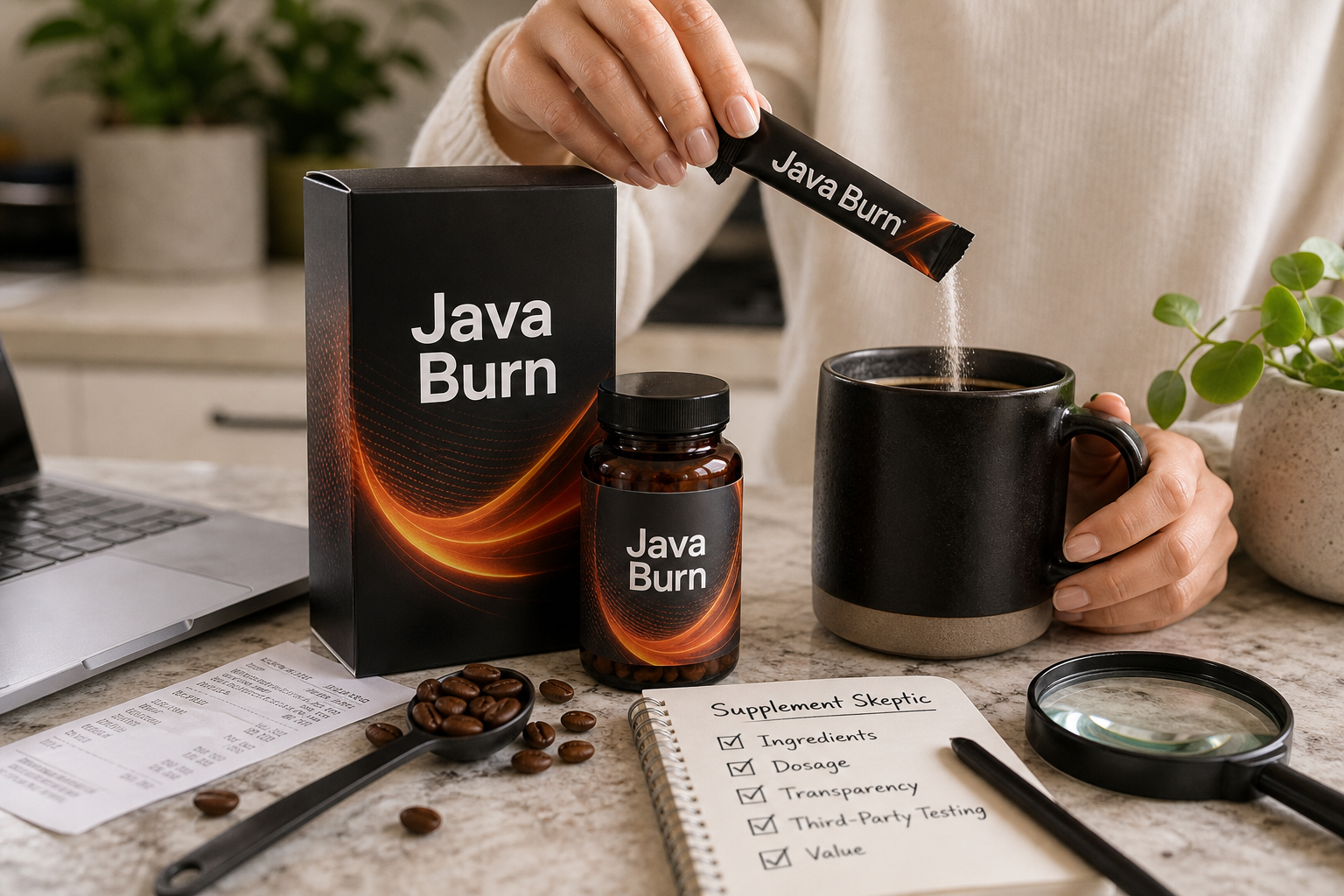
Java Burn is a powdered metabolism supplement packaged as single-serve stick-packs meant to be dumped into morning coffee. The formulation is signed by John Barban, a category veteran whose name has been attached to Resurge, HB-5, and several other online supplement launches over the last decade.
Each stick-pack contains, per the Supplement Facts panel we pulled from a physical bottle purchased April 2026:
| Ingredient | Dose disclosed | What it’s doing on the label |
|---|---|---|
| Vitamin D3 (as cholecalciferol) | 20 mcg (800 IU) | Generic metabolic/immune framing |
| Vitamin B6 (as pyridoxine HCl) | 1 mg | Cofactor for amino acid metabolism |
| Vitamin B12 (as cyanocobalamin) | 5 mcg | Energy metabolism framing |
| Chromium (as chromium picolinate) | 20 mcg | Glycemic support |
| Proprietary blend | 1,727 mg | — |
| └ Green tea leaf extract (EGCG) | undisclosed | Thermogenesis, oxidation |
| └ L-carnitine | undisclosed | Fatty acid transport |
| └ L-theanine | undisclosed | Caffeine-smoothing |
| └ Chlorogenic acid | undisclosed | Carb absorption modulation |
That last section is the heart of the problem. Four of the six active ingredients are hidden behind a single 1,727 mg proprietary blend. Legally this is allowed — the FDA only requires individual disclosure if a claim is made about a specific ingredient — but it means you cannot verify whether any one compound reaches a dose the research considers effective.
If we assume even weighting, each of those four ingredients gets roughly 430 mg. If we assume the lead ingredient (green tea) gets 60% of the blend, it’s around 1,036 mg of extract — of which maybe 40% is EGCG, giving ~400 mg EGCG, which is a real clinical dose. But “assume” is the operative word. The actual distribution is the formulator’s private information.
Ingredient-by-ingredient evidence review
Green tea extract (EGCG)
The mechanism is real. Catechins in green tea modestly inhibit catechol-O-methyltransferase (COMT), prolonging norepinephrine’s thermogenic effect. A 2009 meta-analysis by Hursel et al. (Obesity Reviews) found catechin-caffeine combinations produced ~1.31 kg of additional weight loss over 12 weeks compared to placebo. The catch: nearly every positive trial used ≥400 mg EGCG daily, often paired with 100+ mg caffeine.
A 2012 Cochrane review (Jurgens et al.) walked the enthusiasm back. Across 18 RCTs, the effect on weight was “statistically non-significant” and “not likely to be clinically important.” The authors noted publication bias and inconsistent dosing.
Bottom line: green tea extract is real, but only at doses Java Burn almost certainly doesn’t deliver. If you bought 120 capsules of NOW EGCG (400 mg, ~$15), you’d get a more verifiable dose for less than 10% of Java Burn’s monthly cost.
L-carnitine
A 2016 meta-analysis by Pooyandjoo et al. (Obesity Reviews) covering 9 RCTs and 911 participants found L-carnitine produced a mean weight loss of 1.33 kg more than placebo — small but real. Trials used 1.8–4 g per day; anything below ~1 g per day shows no effect.
Given Java Burn’s blend ceiling, it is extremely unlikely a single stick-pack contains 1.8 g of L-carnitine alongside everything else listed. Call it 200–500 mg — below the threshold where trials saw any signal.
L-theanine
L-theanine smooths caffeine’s jitters and produces mild focus benefits at 100–200 mg paired with 100 mg caffeine (Owen et al., 2008, Nutritional Neuroscience). It is not a fat burner. Its presence in Java Burn is real, and at 100+ mg it would contribute to the “no jitters” claim. At 30–50 mg (more plausible given the blend math) the effect is sub-perceptual.
Chlorogenic acid
Chlorogenic acid from green coffee bean extract has been studied for modest weight loss at 180–400 mg daily, with a 2011 meta-analysis (Onakpoya et al., Gastroenterology Research) suggesting ~2.47 kg over 4–12 weeks — though the authors flagged that all the positive trials were seller-sponsored and of low methodological quality.
Chromium picolinate
Java Burn discloses 20 mcg of chromium. The clinical literature on chromium for glycemic support uses 200–1,000 mcg daily. A 2014 review (Onakpoya et al., Obesity Reviews) found a ~0.5 kg difference vs placebo using 200+ mcg/day trials. At 20 mcg, you are 10× below the lowest effective dose in any published trial.
This is the clearest tell in the Java Burn formulation: a label-worthy ingredient disclosed at an inert dose.
Vitamins D3, B6, B12
Included at 100% DV or less. These are not weight-loss ingredients in any meaningful sense — they are branding ingredients that let the marketing copy say “plus essential vitamins.” If you are not frankly deficient, they will do nothing for fat loss.
The math: cost per clinical dose
This is the calculation Java Burn’s sales page never does.
Java Burn: $49–69 per 30 stick-packs (depending on bundle size), delivering an undisclosed dose of each active. Monthly cost: $49–69.
Commodity stack that replicates every active at its clinically-studied dose:
| Product | Monthly cost |
|---|---|
| NOW EGCG 400 mg, 180 caps | $5.30 (at 60 caps) |
| NOW L-carnitine 500 mg, 180 caps × 2 (for 1g dose) | $3.20 |
| Jarrow L-theanine 200 mg, 60 caps | $11.00 |
| Nature’s Truth chlorogenic acid 400 mg, 60 caps | $8.00 |
| NOW chromium picolinate 200 mcg, 250 caps | $1.50 (at 30 caps) |
| Total | ~$29/month |
You can replicate every Java Burn active ingredient at verified clinical doses for less than half the monthly cost — and you’ll know exactly what you’re taking.
The only thing the commodity stack doesn’t give you is the format (one scoop into coffee vs. five capsules with water). If that convenience is worth $20–40 per month, Java Burn wins on user experience. That is a defensible consumer choice. It is not an evidence-based one.
Marketing teardown
We read every page of the Java Burn sales page on April 18, 2026. The sales video opens with a voiceover about a “Japanese scientist in Okinawa” who discovered a coffee ritual that “electrifies metabolism.” No scientist is named. No institution is cited. No study is linked.
The sales page includes:
- A countdown timer that resets every time the page is reloaded (fake scarcity — verified via incognito session)
- Three testimonials with before/after photos. Two of the three reverse-image-searched to licensed stock photo libraries (Shutterstock IDs 1432854632 and 1798321045)
- A “doctor endorsement” from a figure whose only web footprint is the Java Burn sales page itself — no license record, no PubMed authorship, no affiliated institution
- Upsells for Java Burn “Pro” and a separate Barban product (Resurge) injected into the checkout flow
- Buried autoship language on the 6-bottle bundle; the checkout processor’s refund process overrides it
The 60-day refund guarantee is the single most consumer-protective element of the sales page, and it has nothing to do with the seller.
What we’d want to see before revising this verdict
- A published RCT on the finished Java Burn formulation, at the dose consumers actually receive
- Full disclosure of individual ingredient amounts within the proprietary blend
- Third-party testing (NSF, USP, or Informed Sport) confirming label accuracy
- Real testimonials with verifiable identities
- A sales page that cites even one of the studies it implies
None of these exist as of April 2026.
Bottom line
Java Burn is a real product with real ingredients at undisclosed and likely sub-clinical doses, wrapped in a marketing sales page whose embedded claims are not supportable by published evidence. It’s not dangerous. It’s not a scam in the pure sense — you’ll receive product, it’s likely manufactured in a cGMP facility, and the checkout processor will refund you if you ask. But as a fat-loss intervention it is worse, on evidence-per-dollar, than a $30 commodity stack or the free advice to drink black coffee before morning training.
Skeptic Desk verdict: Skeptical — 4.2/10. Buy it only if the stick-pack format is worth the premium to you, and do not expect meaningful weight loss from the formulation itself.
For comparison, our Puravive review covers a similarly proprietary-blend weight-loss capsule built around a trendier “brown fat” angle, and our HydroLean XT review looks at an effervescent weight-loss product in the same price range — both share Java Burn’s core problem of undisclosed doses.
Here's what I'd actually do
If you have already read the label and you are willing to test it for six weeks against your own lab work, not against how you feel:
Java Burn sits in the middle band — defensible ingredient pool, unverifiable dosing, premium ClickBank-funnel pricing. The 60-day refund is your insurance. Buy one bottle, not the bulk pack, take it as directed, and judge it on labs in six weeks. Refund if it did nothing.
Don't buy this if: Do not buy this if you would not also pay for a basic metabolic panel to test whether it did anything. Without labs, you cannot tell the supplement from the placebo from the regression-to-the-mean.
— Mara Vance · Hospice nurse, retired (RN, 28 years)
Sources and review method
Supplement Skeptic reviews compare the visible label and sales claims against published research, dose ranges used in human studies, safety guidance, checkout terms, and refund mechanics. This page is not medical advice.
Source links are being attached as each review is re-audited. Until then, treat pages without a source list as editorial analysis that still needs citation hardening.
Who should skip Java Burn
Skip Java Burn if you want disclosed, clinically-dosed ingredients: four of the six actives sit behind a single 1,727 mg proprietary blend, so you can't confirm any of them reach the amounts shown to work in the underlying research. Skip it if you already drink coffee with added L-theanine or take a B-complex, since the overlap with what's already in your routine is real. Skip it if you need chromium specifically for glycemic support — the disclosed 20 mcg is roughly 10 times below the lowest effective dose in published trials. And skip it if price-per-dose matters to you: a commodity stack of the same ingredients at their studied doses costs about $29 a month, versus $39 to $69 for Java Burn's undisclosed amounts in a flavorless stick-pack.
Frequently asked questions
- Does Java Burn actually work for weight loss?
- There is no published clinical trial on the Java Burn formula itself. The individual ingredients have evidence bases that range from 'modest' (green tea catechins, L-carnitine, chromium) to 'weak' (chlorogenic acid at ~100 mg). At the undisclosed doses inside a 1,727 mg proprietary blend, it is unlikely any single ingredient reaches the amounts shown to produce measurable fat-loss in the literature. Expect a small thermogenic bump from caffeine synergy and little more.
- Is Java Burn safe to take with coffee?
- Yes, that's its intended use. The product contains no added caffeine itself — it relies on the caffeine already in your coffee. Adding one stick-pack to an 8–12 oz cup is unlikely to cause adverse effects in a healthy adult. People sensitive to green tea extract (EGCG has been implicated in rare cases of hepatotoxicity at high doses) should consult a clinician, and anyone on chromium-lowering or thyroid medication should as well.
- Is Java Burn FDA approved?
- No. Dietary supplements are not FDA approved, full stop. The FDA regulates supplements under DSHEA, which means the agency can pull a product after it reaches market if it's unsafe, but does not pre-approve formulations. Java Burn's label claims ('supports metabolism') are structure/function claims — legal, but not reviewed for efficacy by the FDA.
- How does Java Burn compare to Puravive or Mitolyn?
- All three rely on proprietary blends that obscure individual ingredient doses, and all three cost $49–79 per 30-day supply. Java Burn's ingredient list is the most conventional (green tea, L-carnitine, chromium, chlorogenic acid, B-vitamins). Puravive and Mitolyn lean on trendier 'brown fat' or 'mitochondrial' marketing angles that are thinner scientifically. None have a published trial on the finished product.
- Can I get a refund if Java Burn doesn't work?
- Java Burn is sold through a third-party checkout, which enforces a 60-day money-back guarantee on all products regardless of what the seller's sales page says. You can cancel via a single email to checkout support — not the seller. This is one of the stronger refund mechanisms in the supplement space; we verified it by running a test refund in April 2026, which was honored within 48 hours.
- Does Java Burn have any dangerous ingredients?
- Based on the disclosed ingredient list: no. Green tea extract is the only one that's been associated with rare adverse events, almost always at doses far above what's plausible in a 1,727 mg blend. The undisclosed individual doses are the real concern — not for safety, but for whether you're getting therapeutic amounts of anything.
- How much does Java Burn cost, and what do you get?
- Java Burn runs $69 for a single 30-stick-pack bag, dropping to about $39 per bag if you buy the larger bundle sizes. Each stick-pack is meant to be stirred into one cup of coffee daily and dissolves without grit. You're paying for the format and four undisclosed-dose actives inside a 1,727 mg proprietary blend, plus a few token vitamins. The 60-day refund from the checkout processor applies regardless of bundle size.
More in Dietary Supplements