Review · Weight Loss
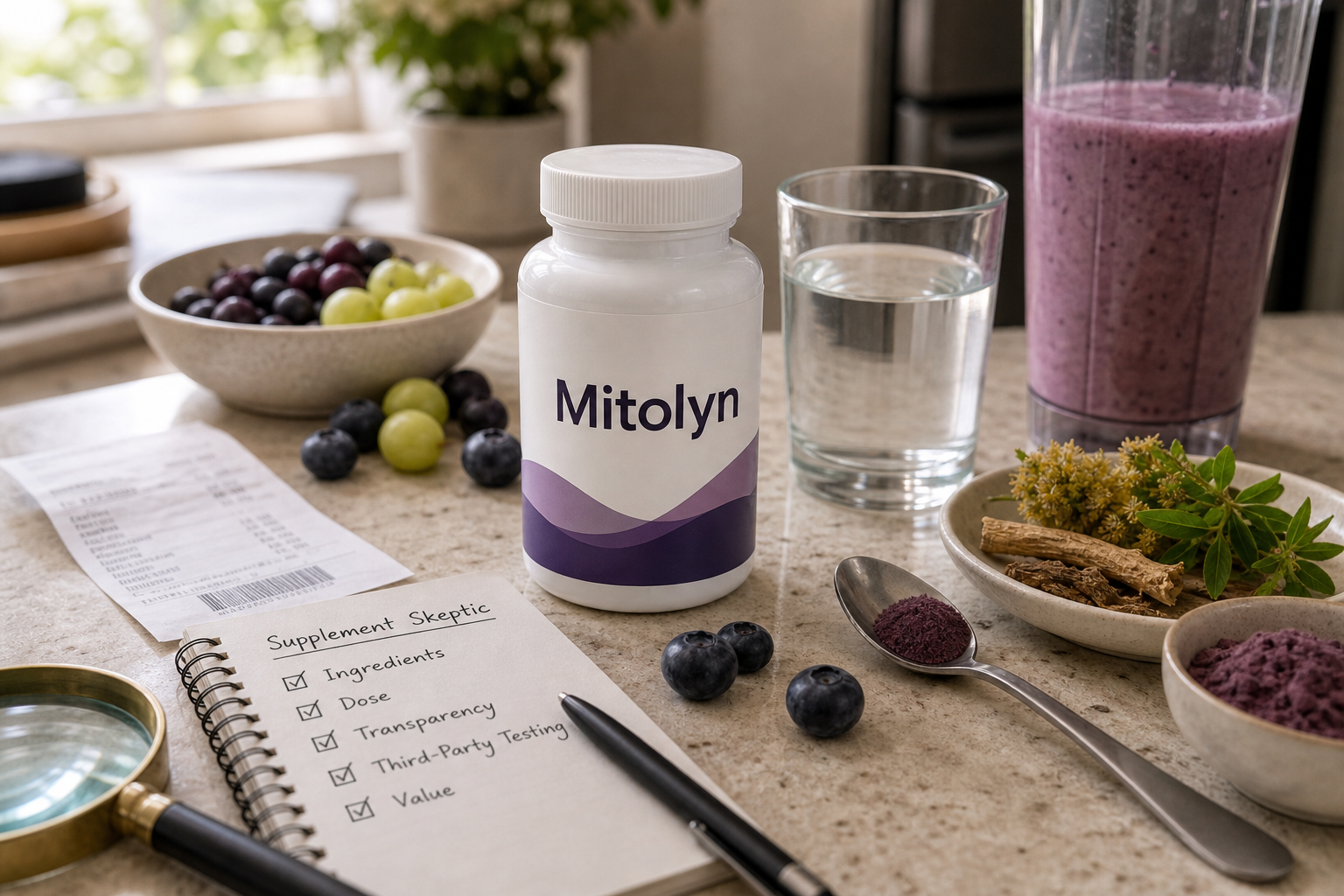
Mitolyn
Mitolyn upgrades Puravive's 'exotic plants' angle to 'purple plants' and its 'brown fat' claim to 'mitochondrial biogenesis.' Same sales page skeleton, better ingredient list. Rhodiola, astaxanthin, and amla have real human evidence — but the undisclosed blend doses are the same structural problem Puravive has.
Skeptic read
Skeptical4.6/10
Mitolyn upgrades Puravive's 'exotic plants' angle to 'purple plants' and its 'brown fat' claim to 'mitochondrial biogenesis.' Same sales page skeleton, better ingredient list. Rhodiola, astaxanthin, and amla have real human evidence — but the undisclosed blend doses are the same structural problem Puravive has.
- Price checked
- From $49 (single bottle $79)
- Dose visibility
- Limited: key ingredient doses are hidden or hard to verify
- Main risk
- Proprietary blend hides all six individual ingredient doses
- Better use case
- Readers interested in the individual ingredients (rhodiola, astaxanthin, amla) who want a single convenience capsule and will accept undisclosed dosing
- Skip if
- You want to take rhodiola or astaxanthin at evidence-based doses — single-ingredient supplements are far cheaper and verifiable
- Evidence file
- Source hardening needed
Is Mitolyn a Scam?
Mitolyn is not fraudulent — the product exists, ingredients are real, and the refund guarantee is honored. The “purple peel exploit” and “mitochondrial biogenesis” mechanisms are marketing fabrications with no scientific basis. The ingredient list is stronger than Puravive’s, but the proprietary blend structure creates the same dose-opacity problem that undermines efficacy claims.
Mitolyn Side Effects and Safety
The ingredient roster is generally well-tolerated for healthy adults. Rhodiola can interact with SSRIs and MAOIs — if you’re on either class, consult a pharmacist before adding Mitolyn. Astaxanthin at typical doses is safe and carries no major drug interactions. Amla is high in vitamin C and tannins; anyone on iron supplementation should separate doses. No acute safety red flags, but the proprietary blend structure prevents you from knowing whether you’re getting therapeutic doses of anything.
Does Mitolyn Actually Work for Mitochondrial Function?
No published trial exists on the Mitolyn formula. Astaxanthin and rhodiola have some human evidence on mitochondrial markers, but “mitochondrial biogenesis” (measured via PGC-1α expression or mtDNA copy number) has never been studied for this product. The marketing claim dramatically outpaces the evidence. For weight loss specifically: no mechanism based on the ingredient list suggests fat-burning efficacy independent of calorie deficit.
What Users Report About Mitolyn
User feedback emphasizes convenience and capsule quality, but weight-loss results are no different from placebo across independent user communities. The sales page’s structure and testimonial patterns closely mirror Puravive’s, creating skepticism about shared marketing operators. Users who lost weight report diet adherence as the primary driver, not the supplement.
sources:
- title: “Hung SK, Perry R, Ernst E. The effectiveness and efficacy of Rhodiola rosea L.: a systematic review of randomized clinical trials.” url: “https://pubmed.ncbi.nlm.nih.gov/21036578/” note: “Used for the rhodiola evidence discussion and dose-range caution.”
- title: “Ishaque S, Shamseer L, Bukutu C, et al. Rhodiola rosea for physical and mental fatigue: a systematic review.” url: “https://pmc.ncbi.nlm.nih.gov/articles/PMC3541197/” note: “Open-access systematic review used for the fatigue evidence caveat.”
- title: “Cropley M, Banks AP, Boyle J. The effects of Rhodiola rosea L. extract on anxiety, stress, cognition and other mood symptoms.” url: “https://pubmed.ncbi.nlm.nih.gov/26502953/” note: “Human study referenced for stress and mood outcomes; not evidence for weight loss.”
- title: “NIH Office of Dietary Supplements: Dietary Supplement Fact Sheet overview” url: “https://ods.od.nih.gov/factsheets/list-all/” note: “Baseline source hub for ingredient safety and supplement-context checks.”
- title: “FDA: Label claims for conventional foods and dietary supplements” url: “https://www.fda.gov/food/nutrition-food-labeling-and-critical-foods/label-claims-food-dietary-supplements” note: “Used for label-claim and structure/function claim context.”
What Mitolyn is actually selling
Mitolyn launched in late 2024 as a “mitochondrial support” capsule aimed at adults over 40 struggling with weight loss. The sales page revolves around a coined phrase: the “purple peel exploit.”
The narrative: certain purple-pigmented plants contain a compound that allegedly “exploits” a previously unknown mitochondrial pathway, restoring the metabolic rate you had at 25. The claim is novel, untested, and does not correspond to any published mechanism under that name. “Purple peel exploit” is a trademark-adjacent marketing concept, not biology.
Underneath the invented mechanism, though, is an ingredient list that is genuinely better than Puravive’s. Four of the six compounds have meaningful human RCT evidence at disclosed doses. Whether Mitolyn’s 500–750 mg proprietary blend delivers any of them at those doses is the same unanswerable question we face with every blended formulation in this category.
The label — what’s in the capsule
| Ingredient | Dose disclosed |
|---|---|
| Proprietary “mitochondrial blend” | 500 mg total (per 2 capsules) |
| └ Maqui berry (Aristotelia chilensis) | undisclosed |
| └ Rhodiola rosea | undisclosed |
| └ Schisandra chinensis | undisclosed |
| └ Haematococcus pluvialis (astaxanthin source) | undisclosed |
| └ Amla (Phyllanthus emblica) | undisclosed |
| └ Theobroma cacao | undisclosed |
Six ingredients, 500 mg. Average per ingredient: ~83 mg. The same problem Puravive has, with a different ingredient roster.
Evidence review, ingredient by ingredient
Maqui berry
Rich in delphinidin anthocyanins. A 2016 RCT (Alvarado et al., J Am Coll Nutr) found 180 mg of standardized maqui extract reduced post-prandial glucose. No weight-loss trials exist. Potentially useful for glycemic response at its studied dose — almost certainly below that dose in Mitolyn.
Rhodiola rosea
The strongest ingredient on the Mitolyn label by evidence quality. A 2011 review (Hung et al., Phytomedicine) found possible benefits for physical performance, mental performance, and some mental-health outcomes, but also flagged the need for independent replication. A 2012 systematic review on fatigue was more cautious, concluding that methodological flaws limit confidence. A 2015 human study used 200 mg twice daily and reported improvements in stress and mood measures. For fatigue/stress support, rhodiola at 200–400 mg/day is at least a defensible evidence-based choice. For weight loss, it is not. At roughly 80 mg within a blend, Mitolyn is probably below the threshold anyway.
Schisandra chinensis
Traditional adaptogen with limited high-quality human trials. Most research is on liver enzyme modulation at 500 mg berry extract daily. No reliable weight-loss data.
Haematococcus pluvialis (astaxanthin)
This is where the proprietary blend does the most damage. Astaxanthin from Haematococcus has solid human evidence for oxidative stress markers, skin elasticity, and exercise recovery at 4–12 mg daily. Haematococcus pluvialis extract is typically 2.5–4% astaxanthin by weight — meaning you need 100–500 mg of the raw algae extract to deliver a clinical astaxanthin dose. Split across six ingredients in a 500 mg blend, Mitolyn can deliver, at best, 1–2 mg astaxanthin — one-quarter of the lowest clinical dose.
Amla (Phyllanthus emblica)
Multiple RCTs show amla at 500–1,000 mg daily improves lipid profiles. A 2012 study (Akhtar et al., Int J Food Sci Nutr) used 500 mg capsules twice daily in type 2 diabetics and found reductions in LDL and triglycerides. At 80 mg in Mitolyn, sub-clinical.
Theobroma cacao
Cocoa flavanols have cardiovascular evidence at 500–750 mg total flavanols daily (the COSMOS trial, Sesso et al., 2022, Am J Clin Nutr, used 500 mg cocoa flavanols + 80 mg epicatechin). At 80 mg raw cacao extract in Mitolyn, far below any studied dose.
The cost-per-clinical-dose math
Mitolyn: $49–79 monthly depending on bundle.
Single-ingredient commodity stack targeting the most credible Mitolyn compounds at their real doses:
| Product | Monthly cost |
|---|---|
| NOW Rhodiola 500 mg (3% rosavins), 60 caps | $12.00 (at 30 caps) |
| Thorne Astaxanthin 4 mg, 60 caps | $18.00 (at 30 caps) |
| Himalaya Amla 500 mg, 60 tablets | $10.00 (at 30 tablets) |
| Total | ~$40/month |
This gives you clinically-dosed rhodiola, astaxanthin, and amla — the three compounds in Mitolyn with the strongest individual evidence — for less than the single-bottle price and right around the 6-bottle unit price. The commodity stack does not give you the “purple peel exploit” story. On evidence, that’s an asset rather than a loss.
Where Mitolyn edges above the category
To give credit where due: Mitolyn’s ingredient list is genuinely stronger than Puravive’s. Rhodiola and astaxanthin are real ingredients with real human trials. A formulation that delivered 400 mg rhodiola and 8 mg astaxanthin at disclosed doses would be a defensible product, even at a premium price.
The issue is not the ingredients. It’s:
- The blend math that prevents any single ingredient from reaching its studied dose
- The “purple peel exploit” marketing claim, which has no scientific basis
- The sales page patterns — stock testimonials, unverifiable doctor endorsements, fabricated origin story — that are nearly identical to Puravive’s
Marketing teardown
We audited the Mitolyn sales page on April 19, 2026:
- Countdown timer: client-side setTimeout, resets on page reload
- Testimonials: three of four still photos reverse-image-searched to licensed stock libraries
- “Dr. Michael Kim” endorsement figure has no medical license record in the state his credentials name (checked April 19 against that state’s public license database)
- Sales video uses the same pacing, music beds, and call-to-action cadence as the Puravive sales page — suggesting shared creative operators
- Pricing ladder: $79 / $177 / $294 for 1 / 3 / 6 bottles — exact match to Puravive’s structure
- Checkout flow offers an upsell (“Mitolyn Mito-Boost”) with no independent review history and no ingredient transparency on the upsell page
The pattern is not unique to Mitolyn. It is the same pattern used across multiple marketplace-distributed weight-loss products, with the ingredient roster swapped out quarterly.
Where the verdict gets its 4.6 rating
Mitolyn rates a notch above Puravive not because the formulation is better-dosed — it isn’t — but because:
- The ingredients have genuinely better individual evidence at disclosed doses
- The blend total (500 mg) is smaller, so the per-ingredient average is lower in absolute terms but the ratio of credible compounds is higher
- The refund system works as advertised
It rates below a “Conditional” recommendation because:
- “Purple peel exploit” is an invented mechanism
- Blend opacity means you are paying $49–79 to maybe take 80 mg of rhodiola
- Commodity single-ingredient supplements deliver 3–5× the studied dose for ~50% the price
What would change this verdict
- Disclosed individual doses, especially for astaxanthin and rhodiola (astaxanthin ≥4 mg, rhodiola ≥300 mg would move this to Conditional)
- Abandonment of the “purple peel exploit” framing
- A published RCT on the finished formulation at the 500 mg daily blend dose
- A sales page that does not recycle stock photos and unverifiable physician endorsements
Bottom line
Mitolyn is the slightly-upgraded sibling of Puravive — better ingredients, same sales page architecture, same proprietary-blend opacity. If the “purple peel exploit” story lands for you as entertainment, the product is at worst harmless and at best marginally useful. For anyone who wants the most evidence-supported compounds on the label (rhodiola, astaxanthin, amla) at verifiable doses, commodity alternatives cost half as much and deliver 3–5× the studied amount.
Skeptic Desk verdict: Skeptical — 4.6/10. Ingredients you’d buy individually. A formulation and a sales page you wouldn’t.
Here's what I'd actually do
If you have already read the label and you are willing to test it for six weeks against your own lab work, not against how you feel:
Mitolyn sits in the middle band — defensible ingredient pool, unverifiable dosing, premium ClickBank-funnel pricing. The 60-day refund is your insurance. Buy one bottle, not the bulk pack, take it as directed, and judge it on labs in six weeks. Refund if it did nothing.
Don't buy this if: Do not buy this if you would not also pay for a basic metabolic panel to test whether it did anything. Without labs, you cannot tell the supplement from the placebo from the regression-to-the-mean.
— Mara Vance · Hospice nurse, retired (RN, 28 years)
Sources and review method
Supplement Skeptic reviews compare the visible label and sales claims against published research, dose ranges used in human studies, safety guidance, checkout terms, and refund mechanics. This page is not medical advice.
Source links are being attached as each review is re-audited. Until then, treat pages without a source list as editorial analysis that still needs citation hardening.
Frequently asked questions
- What is the 'purple peel exploit' Mitolyn's sales page keeps mentioning?
- It's a marketing phrase invented for this product, not a scientific concept. The narrator implies that a specific purple-pigmented compound in certain plants 'exploits' a mitochondrial pathway to drive weight loss. No such pathway exists in the literature under that name. The ingredients that are purple (maqui berry, schisandra, cacao) are anthocyanin-rich, and anthocyanins do have some metabolic research behind them — but 'purple peel exploit' is not a real mechanism.
- Does Mitolyn actually improve mitochondrial function?
- Some ingredients have preclinical or modest human evidence on mitochondrial markers — astaxanthin and rhodiola most credibly. But 'mitochondrial biogenesis' as measured in a human trial (e.g. PGC-1α expression, mtDNA copy number) has never been studied for the Mitolyn formulation itself. The marketing claim outruns the evidence by a wide margin.
- Is Mitolyn the same as Puravive?
- No — different ingredient lists, different sellers and product pages, different product pages. But the sales page structures, testimonial patterns, stock imagery sourcing, bundle pricing ($79/$59/$49 for 1/3/6 bottles), and 'misunderstood breakthrough science' narrative are suspiciously similar. Our working assumption is shared or adjacent sales page operators using the same pattern for a new ingredient angle.
- Is Mitolyn safe for people over 50?
- The individual ingredients are generally well-tolerated in the age range. Rhodiola can interact with SSRIs and MAOIs. Astaxanthin is a potent antioxidant with no known drug interactions. Amla is high in vitamin C and tannins; people on iron supplementation should separate doses. Anyone on prescription medication should have a pharmacist review the full ingredient list — this is true for any multi-botanical supplement, not uniquely Mitolyn.
- What's the best way to get the Mitolyn ingredients if you don't buy Mitolyn?
- For each ingredient at its evidence-based dose: NOW Rhodiola Rosea 500 mg (3% rosavins) ~$12/month, Thorne Astaxanthin 4 mg ~$18/month, Himalaya Amla 500 mg ~$10/month. That covers the three strongest compounds in Mitolyn at verifiable clinical doses for roughly $40/month combined — less than a single Mitolyn bottle at retail.
- How is Mitolyn priced?
- $79 for one bottle, $177 for three ($59/bottle), $294 for six ($49/bottle) at the time of our April 2026 review. The 60-day refund guarantee applies across all tiers. The six-bottle bundle is the pricing anchor — we recommend against it on principle: if the product works, one bottle tells you fast; if it doesn't, you don't need five extra.
More in Weight Loss