Review · Dietary Supplements
Claritox Pro
A $123 supplement for dizziness built on a blend of underdosed ingredients and no published clinical trial. The refund window is real, but the evidence isn't.
Skeptic read
Conditional4.2/10
A $123 supplement for dizziness built on a blend of underdosed ingredients and no published clinical trial. The refund window is real, but the evidence isn't.
- Price checked
- $123
- Dose visibility
- Better than average: key doses are disclosed enough to compare
- Main risk
- No published clinical trial on the Claritox Pro formula itself—zero evidence it reduces dizziness in humans
- Better use case
- Someone who has already seen a doctor for dizziness, ruled out serious causes, and wants to experiment with a supplement while fully aware the evidence is thin
- Skip if
- You haven't seen a physician for your dizziness—this supplement could mask a real neurological or cardiovascular problem
- Evidence file
- 1 source attached
What Claritox Pro actually is
A bottle of 60 capsules—one month’s supply—sold for $123 on ClickBank. The pitch: a natural, “proprietary blend” that targets the root cause of dizziness by balancing brain chemicals and improving inner-ear circulation. The reality: a mix of nine ingredients you can buy separately for a fraction of the cost, with no published study showing the combination does anything for dizziness.
The sales page is a classic VSL: a long-form video that walks you through a story about a retired chemist who cracked the dizziness code. It’s persuasive. That’s why affiliates report $3–6 EPCs. But persuasion is not evidence, and the more time you spend on the page, the less you’ll find in the way of actual data.
What you actually get
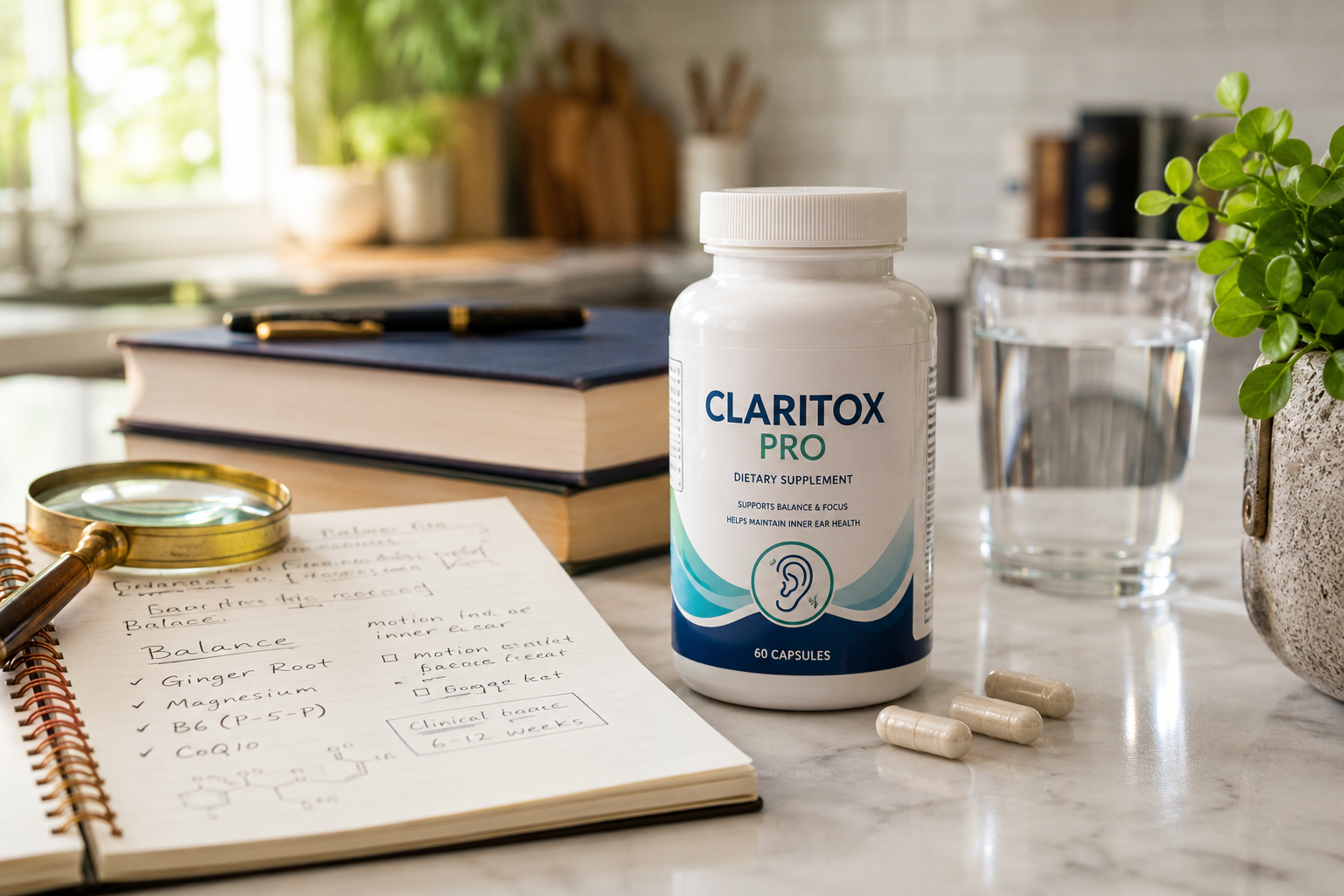
You get a white bottle with a blue label, 60 capsules, and a suggested dose of two capsules a day with a meal. The bottle lists a “Proprietary Blend” of 720 mg total, without breaking down individual ingredient amounts—so you don’t know how much zinc, berberine, or anything else you’re swallowing.
In addition to the bottle, the checkout page may throw in a digital bonus guide (a generic PDF on “wellness tips”), but that’s filler. There’s no community access, no coaching, no ongoing support. You’re buying a pill bottle and a promise.
The ingredient list vs. the evidence
The label shows: zinc, chromium, green tea extract, berberine HCl, resveratrol, milk thistle seed extract, cayenne fruit powder, Korean ginseng root, and banaba leaf extract. Let’s look at what the research actually says—and what it doesn’t.
- Zinc and chromium: Both are essential minerals. Deficiencies can cause neurological symptoms, including balance issues, but deficiency is rare in developed countries unless you’re malnourished or have absorption disorders. If you’re not deficient, supplementing won’t help, and the dose here (likely 7.5 mg zinc, 50 mcg chromium based on typical labels) is too low to correct a real deficiency anyway.
- Green tea extract: Contains EGCG and caffeine, which might improve alertness and blood flow. Some small studies hint at improved cognitive function, but none specifically on dizziness. The extract amount is probably 200 mg or less—far below the doses used in those studies.
- Berberine: Good evidence for blood sugar control, modest evidence for lipid lowering. No evidence for dizziness. The dose needed for metabolic effects is 900–1500 mg per day; a 100 mg sprinkle in a blend won’t do much.
- Resveratrol: Anti-inflammatory in petri dishes, but human trials are all over the map. Dizziness isn’t an endpoint in any resveratrol study I can find. The 20 mg or so in this blend is a cosmetic dose.
- Milk thistle: Liver health claims, weak evidence. No connection to balance.
- Cayenne: Capsaicin might boost circulation transiently. Could theoretically help if your dizziness is from poor blood flow, but that’s a stretch, and the dose here is tiny.
- Korean ginseng: Adaptogen claims, some evidence for fatigue and cognitive function. Dizziness? Not studied.
- Banaba leaf: Blood sugar claims. No dizziness research.
The bottom line: nothing in this bottle has been shown to treat dizziness in a controlled trial. The formula is a kitchen-sink approach—throw in things that sound plausible and hope the placebo effect and the refund window do the work.
How the marketing oversells
The VSL uses a common ClickBank structure: identify a “hidden root cause” (neuroinflammation), present a natural solution, show testimonials, and layer on scarcity. The problem is that the root cause it invents isn’t recognized by any major medical organization as the primary driver of chronic dizziness. Most dizziness cases are vestibular, cardiovascular, or medication-related. Neuroinflammation might play a role in some rare conditions, but it’s not the universal explanation the video implies.
The sales page also drops affiliate jargon like “unsaturated niche” and “$3–6 EPCs.” That language isn’t for you; it’s for affiliates. It tells you the funnel converts well. It doesn’t tell you the product works.
What it costs and how the refund actually works
The sticker price is $123 per bottle, but the order form typically offers discounts if you buy 3 or 6 bottles at once—bringing the per-bottle cost down to around $59 or $49. That’s still expensive for what’s inside.
The 60-day money-back guarantee is ClickBank’s standard policy, not the vendor’s. To get a refund, you contact ClickBank directly with your order ID. However, the vendor’s terms often require you to return the empty bottle(s) before a refund is processed. You pay return shipping. Some buyers report that the vendor deducts a “restocking fee” or only refunds the product cost, not the original shipping. It’s not the no-questions-asked safety net the video suggests.
The real risk nobody talks about
This one matters: if you’re dizzy, you need a diagnosis, not a supplement. Dizziness can be a symptom of stroke, heart arrhythmia, Meniere’s disease, BPPV, or medication side effects. Taking Claritox Pro might delay you from getting a proper workup. And if you’re on blood pressure meds, berberine and ginseng can amplify their effects, potentially causing dangerous hypotension. The label doesn’t warn you about that. The sales page certainly doesn’t.
Who should buy, who should skip
Buy this only if you’ve exhausted medical options, your doctor has given you a shrug, and you want to run a personal experiment with a 60-day safety net. Even then, I’d suggest buying a single bottle, trying it for two weeks, and requesting a refund the moment you realize it’s not doing anything. Don’t let the refund window close while you “give it more time.”
Skip this if you haven’t seen a doctor. Skip it if you’re on any chronic medication. Skip it if you think $123 is a fair price for a supplement with no evidence—because it’s not. Skip it if you want a product that’s been tested in humans for the thing it claims to treat.
The honest read
Claritox Pro is a well-marketed bottle of underdosed, unproven ingredients. The sales page is a masterclass in conversion, but that’s a skill set, not a clinical trial. The 60-day refund window is the only thing that makes this offer remotely defensible, and even that comes with friction.
If you’re dizzy, spend the $123 on a copay and a set of vestibular exercises from a physical therapist. You’ll get more relief than any capsule in this bottle can provide.
— Mara Vance
Here's what I'd actually do
If you have already read the label and you are willing to test it for six weeks against your own lab work, not against how you feel:
Claritox Pro sits in the middle band — defensible ingredient pool, unverifiable dosing, premium ClickBank-funnel pricing. The 60-day refund is your insurance. Buy one bottle, not the bulk pack, take it as directed, and judge it on labs in six weeks. Refund if it did nothing.
Don't buy this if: Do not buy this if you would not also pay for a basic metabolic panel to test whether it did anything. Without labs, you cannot tell the supplement from the placebo from the regression-to-the-mean.
— Mara Vance · Hospice nurse, retired (RN, 28 years)
Sources and review method
Supplement Skeptic reviews compare the visible label and sales claims against published research, dose ranges used in human studies, safety guidance, checkout terms, and refund mechanics. This page is not medical advice.
- Vendor sales page — ClickBank-listed sales page (active as of catalog import)
Frequently asked questions
- Does Claritox Pro really work for dizziness?
- There is no clinical proof. The individual ingredients have been studied for blood sugar, inflammation, and circulation, but none have been shown to treat chronic dizziness in a reliable, replicable way. The formula as a whole has never been tested.
- What's actually in Claritox Pro?
- The label lists zinc, chromium, green tea extract, berberine, resveratrol, milk thistle, cayenne, Korean ginseng, and banaba leaf. Exact amounts are not disclosed on the sales page, and typical doses in similar supplements are too low to match the studies that show any benefit.
- How does the refund work?
- ClickBank offers a 60-day money-back guarantee. You request a refund through ClickBank support with your order ID. However, the vendor may ask you to return the empty bottle(s) first. Shipping costs are usually not refunded. Some buyers report delays or partial refunds after 'restocking fees.' It's not as frictionless as the sales page implies.
- Is Claritox Pro a scam?
- Not in the sense that they take your money and run. You'll receive a bottle of capsules. But the marketing overpromises, the formula is unproven, and the price is inflated. It's a classic supplement hustle: a plausible-sounding blend sold on fear and a refund policy that's harder to use than it looks.
More in Dietary Supplements