
Ingredient pillar · Antioxidant / cardiovascular
Grape seed extract: what the evidence actually says
Grape seed extract is one of the supplement category's genuinely well-studied antioxidants. The evidence is real for a narrow set of conditions. The marketing usually attaches it to whatever vague claim is fashionable that quarter.
- OPC
- oligomeric proanthocyanidins
- grape seed proanthocyanidins
What it is
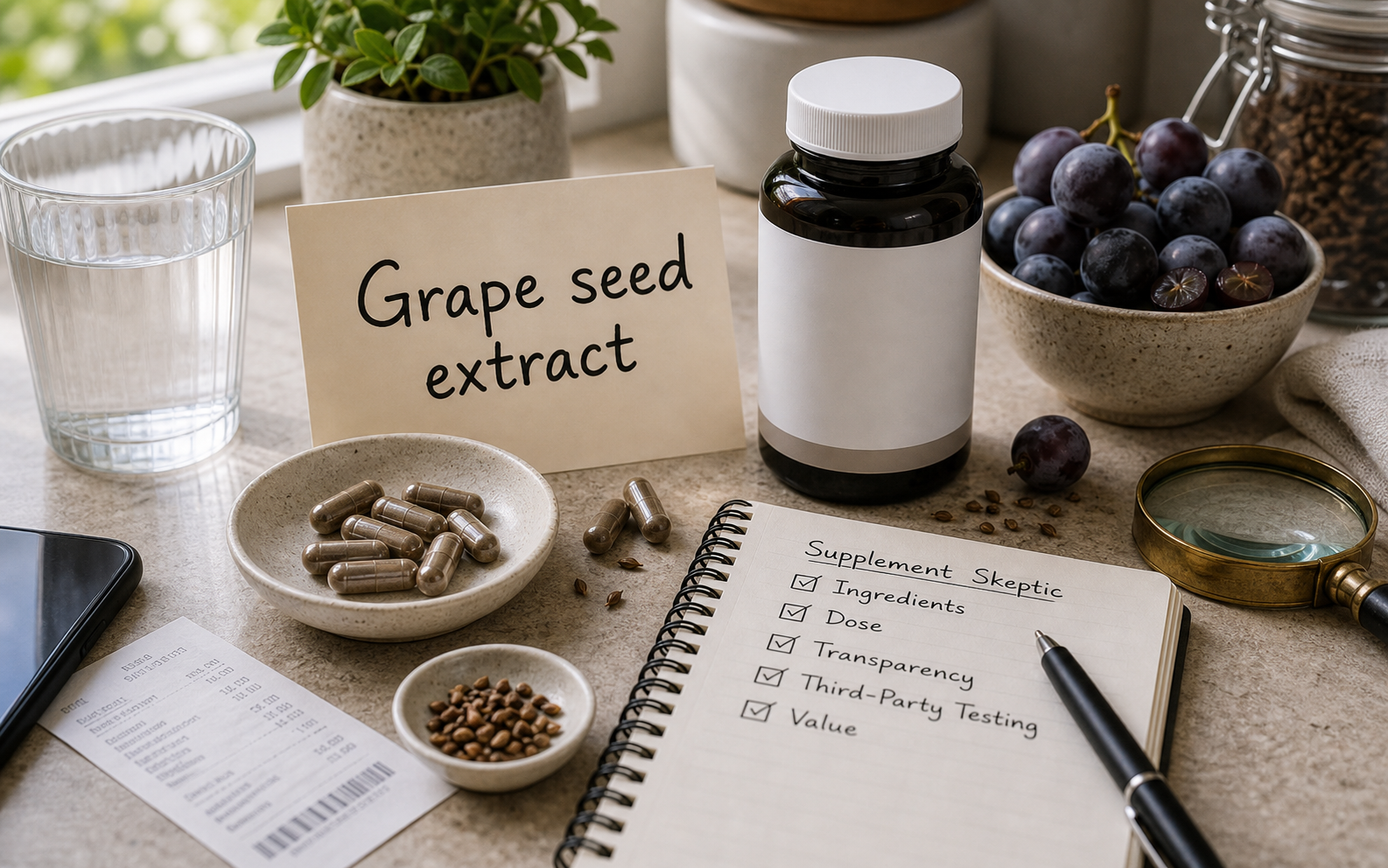
Grape seed extract is a concentrated preparation of polyphenols from the seeds of Vitis vinifera. The bioactives are oligomeric proanthocyanidins — OPCs — flavanol oligomers that are also found in pine bark and a few other sources.
On a label, look for the OPC percentage, typically 95%. A 200 mg capsule of "95% OPC standardised grape seed extract" delivers roughly 190 mg of OPCs.
A handful of branded extracts (Masquelier, Activin, MegaNatural-BP) have most of the human trial data. Generic grape seed extract is chemically similar but has not been independently trialed at the same level.
What the marketing claims
The phrasing on a supplement label or sales page tends to recycle a few patterns. Grape seed extract usually shows up wearing one of these:
- "Powerful antioxidant — more potent than vitamin C and E."
- "Supports healthy circulation."
- "Protects nerve and brain cells."
- "Promotes hearing health and reduces tinnitus."
What the published evidence actually says
Grape seed OPCs have human RCT evidence for chronic venous insufficiency — reductions in leg swelling, heaviness, and capillary fragility versus placebo over 4–12 weeks. The effect is modest and reproducible across multiple small trials.
Mild blood pressure reductions in adults with prehypertension or stage-1 hypertension have been reported in several small trials, on the order of 4–6 mmHg systolic.
Antioxidant biomarker effects (lipid peroxidation, plasma antioxidant capacity) are real and reproducible at studied doses.
Hearing and tinnitus claims are not supported by published human trials of grape seed extract. A small number of animal studies suggest pretreatment with OPCs may attenuate noise-induced cochlear damage in rodents. None of this has been demonstrated in human auditory outcomes.
Cognitive and "nerve protection" claims rest on cell-culture and rodent work. There is no convincing human cognitive-outcomes trial of grape seed extract at supplement doses.
Effective dose vs typical supplement dose
Trials reporting venous insufficiency or blood pressure effects used 150–300 mg of grape seed extract per day, standardised to ≥85% OPCs.
In a tincture or proprietary blend, the OPC dose is rarely disclosed and is almost certainly below the threshold trials used.
OPC absorption is fast (peak plasma at 1–2 hours) and clearance is fast. Splitting the daily dose helps maintain plasma exposure.
Safety profile
Generally well tolerated at studied doses. Most reported side effects are mild — headache, gastrointestinal upset, dry mouth.
Mild antiplatelet effect. Caution if you are on warfarin, a direct oral anticoagulant, or daily aspirin. Effect is small but additive.
May modestly lower blood pressure. Worth knowing if you are already on antihypertensives.
Pregnancy and breastfeeding: limited human safety data on concentrated extracts. Dietary grape consumption is fine; concentrated daily extract is not the same exposure.
This is general information, not medical advice. Anyone on prescription medication, pregnant or breastfeeding, or managing a chronic condition should bring an ingredient like Grape seed extract to their clinician before starting it.
Supplements on this site that contain grape seed extract
The following reviewed products list grape seed extract on the label, mention it in the ingredient discussion, or are built around the ingredient category. Verdicts are independent of whether the ingredient is present — a product can include grape seed extract and still be a "Skeptical" or "Avoid."
Dietary Supplements
Cardio Slim Tea
Cardio Slim Tea wraps a generic 15-herb tea blend (hibiscus, green tea, hawthorn, beetroot, ginger, chamomile, dandelion, lemongrass, monk fruit, etc.) in a 'normalize blood pressure to 120/80 and melt belly fat' VSL. Hibiscus and beetroot have published BP-lowering trials. The rest is wellness-store tea-aisle herbs at undisclosed doses. The medical claims (specifically about homocysteine and blood pressure 'normalization') exceed what the FTC tolerates for dietary supplements and what the formula could plausibly deliver.
Dietary Supplements
Neuro Serge
Neuro Serge claims '20+ clinically-proven ingredients' but its public ingredient panel names only six (olive leaf, cinnamon, deglycyrrhizinated licorice, green tea extract, grape seed extract, bilberry extract). The rest live inside an undisclosed proprietary blend. The bonus stack ('Balance Your Blood Sugar Blueprint', 'The Blood Sugar Solution') is the give-away: this is a glucose-management formula re-skinned as a brain product. The video preface labels itself 'Medical Breakthrough Gluco Repair' before the brain pitch begins.
General Health
ZenCortex
ZenCortex is Quietum Plus with a different solvent system and a slightly upgraded antioxidant story. Grape seed OPCs are genuinely well-studied — for cardiovascular oxidative stress and venous insufficiency, not auditory function. The hearing positioning is unsupported by any human trial in the formula or in the ingredient literature. The brain positioning is thinner still.
Brain / focus
Earth Ritual Brain & Focus Formula
Earth Ritual Brain & Focus Formula uses recognizable cognitive-support ingredients in a broad multinutrient formula. The conditional read is simple: it may fit buyers who want an all-in-one brain-support capsule, while buyers seeking clinical-dose nootropic targeting should compare the full Supplement Facts panel first.
The skeptic's checklist
Before paying for a supplement that lists grape seed extract on the label, the buyer should be able to answer yes to most of these:
- OPC percentage disclosed. A real label states the OPC standardisation. "Grape seed extract" with no percentage is a low-potency raw powder in many cases.
- Mg of extract ≥ 150. Below 150 mg per day is below the studied threshold for any of the documented effects.
- Capsule, not tincture. Liquid tinctures of grape seed extract are the least dose-auditable format and frequently the lowest delivered dose.
- No proprietary blend. OPCs in an "antioxidant blend" alongside ten other ingredients is a label-credibility ingredient, not a therapeutic dose.
- Anticoagulant warning on label. A grape seed product that does not warn about anticoagulant interaction is a product that has not read its own literature.