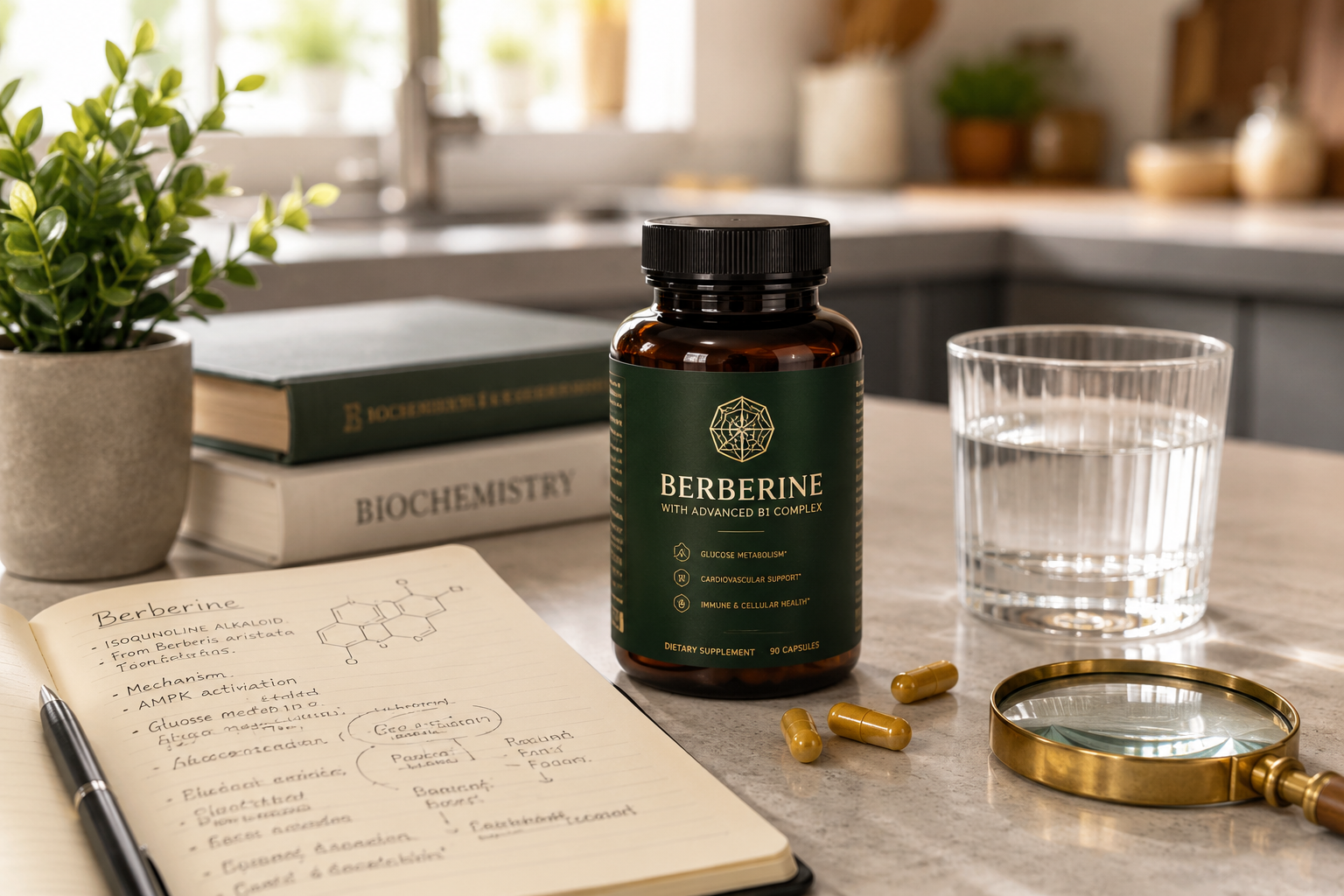
Berberine and Blood Sugar: What the Research Shows
A clinical, evidence-first look at berberine for blood-sugar support — what the trials found, the doses used, the absorption problem, and how to read a berberine label.
The short version
- Berberine has the most human data of any popular blood-sugar botanical, but the trials are mostly small and short.
- The doses used in studies cluster around 500 mg taken two to three times a day, with meals.
- Berberine is poorly absorbed, which is why dosing is split across the day rather than taken all at once.
- It can interact with prescription medication, so it is a talk-to-your-clinician ingredient, not a free-for-all.
- Many blood-sugar blends bury berberine in a proprietary mix, so you cannot confirm a study-level dose.
Berberine is the most studied botanical in the blood-sugar-support category, and the human data is genuinely interesting — but it is built on small, short trials, it has a real absorption problem, and it interacts with common medications. Read the dose and talk to your clinician before you start.
I prescribed against this market for most of my career before a prostate scare put me on the buying side of it. I read the ingredient panel out loud before I read the sales page. With berberine, the panel is where the whole story lives.
What is berberine, and what did the trials find?
Berberine is a compound extracted from several plants, including goldenseal and barberry. It has been used in traditional medicine for centuries, but the modern interest is metabolic. A frequently cited body of work, summarized at the NIH National Center for Complementary and Integrative Health, points to small human trials in which berberine supported healthier fasting glucose and HbA1c readings.
The honest caveat the same sources raise: most of those trials are small, run for only weeks to a few months, and vary widely in quality. A signal across several small studies is worth noting. It is not the same as the large, long-term evidence base behind a prescription. Treat berberine as a supporting ingredient with promising-but-preliminary data, not a settled answer.
What dose did the studies use?
This is where most shoppers go wrong. The trials that found an effect generally used about 500 mg, two to three times per day, taken with meals — a total daily intake around 1,000 to 1,500 mg. A capsule that delivers 100 mg once a day is not delivering a study-level dose, no matter what the label implies.
The absorption problem nobody mentions
Berberine has notoriously low oral bioavailability — your gut absorbs only a fraction of what you swallow. That is the actual reason the trials split the dose across the day with food, rather than taking it all at once. If a product brags about a single mega-dose capsule, that is a marketing flourish, not better science. Splitting the dose is the evidence-based approach.
The interaction you cannot ignore
Berberine is not a free-for-all ingredient. It can affect how the body handles certain prescription drugs, and it can stack with glucose-lowering medication. The Mayo Clinic general guidance on supplements is blunt about this: “natural” does not mean “no interactions.” If you take prescription medication — especially anything for glucose, blood pressure, or blood thinning — this is a conversation to have with your clinician before the first capsule, not after.
How to read a berberine label
Run the panel through three checks:
- Is the dose disclosed per serving? You want to see milligrams of berberine, not “proprietary blend.”
- Does it reach a study-level daily total? Aim to compare against the ~1,000–1,500 mg/day used in trials.
- Does it split the dose? A two- or three-capsule daily protocol respects the absorption data.
A blood-sugar blend that hides berberine inside a 15-ingredient proprietary mix fails the first check on its own, and you can stop there.
The bottom line
Berberine earns its spot as the most evidence-backed botanical in this category, with the understanding that the evidence is early and the dosing and interactions are real. If you want a transparent product, a standalone, clearly dosed berberine is easier to evaluate than a blend. Among the blends, we read Sugar Defender, Gluco6, and CelluCare against exactly these questions, and the full field is ranked in our blood-sugar support roundup.