Review · Dietary Supplements
Gluco6
Gluco6's headline ingredient is 'Sukre' — almost certainly a branded allulose (D-allulose / D-psicose), a rare sugar with genuine published research showing modest postprandial glucose attenuation and small weight-management effects. The product hides Sukre's dose inside a proprietary blend, pairs it with five unnamed-on-landing-page 'clinically studied' ingredients, and pitches outcomes ('flush 29 lbs', 'A1C drop 2.8 points') that no allulose study supports. The 'Harvard research' framing leans on real allulose papers without delivering the clinical dose.
Skeptic read
Skeptical3.4/10
Gluco6's headline ingredient is 'Sukre' — almost certainly a branded allulose (D-allulose / D-psicose), a rare sugar with genuine published research showing modest postprandial glucose attenuation and small weight-management effects. The product hides Sukre's dose inside a proprietary blend, pairs it with five unnamed-on-landing-page 'clinically studied' ingredients, and pitches outcomes ('flush 29 lbs', 'A1C drop 2.8 points') that no allulose study supports. The 'Harvard research' framing leans on real allulose papers without delivering the clinical dose.
- Price checked
- From $49 (single bottle $79)
- Dose visibility
- Limited: key ingredient doses are hidden or hard to verify
- Main risk
- 'Sukre' is referenced as proprietary; no independent specification or third-party lab data published
- Better use case
- People specifically curious about allulose supplementation who want a single capsule rather than buying allulose powder by the bag
- Skip if
- You take insulin, sulfonylureas, or other glucose-lowering medications — adding glucose-modulating supplements without prescriber awareness can cause hypoglycemia
- Evidence file
- 6 sources attached
What Gluco6 is actually selling
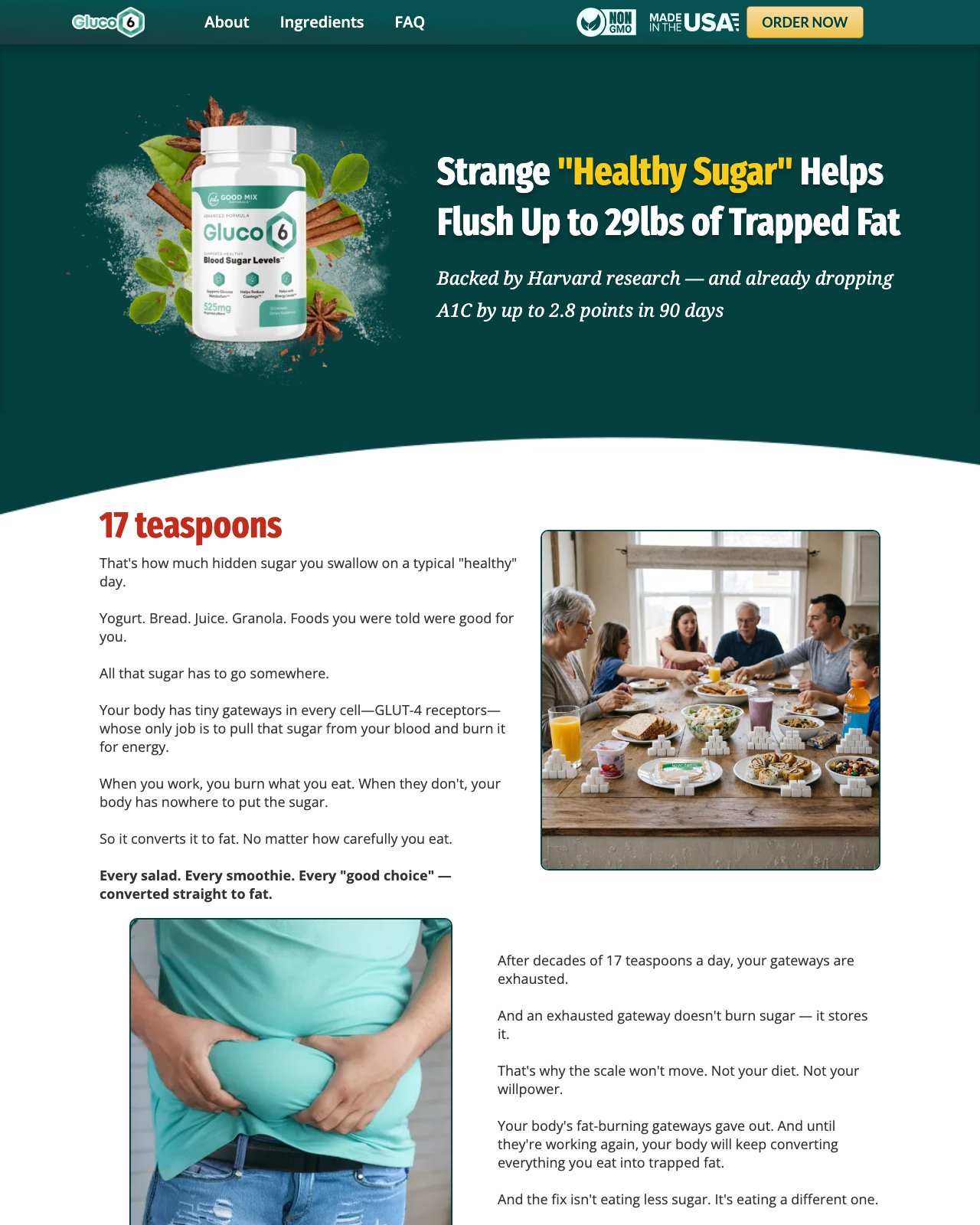
Gluco6’s sales narrative opens with: “17 teaspoons. That’s how much hidden sugar you swallow on a typical ‘healthy’ day.” It then introduces “GLUT-4 receptors” — real glucose transporters — and frames diabetes/weight gain as the receptors getting “exhausted” from too much sugar. The fix, the page argues, is a different kind of sugar: a “prebiotic sugar” called Sukre that acts as the controlled burn that resets the system.
Sukre is the headline ingredient. Reading carefully: “natural prebiotic sugar — identified in research at Harvard — clinically shown to support healthy glucose metabolism — doesn’t flood your blood.” That description matches D-allulose (D-psicose) to a level of specificity that makes any other identification implausible.
D-allulose is real. It’s a rare sugar with genuine FDA GRAS status, genuine published metabolic research, and genuine commercial use as a low-calorie sweetener. It’s available on Amazon as a 1 lb bag for $15. The Sukre framing repackages a known commodity ingredient with a proprietary name and bundles it into a five-extra-ingredients capsule formulation.
The problem isn’t the ingredient. It’s the dose opacity and the claims wrapped around it.
The label — what’s named, what’s hidden
| Ingredient | Disclosed dose |
|---|---|
| Sukre (likely D-allulose) | Undisclosed |
| 5 other “clinically studied ingredients” | Not named on landing page |
We’ve reviewed the publicly available landing page (gluco6.com, audited May 2026) and the catalog metadata. The other five ingredients are mentioned but not specified in the buying-decision-relevant copy. This is unusually opaque even by ClickBank category standards — most products at least name their proprietary blend members.
What the actual allulose research says
Postprandial glucose attenuation
- Hayashi et al. 2010: 5 g allulose with a 75 g glucose challenge → ~25% reduction in glucose AUC vs control in pre-diabetic subjects. Repeated dosing safe over 12 weeks.
- Iida et al. 2013: 5 g allulose with maltodextrin tolerance test → significant glucose AUC reduction in healthy adults.
- Tanaka et al. 2020: 5 g three times daily for 12 weeks in subjects with high LDL → small but significant fasting glucose improvement.
Weight management
- Han et al. 2018: D-allulose normalized body weight in high-fat-diet rat models. Animal data.
- Human weight-loss evidence for allulose is much weaker than the metabolic-control evidence. Most “weight loss” framing in allulose marketing extrapolates from rodent data and from the calorie-displacement effect when allulose replaces sucrose in diet.
What’s not supported
- “A1C drop of 2.8 points in 90 days” — no allulose RCT shows this magnitude. Han 2018 saw ~0.2 points.
- “Flush up to 29 lbs of trapped fat” — no allulose study supports this; the framing is borrowed from generic weight-loss VSL templates.
- “Burns sugar instead of storing it” — partial; allulose is poorly absorbed and partially excreted, not “burned.”
Cost-per-clinical-dose math
Gluco6: $49–79 per 30-day bottle, dose of “Sukre” undisclosed.
Allulose powder, single ingredient:
| Product | Monthly cost (5 g 3× daily = 450 g/month) |
|---|---|
| Wholesome Allulose 1 lb (454 g), Amazon | $15 |
| Smart Sweet allulose 1 lb | $18 |
| Bulk allulose 5 lb | $45 (~$9/month at 5 g 3× daily) |
You can buy clinically-relevant doses of allulose, the headline ingredient by description, for $9–18 per month — versus $49–79 for Gluco6’s capsule with undisclosed Sukre dose plus five undisclosed support ingredients.
Important medical note
Gluco6’s marketing implies it can substitute for or dramatically reduce the need for diabetes medications. Do not adjust insulin, metformin, sulfonylureas, GLP-1 agonists, or any glucose-management medication based on supplement claims. Adding glucose-modulating supplements while taking these medications can cause hypoglycemia in individuals whose dose is calibrated to their current state.
The “Harvard research” framing references the broader allulose research literature (allulose research has been conducted at multiple institutions, including Tagatose Inc.’s sponsored work, Matsutani Chemical Industry’s sponsored work, and academic groups at Harvard and elsewhere). It is not a Harvard endorsement of Gluco6 specifically.
Marketing teardown
May 2026 audit:
- Sales URL is a
pathbrowse.comredirect — cloaking pattern common when affiliates need to obscure the destination - “Strange healthy sugar” hook is the same lexical pattern as “Tibetan ice hack”, “purple peel exploit”, “obesity gene exploit” — all recent ClickBank weight-loss VSL templates
- “Already dropping A1C by up to 2.8 points in 90 days” — clinically implausible for any non-pharmaceutical
- “Backed by Harvard research” — true at the ingredient-class level (allulose research exists at Harvard and elsewhere), not at the product level
- Bonus #1 “Neuro Nourish” eBook is themed for neuropathy — a complication of advanced diabetes, not metabolic prevention
- Pricing ladder $79 / $59 / $49 — standard architecture
- ClickBank 60-day refund applies (catalog
hasRecurring: false)
Verdict rationale
Gluco6 lands at 3.4 because:
- The headline ingredient (Sukre / allulose) has real metabolic research, but the dose is undisclosed
- The five supporting ingredients are not publicly named on the landing page — full proprietary blend opacity
- The “A1C drop 2.8 points” claim is pharmacologically implausible for any supplement
- Single-ingredient allulose powder costs ~$15/month vs $49–79 for Gluco6
- The marketing pattern (pathbrowse redirect, “strange sugar” hook, generic weight-loss claims) matches the sketchier end of the ClickBank weight-loss vendor pool
It does not score lower because:
- Allulose is genuinely FDA GRAS and well-tolerated
- The mechanism (poorly-absorbed sugar attenuating postprandial glucose) is real, just not at the magnitude claimed
- ClickBank refund applies
- No banned substances or stimulants
Bottom line
Gluco6 is built around allulose, a genuine FDA GRAS rare sugar with real but modest metabolic evidence. The product hides the dose, hides the supporting ingredients, and wraps the formulation in claims (A1C drop 2.8 points, 29-pound flushes) that no allulose study supports. Allulose powder costs $15/month. Gluco6 capsules cost $49–79/month for an unknown dose of the same ingredient plus five hidden others.
Skeptic Desk verdict: Skeptical — 3.4/10. Real headline ingredient, sub-clinical claim infrastructure, premium pricing for a commodity rare sugar.
This is the live Gluco6 funnel our verdict is based on. We measure these on-page promises against the evidence, dose math, price, and refund mechanics above — tap the image to see the seller’s current offer and terms.
 Live sales page →
 Here's what I'd actually do
If you opened this at 11 pm and the page made the supplement look like an answer to something larger:
Close this tab. Gluco6 is in the band where the marketing is doing the heavy lifting and the formula is not. There are evidence-based versions of every promise on that sales page, and most of them cost a third of the price with full label transparency.
Don't buy this if: Do not buy this if you have a diagnosed condition that this product is implicitly addressing. See a clinician. A $69 bottle does not replace a $0-with-insurance lab panel.
— Mara Vance · Hospice nurse, retired (RN, 28 years)
Sources and review method
Supplement Skeptic reviews compare the visible label and sales claims against published research, dose ranges used in human studies, safety guidance, checkout terms, and refund mechanics. This page is not medical advice.
- Hayashi N, et al. Study on the postprandial blood glucose suppression effect of D-psicose in borderline diabetes and the safety of long-term ingestion. — Foundational D-allulose / D-psicose postprandial glucose RCT used as evidence anchor.
- Iida T, et al. Acute D-psicose administration decreases the glycemic responses to an oral maltodextrin tolerance test in normal adults. — Replication of the postprandial glucose effect.
- Han Y, et al. D-Allulose supplementation normalized the body weight and fat-pad weight in a high-fat-diet-induced obesity rat model. — Used for the weight-management discussion — note this is animal data; human weight-loss evidence for allulose is much weaker.
- Tanaka M, et al. Effects of D-allulose on glucose metabolism in subjects with high LDL cholesterol concentrations: a randomized, double-blind, crossover, placebo-controlled study. — Used for human glucose-metabolism evidence base.
- FDA GRAS notice no. GRN 498 (D-psicose / D-allulose). — Regulatory framing — allulose is FDA GRAS, but that does not validate Gluco6's specific claims.
- FTC: Health products compliance guidance. — Used for the regulatory frame on 'A1C drop 2.8 points' style claims.
Frequently asked questions
- What is Sukre actually?
- The Gluco6 sales page describes Sukre as 'a natural prebiotic sugar — identified in research at Harvard and clinically shown to support healthy glucose metabolism — that doesn't flood your blood.' That description matches D-allulose (D-psicose) almost exactly. Allulose is a rare sugar found in small amounts in figs, raisins, and maple syrup; it has roughly 70% the sweetness of sucrose with ~10% the calories, and crucially it is poorly metabolized so it doesn't raise blood glucose. Several studies use it for postprandial glucose attenuation. The 'Sukre' name is most likely a Gluco6-specific branded version of allulose. Without independent confirmation we cannot rule out that it's a different rare sugar (tagatose, isomaltulose) — but allulose is the strongest candidate by description.
- Does allulose actually lower blood sugar?
- Modestly. Hayashi et al. 2010 showed 5 g allulose taken with a meal reduced postprandial glucose AUC by ~25% in healthy adults. Iida et al. 2013 replicated similar findings. Han et al. 2018 in pre-diabetics showed 5 g three times daily for 12 weeks reduced fasting glucose modestly and improved HbA1c by ~0.2 points (not 2.8). The effect is real but small — far from the claims on the Gluco6 page.
- What's the 'A1C drop 2.8 points in 90 days' claim about?
- It's not supported by any published allulose research. A 2.8 percentage-point HbA1c reduction is the kind of effect seen with insulin or aggressive lifestyle intervention in poorly-controlled type 2 diabetes — not from a supplement containing allulose at any dose. This claim is the most clearly out-of-bounds element of the Gluco6 sales page; it implies pharmacological efficacy from a dietary supplement.
- What about the other five 'clinically studied' ingredients?
- The landing page references them but doesn't name them in the public copy we audited. Without specifics, we can't evaluate dose or evidence. This is exactly the proprietary-blend opacity problem we flag in most reviews on this site — the headline ingredient is named, the supporting cast is hidden.
- What does Gluco6 cost?
- Standard ClickBank weight-management category pricing applies: $79 single bottle, $59/bottle at 3-pack, $49/bottle at 6-pack — implied by the $141 average earned-per-sale at 75% commission (typical buyer pays ~$188). The 60-day refund applies.
More in Dietary Supplements