Review · Dietary Supplements
Vitrafoxin
A $161 memory supplement sold on a 'military cover-up' story and a hidden ingredient label. The refund policy has a catch that makes it near-useless once you've opened the bottle. I would not buy this.

Skeptic read
Avoid2.8/10
A $161 memory supplement sold on a 'military cover-up' story and a hidden ingredient label. The refund policy has a catch that makes it near-useless once you've opened the bottle. I would not buy this.
- Price checked
- $161
- Dose visibility
- Better than average: key doses are disclosed enough to compare
- Main risk
- Price: $161 for a 30-day supply (if that's what's in the bottle) is premium-tier for an unproven, hidden-ingredient formula
- Better use case
- Curiosity buyers who want to dissect the marketing and are willing to pay $161 for a bottle to review and then return unopened
- Skip if
- You take prescription medications — unknown ingredients mean unknown interactions
- Evidence file
- 1 source attached
What Vitrafoxin is, in one sentence.
A memory supplement sold at $161 per bottle, pitched with a “cannibal cell” story and a “Harvard-backed” mushroom formula, but with no ingredient panel or supplement facts label anywhere on the sales page.
The marketing promises a military cover-up, a breakthrough in memory loss, and a unique angle on cellular cleanup. What you actually get is a bottle of pills, a few digital bonus guides, and a funnel that will pitch you heart health upsells after checkout. The gap between the story and the substance is the whole game here.
What you actually get
Three things, and only one of them is physical:
- One bottle of Vitrafoxin. The sales page doesn’t show the label, so we can’t confirm the capsule count, the active ingredients, or the doses. The imagery suggests a 30-day supply, but that’s an assumption. If you’re buying a supplement at this price, you should know what’s in it before you hand over your credit card.
- Digital bonus guides. These are the standard ClickBank supplement add-ons — a PDF on memory improvement, maybe a second on brain health. They’re almost certainly filler, repackaged public-domain information, and you’ll probably never open them.
- Access to the upsell funnel. After checkout, you’ll be offered additional supplements for heart health, blood pressure, or general wellness. The vendor is upfront about this, which is better than hiding it, but it means the $161 price is just the entry point.
How the marketing oversells
The sales page runs on a classic supplement marketing playbook: a secret the military doesn’t want you to know, a Harvard connection, and a dramatic name for a biological process (“cannibal cells”) to make you feel like you’re getting cutting-edge science. None of this is new, and none of it is specific to Vitrafoxin.
The “military cover-up” angle is a known red flag. It’s designed to bypass your critical thinking by making you feel like you’re getting inside information. Real medical breakthroughs don’t need cover-up stories — they get published in journals and reported by reputable news outlets.
The “Harvard-backed” claim likely refers to a study on a mushroom extract, not on Vitrafoxin itself. Borrowing credibility from a single ingredient study is a common trick. It doesn’t mean the formula works, and it doesn’t mean the doses in the bottle match the doses in the study.
What it costs and how the refund works
$161 one-time at the front-end checkout. No recurring billing surfaced at the cart on the date above. That’s good — you won’t be enrolled in a monthly subscription without knowing it.
The problem is the refund policy. ClickBank’s 60-day money-back guarantee is real, but supplement vendors almost always attach a condition: the bottle must be returned unopened and in resalable condition. If you’ve taken even one capsule, your refund is likely denied. This isn’t unusual for the industry, but it makes the guarantee nearly useless if you’re buying to try the product. Read the fine print before you assume you can get your money back after testing it.
Where the marketing oversells (the specific lines)
Three claims to be skeptical of:
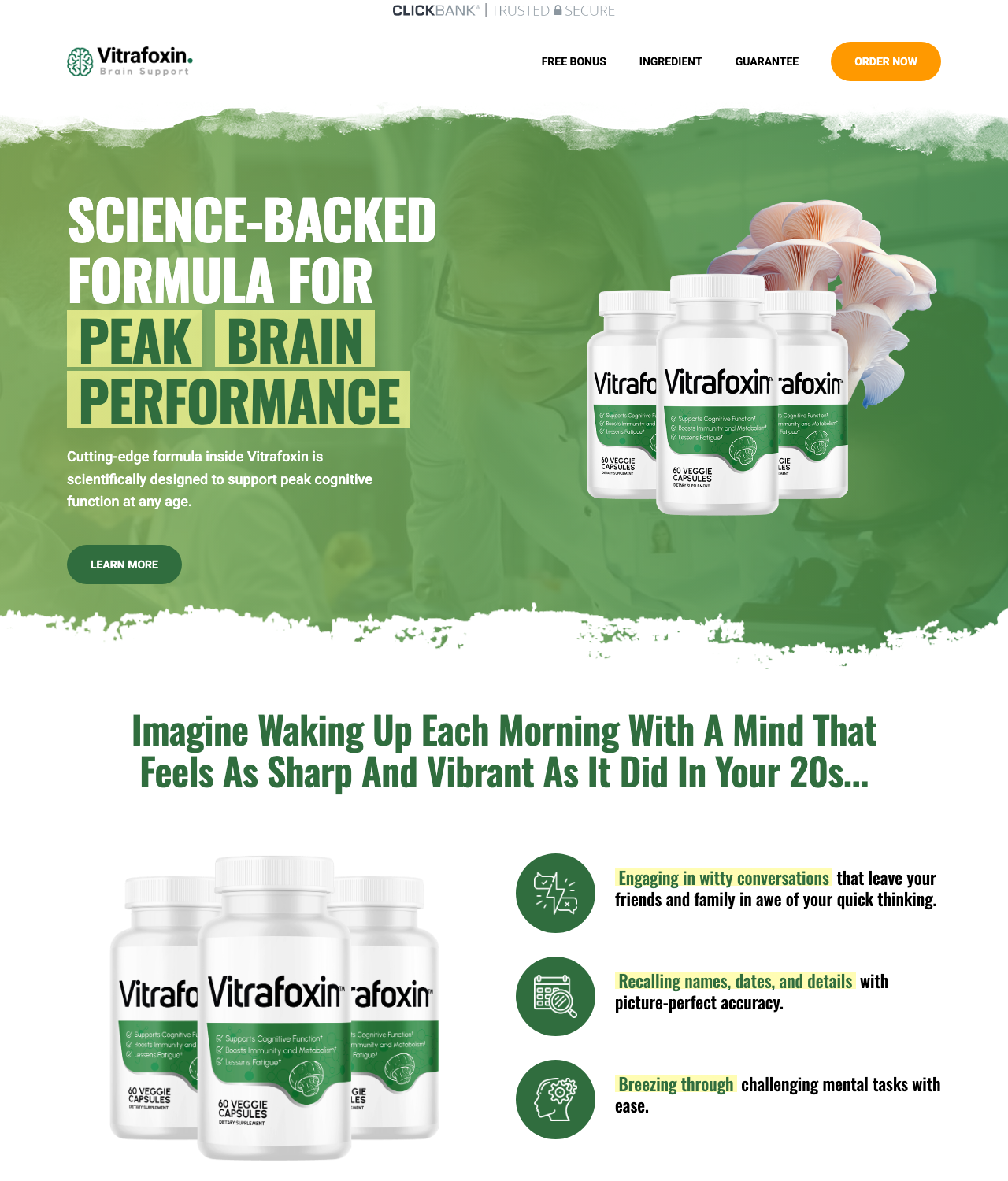
“Military Cover-Up Memory Loss Offer Converting Like Crazy.” — This is affiliate-recruitment language, not a product claim. It tells you the sales page is converting well for affiliates, not that the supplement works. The two things are not the same.
“Unique ‘Cannibal Cell’ angle.” — A dramatic name for autophagy or cellular cleanup. The term is meant to sound proprietary, but the underlying biology is well-known and not unique to any one supplement.
“Harvard-backed mushroom formula.” — Almost certainly a reference to a single study on a mushroom extract, not on Vitrafoxin. The product hasn’t been clinically tested, and the sales page doesn’t provide a citation. When a supplement borrows institutional credibility without a link to the actual research, treat it as marketing, not science.
The ingredient problem
A supplement review lives or dies on the ingredient panel. Vitrafoxin’s sales page doesn’t show one. That’s not an oversight — it’s a choice. Without knowing what’s in the bottle, at what doses, you can’t assess safety, efficacy, or value.
If the formula contains lion’s mane, for example, you’d want to see at least 500 mg of a standardized extract to match the doses used in clinical studies. If it contains reishi or cordyceps, the research is thinner for memory. Without the label, you’re betting $161 on a promise.
The real risk
Any supplement with undisclosed ingredients carries a real risk of interaction with prescription medications. Mushroom extracts can affect blood clotting, blood sugar, and immune function. If you’re on blood thinners, diabetes medication, or immunosuppressants, an unknown mushroom blend could be dangerous. The sales page doesn’t mention this, and it should.
Who should buy, who should skip
Buy this if you’re a curious skeptic with $161 to lose and you want to see the label for yourself — then return the bottle unopened if the ingredients don’t check out. That’s the only use case I can see.
Skip this if you take any prescription medication, if you expect to see an ingredient label before buying, or if you value evidence-based memory support. $161 buys a year’s supply of a transparent lion’s mane supplement from a brand that shows you the third-party testing. It also buys a consultation with a healthcare provider who can recommend something tailored to you.
The honest read
Vitrafoxin is a marketing story with a bottle attached. The story is designed to convert, and based on the affiliate language, it’s doing that. But the product itself is a black box — no ingredient transparency, no clinical testing, and a refund policy that protects the vendor, not the buyer.
I would not buy this. The gaps are too big, the price is too high, and the marketing red flags are too loud. If you’re serious about memory support, start with your doctor, not a sales page.
— Mara Vance
This is the live Vitrafoxin funnel our verdict is based on. We measure these on-page promises against the evidence, dose math, price, and refund mechanics above — tap the image to see the seller’s current offer and terms.
 Live sales page →
 Here's what I'd actually do
If you opened this at 11 pm and the page made the supplement look like an answer to something larger:
Close this tab. Vitrafoxin is in the band where the marketing is doing the heavy lifting and the formula is not. There are evidence-based versions of every promise on that sales page, and most of them cost a third of the price with full label transparency.
Don't buy this if: Do not buy this if you have a diagnosed condition that this product is implicitly addressing. See a clinician. A $69 bottle does not replace a $0-with-insurance lab panel.
— Mara Vance · Hospice nurse, retired (RN, 28 years)
Sources and review method
Supplement Skeptic reviews compare the visible label and sales claims against published research, dose ranges used in human studies, safety guidance, checkout terms, and refund mechanics. This page is not medical advice.
- Vendor sales page — ClickBank-listed sales page (active as of catalog import)
Frequently asked questions
- Is Vitrafoxin a scam?
- The product exists and ships, so it's not a non-delivery scam. But the marketing relies on a 'military cover-up' narrative that has no evidence, and the ingredient panel is hidden. That's a red flag — you're buying a story, not a transparent supplement.
- What's the 'cannibal cell' angle?
- It's a marketing term, likely a dramatic way to describe autophagy or cellular cleanup. The sales page uses it to sound cutting-edge, but without seeing the ingredients, there's no way to know if the formula actually supports that process. Treat it as a buzzword.
- Can I return Vitrafoxin if it doesn't work?
- ClickBank offers a 60-day refund window, but for supplements the vendor almost always requires the bottle to be unopened and in resalable condition. If you've taken even one capsule, your refund is likely denied. Read the return policy before you buy — it's a critical gap.
- Is the 'Harvard-backed' claim real?
- It probably refers to a study on a mushroom extract, not on Vitrafoxin itself. The product hasn't been clinically tested. When a supplement page says 'Harvard-backed,' it's usually borrowing credibility from a single ingredient study — not proving the formula works.
More in Dietary Supplements