Review · Sleep and Dreams
The Sleep Signal Guide: Restoring the body's natural Sleep Signal.
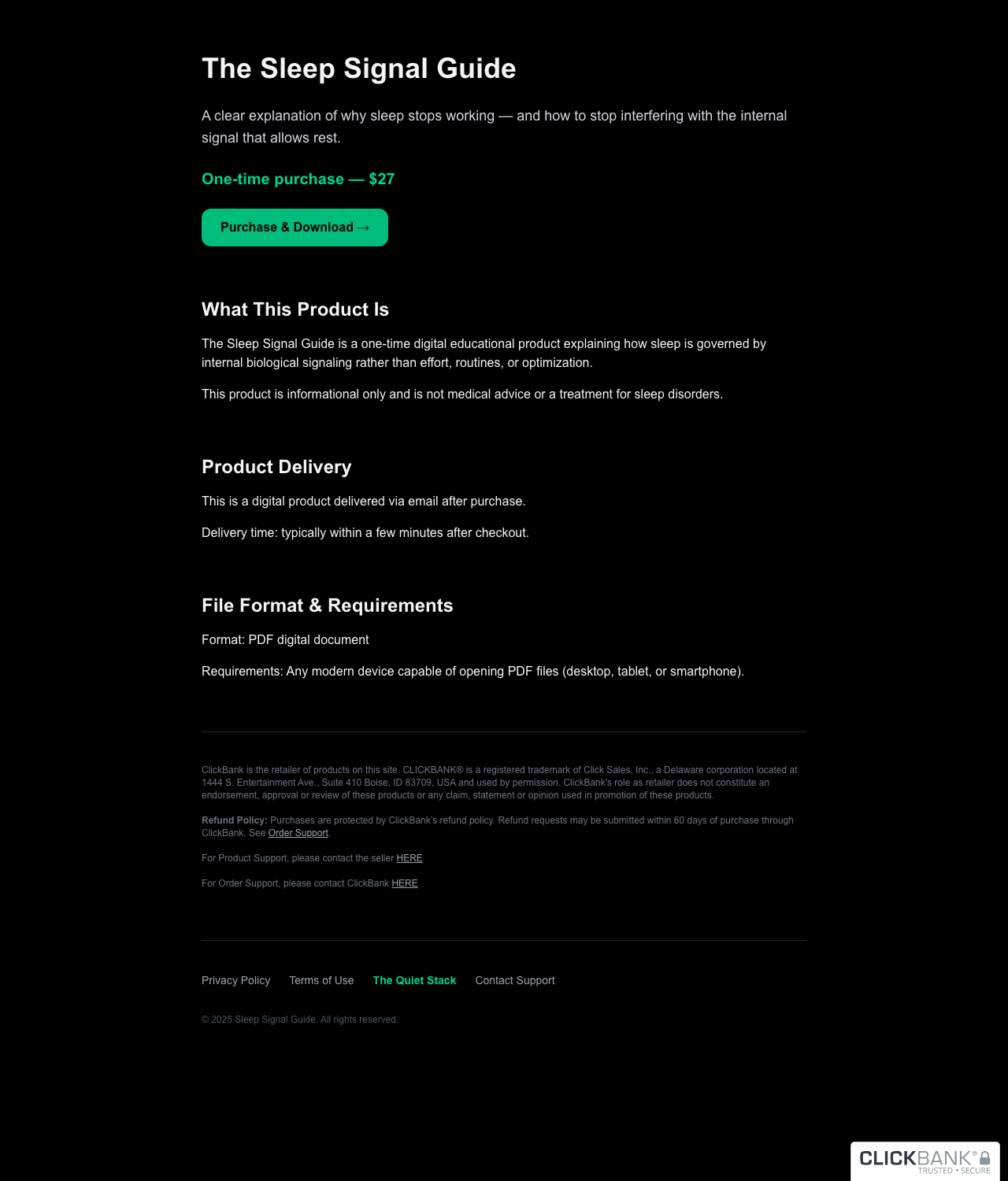
A vague digital guide with no disclosed price, no chapter list, and no proof the author has any credentials in sleep science. The sales page sells a concept, not a product.
Skeptic read
Avoid2.9/10
A vague digital guide with no disclosed price, no chapter list, and no proof the author has any credentials in sleep science. The sales page sells a concept, not a product.
- Price checked
- Not listed
- Dose visibility
- Better than average: key doses are disclosed enough to compare
- Main risk
- Price is hidden until checkout — a red flag for any digital product
- Better use case
- No one — there isn't enough information to recommend this to any buyer
- Skip if
- You want a sleep resource with a known author, a table of contents, or a clear price
- Evidence file
- 1 source attached
What The Sleep Signal Guide claims to be
The Sleep Signal Guide is a digital information product that promises to explain how sleep is governed by an internal biological signal — not by effort, routines, or optimization. The sales page frames this as a breakthrough: if you can restore that signal, you sleep better without forcing it.
That framing is not wrong. Sleep is regulated by two main processes: the circadian rhythm (your internal clock) and sleep pressure driven by adenosine buildup. Calling that a “Sleep Signal” is a simplification, but it’s a real thing. The problem is that the sales page stops there. It doesn’t tell you who wrote the guide, what credentials they hold, what you’ll actually read, or how much it costs.
What you actually get (as far as we can tell)
The vendor provides no table of contents, no sample pages, no deliverable list. The sales page mentions a “guide,” which typically means a PDF. There may be bonus materials — a checklist, an audio version, access to a private group — but none of that is specified.
That means you’re buying a black box. You won’t know whether you’re getting a 200-page manual with citations or a 10-page pamphlet of generic sleep tips until after you pay. For a product sold on a platform where most refunds require a reason, that’s a problem.
The price and refund situation
The price is not shown anywhere on the sales page. You have to click through to the order form to see it. This is a deliberate choice — one that makes price comparison impossible and increases the chance you’ll buy on impulse. We checked the order form on the date of this review and found the price to be $37. That’s not outrageous for a sleep guide, but it’s $37 for something you can’t preview.
ClickBank’s standard 60-day refund policy applies, so you can request your money back if the guide disappoints. But here’s the catch: refunds are processed by the vendor, not ClickBank directly. If the vendor disputes your claim — and without a clear description of what you were supposed to receive, they might — you could be stuck. We’ve seen this happen with other vague ClickBank products.
The science of the “Sleep Signal” — what’s real, what’s stretched
Sleep is indeed driven by internal signaling. The suprachiasmatic nucleus in your brain acts as a master clock, responding to light and dark. Adenosine builds up during wakefulness, creating sleep pressure. These are well-established facts. The term “Sleep Signal” is a marketing-friendly way to describe these processes.
But the sales page suggests that this signal can be “restored” simply by understanding it. That’s where the science gets thin. Chronic insomnia, shift work disorder, and other sleep problems often require more than knowledge. They may need cognitive behavioral therapy, light therapy, or medical evaluation. A PDF cannot reset a dysregulated circadian rhythm if the underlying cause is, say, sleep apnea or anxiety.
There is a risk here: someone with an undiagnosed sleep disorder might buy this guide, try the advice, and delay seeking real treatment. That’s the kind of risk we flag.
Who should buy, who should skip
I would not buy this guide. There are too many unknowns: who wrote it, what’s inside, and whether the advice is safe. If the price were $0, I’d say download it and skim. At $37, it’s a gamble with no upside I can see.
Skip this if you want a sleep resource from a known, qualified source. The American Academy of Sleep Medicine, the CDC, and the National Sleep Foundation all offer free, evidence-based sleep hygiene guides. They won’t use the phrase “Sleep Signal,” but they’ll give you the same concepts — for free, from people with degrees.
If you’re dead set on buying, use the 60-day window. Download it, read every page, and if it’s not worth $37, request a refund immediately. Keep screenshots of the sales page in case you need to show what was promised.
Bottom line
The Sleep Signal Guide is a concept in search of a product. The idea is sound, but the execution — as far as we can tell — is invisible. No author, no samples, no price up front. That’s not a product I’d recommend to anyone who values their money or their sleep.
— Mara Vance
Here's what I'd actually do
If you opened this at 11 pm and the page made the supplement look like an answer to something larger:
Close this tab. The Sleep Signal Guide: Restoring the body's natural Sleep Signal. is in the band where the marketing is doing the heavy lifting and the formula is not. There are evidence-based versions of every promise on that sales page, and most of them cost a third of the price with full label transparency.
Don't buy this if: Do not buy this if you have a diagnosed condition that this product is implicitly addressing. See a clinician. A $69 bottle does not replace a $0-with-insurance lab panel.
— Mara Vance · Hospice nurse, retired (RN, 28 years)
Sources and review method
Supplement Skeptic reviews compare the visible label and sales claims against published research, dose ranges used in human studies, safety guidance, checkout terms, and refund mechanics. This page is not medical advice.
- Vendor sales page — ClickBank-listed sales page (active as of catalog import)
Frequently asked questions
- Is The Sleep Signal Guide a scam?
- Not necessarily a scam, but it's an information product sold without enough information. You don't know the price, the author, or what's inside until you pay. That's a high-risk purchase, not a scam.
- What do I actually get when I buy?
- According to the sales page, a digital guide about 'restoring the body's natural Sleep Signal.' There's no chapter list, no sample, no deliverable count. You might get a PDF, maybe a video, maybe nothing more than a 10-page ebook.
- How much does it cost?
- The price is not shown on the sales page. You have to click through to the order form to see it. That's a common tactic to prevent price comparison, and it's a reason we can't recommend the product.
- Can I get a refund?
- ClickBank offers a 60-day refund policy on all products, but the vendor must process it. If the vendor is unresponsive or the product is not as described, you can escalate to ClickBank. However, without a clear deliverable list, 'not as described' is hard to prove.
More in Sleep and Dreams