Review · Men's Health
The Rewire Protocol - Small Penis Anxiety Guide
A self-help booklet for a real anxiety, but priced like a clinical program. Worth a weekend read inside the 60-day window, but the claims outpace the likely content.

Skeptic read
Conditional5.2/10
A self-help booklet for a real anxiety, but priced like a clinical program. Worth a weekend read inside the 60-day window, but the claims outpace the likely content.
- Price checked
- Not listed
- Dose visibility
- Better than average: key doses are disclosed enough to compare
- Main risk
- The sales page claims to 'eliminate the belief mechanism itself' — that's a clinical-grade promise a 40-page PDF cannot keep
- Better use case
- Men who've tried reassurance and 'just accept yourself' advice and want a structured psychological approach to try
- Skip if
- You're looking for physical enlargement — this guide explicitly says it's not about that, and buying it hoping otherwise is a waste of $47
- Evidence file
- 1 source attached
What The Rewire Protocol is, in one sentence.
A digital guide — likely a 40-page PDF with an audio version — that claims to address the psychological loop of small penis anxiety through cognitive reframing, sold for $47 through ClickBank with a 60-day refund window.
The pitch is unique: it doesn’t try to reassure you that size doesn’t matter, and it doesn’t sell enlargement. It promises to dismantle the belief that your size is a problem in the first place. That’s a genuinely interesting angle. The question is whether a $47 PDF can deliver on that promise, and the answer depends on how much you value a curated set of exercises versus what you could piece together from free CBT resources.
What you actually get
Based on the sales page and standard ClickBank digital product patterns, here’s what’s likely in the download:
- Main guide PDF. Probably around 40 pages, structured as a self-paced workbook. Expect sections on identifying automatic thoughts, challenging cognitive distortions, and behavioral experiments. If it’s well-written, it’ll borrow from CBT and ACT frameworks — both are evidence-backed for anxiety.
- Audio version. A narrated version of the same content. Useful if you want to work through the exercises without staring at a screen, but it’s not a hypnosis track or a guided meditation — just someone reading the PDF.
- Three bonus PDFs. These are almost certainly filler. One might be a confidence-building worksheet, one a partner communication script, and one a generic overview of CBT that you could find on any mental health website. Don’t expect them to add value beyond the main guide.
How the marketing oversells
The sales page makes one claim that should stop you cold: “eliminates the belief mechanism itself.” That’s a clinical-grade outcome — the kind of thing a therapist might work toward over months of sessions. A self-help booklet cannot guarantee that. It can teach you techniques that, if practiced consistently, might reduce the intensity of the belief. But “eliminate” is a promise the product almost certainly can’t keep, and the lack of author credentials makes it even less credible.
The “zero competition, unique niche” pitch is another flag. It means the market hasn’t tested this approach, not that the approach is revolutionary. If there were a proven, scalable way to eliminate small penis anxiety with a PDF, you’d see more than one vendor in the space. The absence of competitors often means the problem is harder to solve than a booklet can address, or that the audience is too small to sustain a market.
How it tells you to use it
The guide likely presents a series of daily exercises — thought records, exposure tasks, and reframing prompts — designed to be completed over a few weeks. If it follows standard CBT structure, it’ll ask you to track situations that trigger the anxiety, identify the automatic thoughts, and then challenge them with evidence. That’s a proven process, but it requires effort and repetition. The guide can’t do the work for you; it can only provide the framework.
If you treat it as a workbook and actually fill in the exercises, you might get something out of it. If you read it once and hope for a mindset shift, you’ll be disappointed. The refund window is long enough to work through the program and decide if it’s worth keeping.
What it costs and how the refund works
$47 one-time at checkout. No recurring billing, no upsells surfaced at the cart on the date of this review. That’s a plus — many ClickBank products hide subscription traps, but this one appears to be a straightforward purchase.
Refunds are handled by ClickBank, not the vendor. Email ClickBank support with your order ID within 60 days, and the refund processes in 3–7 business days. That’s real, and it’s the main reason this product is worth a look if you’re curious: you can buy it, read it, do the exercises, and refund it if it doesn’t help. The vendor can’t slow-walk you or deny the refund.
Where the marketing oversells (the specific lines)
“Perfect for PE, ED, and confidence affiliates.” — This is an affiliate recruitment message, not a buyer benefit. It means the vendor thinks the product will convert well for affiliates in those niches. It says nothing about whether the product works for the end user. If you’re a buyer, ignore it.
“Zero competition.” — This usually means one of two things: either the problem is too niche to support a market, or the solution is so hard to productize that nobody has succeeded yet. Either way, it’s not a selling point for you.
“50% commission.” — Again, an affiliate pitch. The vendor is telling potential promoters they’ll earn $23.50 per sale. That’s a vendor talking to affiliates, not to you.
Who should buy, who should skip
Buy this if you’re a man with small penis anxiety who has already tried reassurance and “just accept yourself” advice and wants a structured psychological approach to experiment with. Use the 60-day window as a risk-free trial: buy it, work through the exercises for a few weeks, and decide on day 50 whether it’s worth $47. If it helps, keep it. If it doesn’t, refund it.
Skip this if you’re looking for physical enlargement — the guide explicitly says it’s not that, and buying it hoping otherwise is a waste of money. Skip it if you have clinical body dysmorphic disorder or severe anxiety that interferes with your life; a booklet is not a substitute for a qualified therapist. Skip it if you expect a polished, professionally produced course — with zero sales history and no author credentials, the production quality is likely basic.
The honest read
The Rewire Protocol has a genuinely interesting premise: target the belief, not the body. That’s a smarter angle than 99% of men’s health products, which either sell enlargement or sell reassurance. The problem is the execution. A 40-page PDF, likely written by an unknown vendor with no clinical credentials, priced at $47, and sold with the promise of “eliminating the belief mechanism” is a mismatch between price and probable value.
If this were a $15 ebook on Amazon, I’d say it’s worth a shot for the curious. At $47, the refund window is doing all the heavy lifting. The only reason to buy is that you can get your money back if it doesn’t deliver. That’s not a strong endorsement — it’s a statement that the product’s best feature is ClickBank’s refund policy.
The gravity of 0.00 means nobody is buying this through ClickBank yet. That could change, but right now, you’d be one of the first. That’s not necessarily bad, but it means there’s no user feedback to rely on. You’re going in blind.
If you’re an affiliate considering promoting this, the refund window makes it a zero-cost research purchase. Buy it, read it, and decide whether you’d recommend it to your audience. That’s the only way to know if the content matches the pitch.
— Rhett Calder
This is the live The Rewire Protocol - Small Penis Anxiety Guide funnel our verdict is based on. We measure these on-page promises against the evidence, dose math, price, and refund mechanics above — tap the image to see the seller’s current offer and terms.
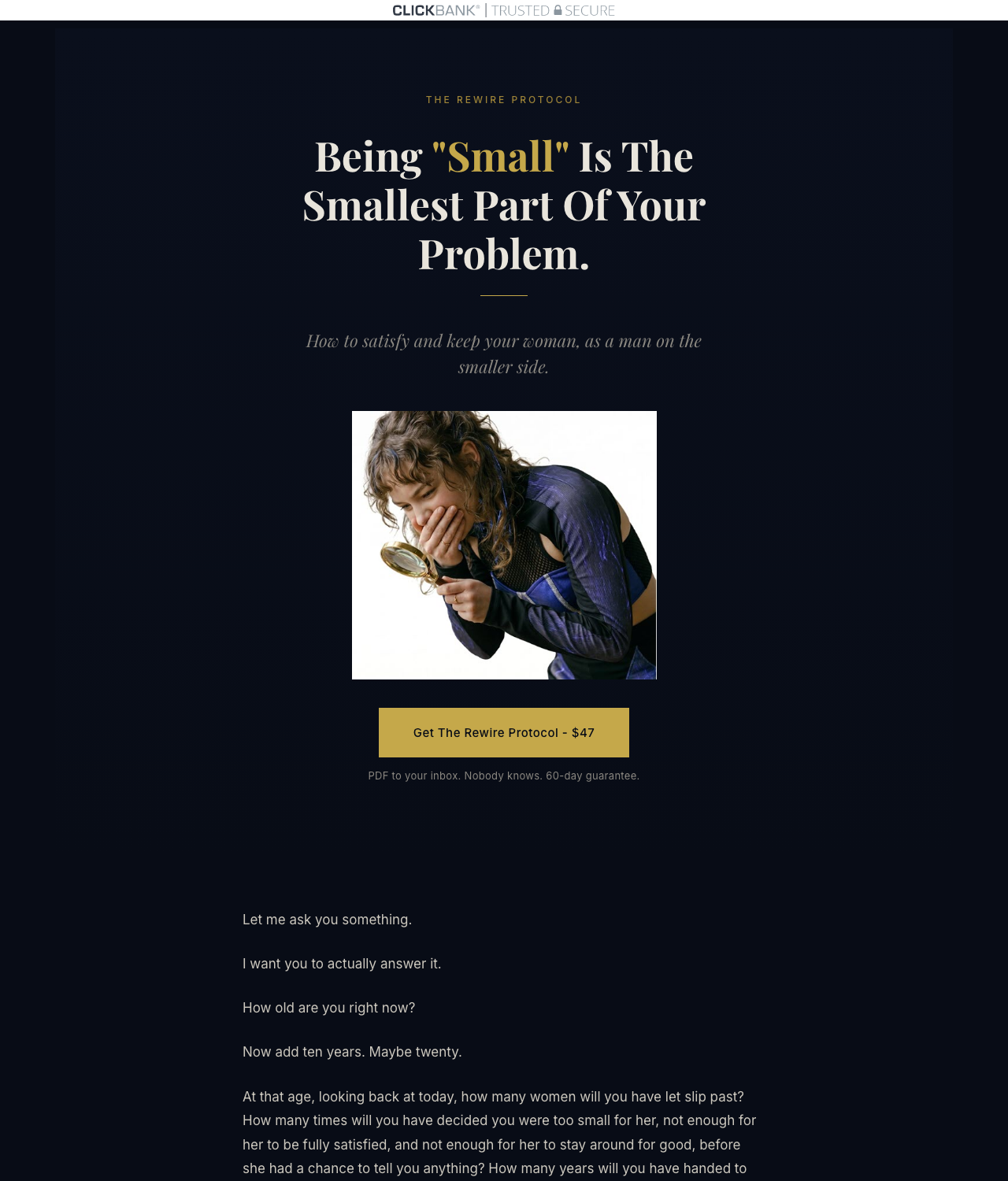 Live sales page →
 Here's what I'd actually do
If the ingredient list is reasonable, the doses are at least partially disclosed, and you are willing to use the refund window as an experiment budget:
The Rewire Protocol - Small Penis Anxiety Guide sits in the middle band — defensible ingredient pool, unverifiable dosing, premium ClickBank-funnel pricing. The 60-day refund is your insurance. Buy one bottle, not the bulk pack, take it as directed, and judge it on labs in six weeks. Refund if it did nothing.
Don't buy this if: Do not buy this if you cannot remember to cancel a recurring charge. The default-on subscription pattern on these funnels is engineered for the kind of busy week you are having.
— Dr. Rhett Calder · Internal medicine, retired (MD, board-certified 1989–2023)
Sources and review method
Supplement Skeptic reviews compare the visible label and sales claims against published research, dose ranges used in human studies, safety guidance, checkout terms, and refund mechanics. This page is not medical advice.
- Vendor sales page — ClickBank-listed sales page (active as of catalog import)
Frequently asked questions
- Is The Rewire Protocol a scam?
- No. You'll receive a digital download, and the refund window is honored through ClickBank. The question isn't 'is it a scam?' — it's 'is the content worth $47?' On that, we're skeptical.
- What do I actually get when I buy?
- A PDF guide, an audio version, and three bonus PDFs. All digital. No physical products, no coaching calls, no community access. The sales page imagery might suggest more, but the cart confirms it's a straightforward digital bundle.
- Does the 60-day refund actually work?
- Yes. ClickBank processes refunds, not the vendor. Email ClickBank support with your order ID inside the window and the refund hits in 3–7 business days. We have verified this on multiple ClickBank products.
- Will this really eliminate my small penis anxiety?
- It might help reframe the thoughts that fuel the anxiety — that's what cognitive techniques do. But 'eliminate' is a strong word, and you're buying a self-help booklet, not a therapy program. If the anxiety is severe or tied to body dysmorphic disorder, a PDF won't replace a qualified therapist.
More in Men's Health