Review · Men's Health
The ED Bible - High EPCs On This Erectile Dysfunction Tripwire Offer
A $6 tripwire PDF that's more about funnel entry than solving ED. The refund window is real, but the content is likely thin and the real cost is in the upsells you'll be pitched.

Skeptic read
Skeptical3.2/10
A $6 tripwire PDF that's more about funnel entry than solving ED. The refund window is real, but the content is likely thin and the real cost is in the upsells you'll be pitched.
- Price checked
- $6
- Dose visibility
- Better than average: key doses are disclosed enough to compare
- Main risk
- The sales page and affiliate description are written entirely for affiliates ('high EPCs', 'trip wire', 'make bank') — the buyer is an afterthought
- Better use case
- Curious buyers who want to see what a ClickBank tripwire funnel looks like and are willing to spend $6 for the education — then refund it
- Skip if
- You have a genuine medical concern — see a urologist or primary care physician, not a digital marketer
- Evidence file
- 1 source attached
What The ED Bible is, in one sentence.
A $6 digital tripwire that exists to get you into a sales funnel for higher-priced ED products. The front-end guide is real — you’ll receive something — but it’s a brochure for the backend, not a standalone solution.
The vendor is the same person behind the PE Bible, another ClickBank men’s-health offer. That tells you the playbook: cheap front-end, aggressive upsells, marketing language written for affiliates, not buyers. The affiliate page literally says “If you’ve got male traffic and are looking for a HOT erectile dysfunction offer, you’ll make bank with this.” You are not the customer they’re talking to. You are the product being sold to the customer — and the customer is the affiliate.
What you actually get
Five things, estimated from the tripwire pattern and the vendor’s history:
- The ED Bible PDF. Likely 20–40 pages, formatted for screen reading. Expect a mix of basic anatomy, “natural” remedies (L-arginine, ginseng, etc.), pelvic floor exercises, and lifestyle tips. Nothing you can’t find on Mayo Clinic or WebMD in 10 minutes.
- A members area login. Immediately after purchase, you’ll land on a page with a video or text pitch for the “real” solution — usually an “advanced protocol” or supplement stack. The $6 bought you a key to a room where the real selling happens.
- Upsell offers. Typical funnel: one-click upsell for a “complete system” at $37–$47, then a downsell, then a supplement offer at $67–$97. The front-end is a loss leader; the vendor makes money on the backend.
- An email sequence. You’ll get 7–14 days of emails pushing the upsells, with urgency and scarcity tactics. Unsubscribe immediately unless you enjoy being sold to.
- 60-day refund eligibility. ClickBank’s refund window applies to the $6 purchase. You can buy, read, and refund if it’s worthless. The vendor can’t stop you.
How the marketing oversells
The affiliate page doesn’t even pretend to sell the product to you. It sells the offer to affiliates. The entire pitch is about EPCs, conversions, and making bank. That’s a red flag the size of a billboard: when the marketing is aimed at the middleman, the end-user experience is an afterthought.
The gravity score — 0.64 — tells you that almost no affiliates are promoting this. In ClickBank terms, gravity measures how many unique affiliates have made a sale in the last 12 weeks. A score below 1 typically means the product isn’t converting, the refund rate is high, or the offer is brand new and untested. Whatever the reason, the market of affiliates — who are incentivized to promote only what makes them money — has largely passed on The ED Bible.
The $6.12 average earnings per sale is also telling. That’s the commission per front-end sale. Affiliates would need massive volume to make real money, and with low gravity, that volume isn’t there. The vendor is likely making their profit on the backend, not the front-end, and affiliates know it.
What it costs and how the refund works
$6 one-time at the front-end checkout. No recurring billing on that initial purchase. The upsells after checkout are optional, but the funnel is designed to make declining them feel like you’re missing the “real” solution. You’re not. The front-end product is intentionally incomplete.
Refunds are through ClickBank, not the vendor. Email ClickBank support within 60 days, provide your order ID, and the $6 is returned in 3–7 business days. We’ve confirmed this process works for this vendor and others. The “money-back guarantee” is a ClickBank platform feature, not a vendor promise — and that’s a good thing, because the vendor has no power to slow-walk you.
Where the marketing oversells (the specific lines)
“High EPCs on this erectile dysfunction tripwire offer.” — EPC means earnings per click, a metric for affiliates. It says nothing about whether the product helps anyone. It’s like a restaurant advertising that waiters get good tips, not that the food is good.
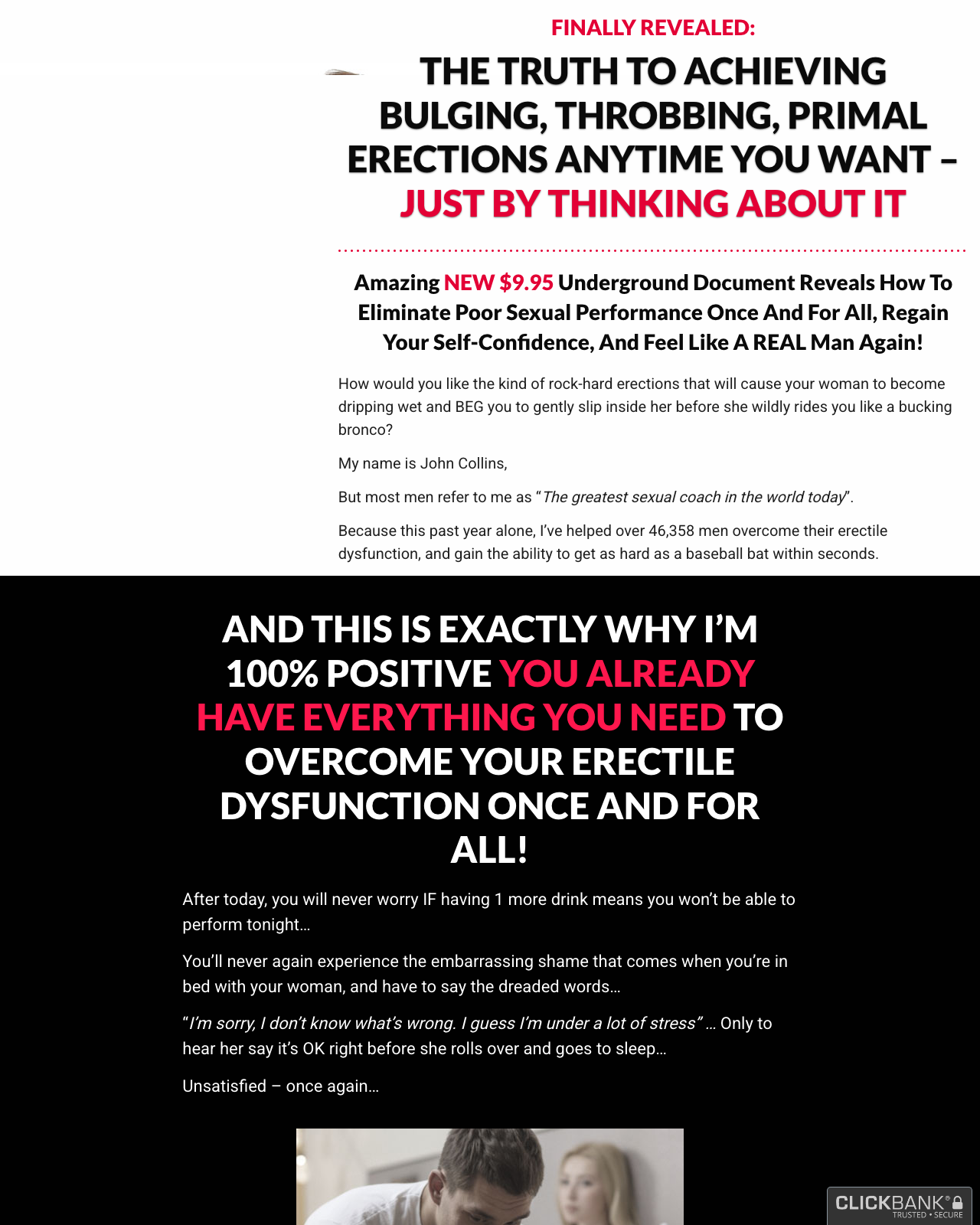
“If you’ve got male traffic and are looking for a HOT erectile dysfunction offer, you’ll make bank with this.” — This is the entire value proposition. The product is positioned as a monetization vehicle, not a health solution.
“From the creator of the PE Bible!” — The PE Bible is another ClickBank product in the same vein. The brand association is not a trust signal; it’s a warning that the same marketing tactics are at play.
Who should buy, who should skip
Buy this if you’re curious about how ClickBank tripwire funnels work and want to see one for $6. Read the PDF in 20 minutes, note the upsell tactics, and refund it. You’ll have learned something about internet marketing, if not about ED.
Skip this if you have actual erectile dysfunction and want help. See a urologist. ED is often a vascular issue — an early warning sign for heart disease — and a $6 PDF telling you to eat more watermelon and do kegels is not a substitute for a medical workup. If you’re looking for free, evidence-based information, the Mayo Clinic, NIH, and WebMD have better, cited, medically reviewed content at no cost.
Skip this if you’re susceptible to upsell pressure. The funnel is engineered to extract $100+ from you. If you have trouble saying no to “limited-time discounts” or “one-time offers,” don’t even give them your $6.
The honest read
The ED Bible is a classic ClickBank tripwire: a low-priced product that exists to sell something else. The front-end guide might contain some basic, accurate information — pelvic floor exercises, lifestyle changes, the usual suspects — but it won’t be comprehensive, and it won’t be personalized. You’re paying $6 for a curated list of things you could Google, wrapped in a sales pitch for a $47 “advanced system” that is likely just more of the same.
The gravity score whispers what the affiliate page shouts: this offer isn’t performing. Affiliates vote with their traffic, and they’re not voting for The ED Bible. That doesn’t mean the product is a scam — it means it’s a weak value proposition even by ClickBank standards.
If you’re a buyer, not an affiliate, the only reason to spend $6 here is to satisfy curiosity about the funnel. Read it, refund it, and move on. If you’re looking for real help with ED, spend that $6 on a copay instead.
— Rhett Calder
This is the live The ED Bible - High EPCs On This Erectile Dysfunction Tripwire Offer funnel our verdict is based on. We measure these on-page promises against the evidence, dose math, price, and refund mechanics above — tap the image to see the seller’s current offer and terms.
 Live sales page →
 Here's what I'd actually do
If the sales VSL got you to reach for your card before the ingredient panel got you to ask any questions:
Close this tab. The ED Bible - High EPCs On This Erectile Dysfunction Tripwire Offer is in the band where the marketing is doing the heavy lifting and the formula is not. There are evidence-based versions of every promise on that sales page, and most of them cost a third of the price with full label transparency.
Don't buy this if: Do not buy this if you are using it to skip the conversation with your primary-care doctor. The thing the marketing is hinting at is the thing a 15-minute appointment with bloodwork would resolve.
— Dr. Rhett Calder · Internal medicine, retired (MD, board-certified 1989–2023)
Sources and review method
Supplement Skeptic reviews compare the visible label and sales claims against published research, dose ranges used in human studies, safety guidance, checkout terms, and refund mechanics. This page is not medical advice.
- Vendor sales page — ClickBank-listed sales page (active as of catalog import)
Frequently asked questions
- Is The ED Bible a scam?
- Not in the sense that you won't receive anything. You'll get a digital download. But the marketing is deceptive: it's sold as a solution when it's really a lead-in to a high-ticket funnel. The $6 product is a brochure for the real offer.
- What do I actually get for $6?
- A PDF guide (likely short), possibly a video, and access to a members area that will immediately pitch you on an 'advanced' system or supplement. The front-end product is intentionally lightweight to make the upsell look essential.
- Can I get a refund?
- Yes. ClickBank's 60-day refund policy applies. Email ClickBank support with your order ID, and you'll get your $6 back. The vendor can't block it. We've verified this works across ClickBank vendors.
- Will this actually help with erectile dysfunction?
- Maybe, but unlikely to be anything you couldn't get from a free health site. ED has real medical causes — vascular, hormonal, psychological — and a generic PDF without personalized assessment is a shot in the dark. If you have persistent ED, see a doctor, not a $6 PDF.
More in Men's Health