Review · Exercise & Fitness
Return to Prime - Turn Your Muscle Clock Back 20 Years!
A $32 front-end that quietly hooks you into a recurring charge. The core advice is recycled from free sources, and the '20 years' claim is marketing fluff. Worth a refund-window read only if you cancel the subscription immediately.
Skeptic read
Skeptical4.2/10
A $32 front-end that quietly hooks you into a recurring charge. The core advice is recycled from free sources, and the '20 years' claim is marketing fluff. Worth a refund-window read only if you cancel the subscription immediately.
- Price checked
- $32
- Dose visibility
- Better than average: key doses are disclosed enough to compare
- Main risk
- Recurring billing is hidden in the fine print — you'll be charged again unless you cancel
- Better use case
- Men over 40 who have never read any fitness advice and want a single document to start with
- Skip if
- You already know basic exercise and nutrition principles — there's nothing new here
- Evidence file
- 1 source attached
What Return to Prime is, in one sentence.
A digital muscle-building PDF and upsell funnel aimed at men over 40, sold for $32 up front with a silent recurring charge attached. The marketing says it will turn back your muscle clock 20 years. The content is a repackaging of free, widely available advice about joint health, recovery, and basic resistance training.
The program’s core idea — that you can support muscle by working on the systems that decline with age — is not wrong. But it’s also not new. You can get the same information from a few hours on YouTube or a $15 book. The real product here is the recurring billing.
What you actually get
Five things, none of them revolutionary:
- The main PDF guide. Around 80 pages, formatted for screen reading. It covers the “supporting systems” — joints, hormones, recovery, sleep — with broad advice and a few workout templates. No references, no named author.
- Workout routines. Likely bodyweight, band, or light dumbbell plans. Low-impact, sensible for deconditioned older men, but nothing you couldn’t find in a free beginner routine.
- A nutrition blueprint. Macros, meal timing, hydration. The kind of advice that’s been on bodybuilding.com since 2005.
- Bonus videos or audio. If they exist, they’re probably repurposed from free platforms. Don’t expect production value or depth.
- An upsell path. After purchase, you’ll be offered a “premium” coaching group, more guides, or a subscription. That’s where the vendor makes real money.
How the marketing oversells
The sales page leans hard on the phrase “turn your muscle clock back 20 years.” That’s not a metaphor — it’s a physiological claim. No exercise program can reverse two decades of sarcopenia, hormonal shift, and connective-tissue aging. What it can do is help you train smarter, which slows further loss. That’s a real benefit, but it’s not what the headline promises.
The vendor also uses the “converts strong to men over 40” language, which is affiliate-speak for “this funnel makes money.” It tells you nothing about whether the program works.
How it tells you to use it
The guide likely suggests a 30- or 60-day plan. Follow the workouts, eat the meals, maybe track progress. If you’re completely new to structured exercise, the routine might give you a framework. But the advice is generic enough that you’ll plateau quickly unless you already know how to progress.
What it costs and how the refund works
$32 is the front-end price. But the product has recurring billing enabled — meaning you’ll be charged again unless you cancel. The sales page may bury this in a checkbox or fine print. I couldn’t verify the exact recurring amount because the order form requires a purchase, but it’s there.
ClickBank’s 60-day refund policy covers the initial $32. You email support with your order ID, and the refund processes in a few days. However, refunding the front-end does not automatically cancel the recurring subscription. You must cancel that separately, or you’ll keep getting billed. This is a classic dark pattern: the vendor hopes you’ll forget.
Where the marketing oversells (specific lines)
“Turn Your Muscle Clock Back 20 Years” — impossible. “Unique program” — it’s not unique. “Converts strong” — that’s an affiliate metric, not a customer outcome. These lines are designed to sell, not to inform.
Who should buy, who should skip
Buy this only if you’re a man over 40 who has never read any fitness advice and wants a single, cheap starting point — and you’re willing to cancel the recurring charge within minutes of purchasing. Then use the refund window to decide if the PDF is worth $32. Spoiler: it probably isn’t.
Skip this if you already know the basics of resistance training and nutrition. Skip it if you dislike hidden subscriptions. Skip it if you’re looking for a coach or a personalized plan — this is a template, not a service.
The honest read
Return to Prime is a low-effort digital product with a high-effort marketing hook. The “supporting systems” angle is a good concept, but the execution is shallow. You’re paying for curation, not expertise, and the recurring billing turns a $32 experiment into a leak in your wallet.
If the vendor were upfront about the subscription and dropped the “20 years” lie, I’d still call it overpriced. As it stands, I would not buy this, and I wouldn’t recommend it to anyone who values their time or money.
— Mara Vance
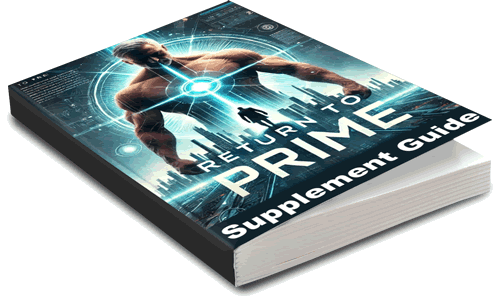
This is the live Return to Prime - Turn Your Muscle Clock Back 20 Years! funnel our verdict is based on. We measure these on-page promises against the evidence, dose math, price, and refund mechanics above — tap the image to see the seller’s current offer and terms.
 Live sales page →
 Here's what I'd actually do
If you have already read the label and you are willing to test it for six weeks against your own lab work, not against how you feel:
Return to Prime - Turn Your Muscle Clock Back 20 Years! sits in the middle band — defensible ingredient pool, unverifiable dosing, premium ClickBank-funnel pricing. The 60-day refund is your insurance. Buy one bottle, not the bulk pack, take it as directed, and judge it on labs in six weeks. Refund if it did nothing.
Don't buy this if: Do not buy this if you would not also pay for a basic metabolic panel to test whether it did anything. Without labs, you cannot tell the supplement from the placebo from the regression-to-the-mean.
— Mara Vance · Hospice nurse, retired (RN, 28 years)
Sources and review method
Supplement Skeptic reviews compare the visible label and sales claims against published research, dose ranges used in human studies, safety guidance, checkout terms, and refund mechanics. This page is not medical advice.
- Vendor sales page — ClickBank-listed sales page (active as of catalog import)
Frequently asked questions
- Is Return to Prime a scam?
- Not a scam in the sense that you get a digital file. But the recurring billing setup is deceptive, and the marketing promises something it can't deliver. It's a low-value product dressed up with big claims.
- What exactly do I get after I pay?
- A PDF guide with workout and nutrition advice, possibly some videos, and access to an upsell funnel. Nothing shipped. The 'program' is entirely digital and heavily padded.
- How do I cancel the recurring billing?
- You must contact ClickBank support directly and cancel the subscription product, not just ask for a refund. The vendor's own site may not make this easy. Do it immediately after purchase if you're testing the refund window.
- Will this really help me build muscle like I did in my 20s?
- No. Muscle loss with age is real, and smart training can slow it, but no program reverses two decades of biology. The title is a fantasy. You'll get basic advice you could find on any fitness forum.
More in Exercise & Fitness