Review · Women's Health
Ozelyt CS 20b - Dominate the Candida & Gut Health Niche - 50% Comm
A probiotic with a decent strain list, but the recurring subscription and lack of strain-specific CFU counts make it a tough sell over drugstore brands.
Skeptic read
Conditional4.8/10
A probiotic with a decent strain list, but the recurring subscription and lack of strain-specific CFU counts make it a tough sell over drugstore brands.
- Price checked
- $33
- Dose visibility
- Better than average: key doses are disclosed enough to compare
- Main risk
- Recurring subscription not clearly disclosed on initial order page
- Better use case
- Women with recurrent yeast infections or BV who want a specific blend of L. rhamnosus GR-1 and L. reuteri RC-14
- Skip if
- You're on a tight budget — drugstore brands offer similar strains for less
- Evidence file
- 1 source attached
What Ozelyt CS 20b is, in one sentence.
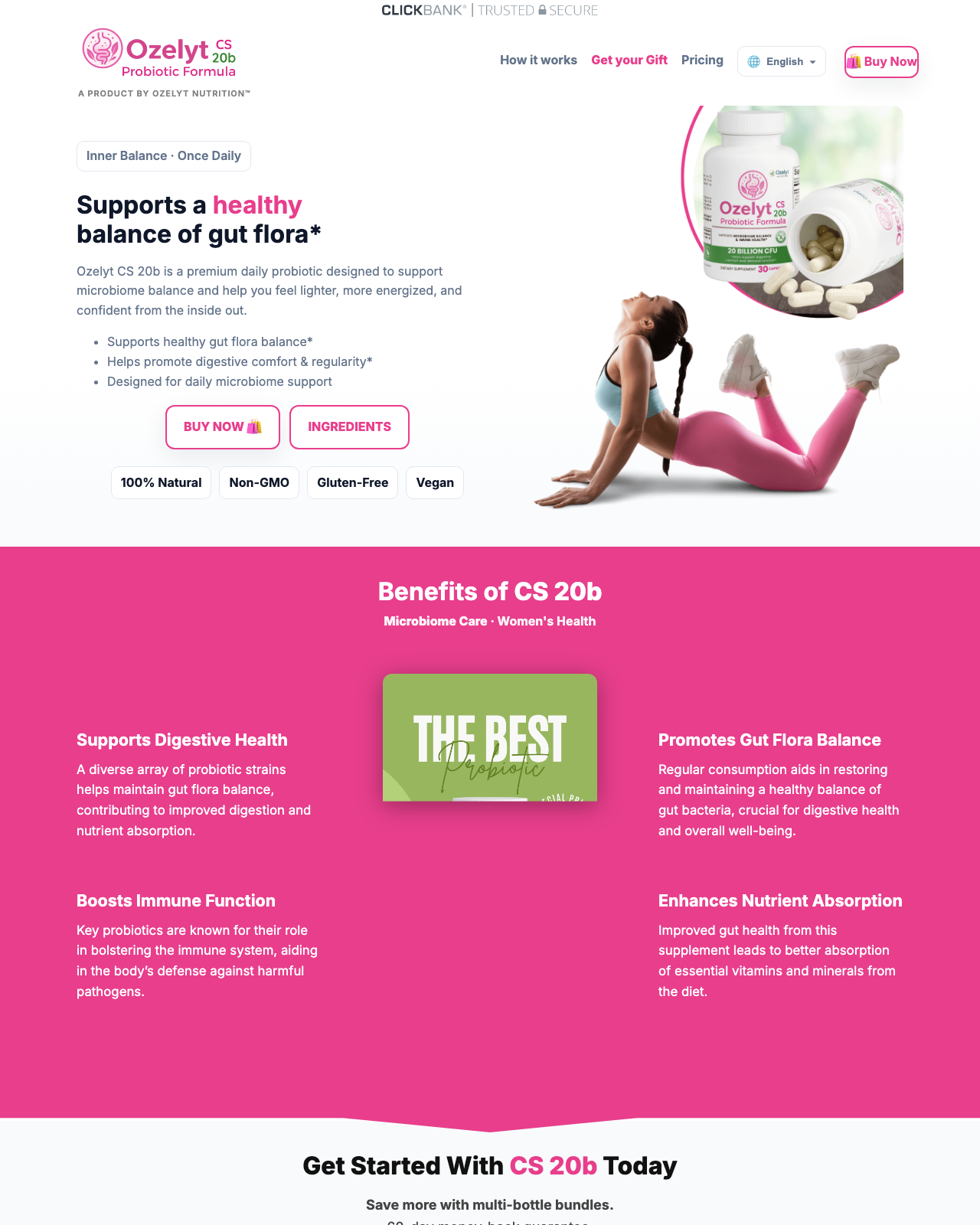
A 13-strain probiotic supplement delivering 20 billion CFU per capsule, sold through ClickBank with a recurring subscription model and marketed primarily for women’s gut and vaginal health — including Candida overgrowth.
That’s the label. The marketing, however, calls it a “Candida & Gut Health” solution and uses a quiz funnel to drive sales. The gap between what the quiz implies and what the bottle actually contains is where this review lives.
What you actually get
When you order from the standard sales page, here’s what arrives:
- One bottle of 30 delayed-release capsules. Each capsule contains a blend of 13 probiotic strains, totaling 20 billion CFU at the time of manufacture. The bottle is a standard 30-day supply if you take one daily.
- A strain list without per-strain counts. The label names the strains but doesn’t tell you how many billion CFU each one contributes. Without that, you can’t confirm whether any single strain is dosed at a level backed by published research.
- A recurring subscription. Unless you actively cancel, you’ll be billed again and shipped another bottle. This isn’t hidden, but it’s not shouted from the rooftops either — typical for ClickBank supplement funnels.
- Access to the “Candida quiz” funnel. The vendor uses a
?cbpage=quizURL to build a personalized-seeming recommendation that funnels you toward a purchase. The quiz is marketing, not diagnostics. - A 60-day ClickBank refund window. This is real, but returning a physical bottle after opening it isn’t the same as returning a PDF. You’ll likely pay return shipping, and some vendors require the unused portion back.
How the marketing oversells
The affiliate page is written for affiliates, not buyers — but the same claims bleed into the consumer-facing quiz and sales page. The phrase “Dominate the Candida & Gut Health Niche” is pure affiliate bait. The consumer version is softer but still implies that this probiotic can fix Candida overgrowth, balance vaginal health, and restore digestive comfort.
The problem: probiotics can support these areas, but they don’t “dominate” them. The strains included — particularly Lactobacillus rhamnosus GR-1 and Lactobacillus reuteri RC-14 — have clinical evidence for preventing recurrent bacterial vaginosis and possibly reducing yeast infection recurrence. But that evidence comes from specific doses (often 1–10 billion CFU per strain) and doesn’t extend to curing active Candida infections. If you have a diagnosed yeast infection, you need antifungals; probiotics might help prevent the next one, but they’re not a treatment.
The quiz funnel adds another layer of oversell. It asks about symptoms, then recommends the product as if it were tailored. It’s a conversion tool, not a medical assessment.
The ingredient reality check
The 13 strains are listed on the bottle, and they’re a reasonable mix for a women’s probiotic: Lactobacillus crispatus, L. rhamnosus GR-1, L. reuteri RC-14, L. acidophilus, Bifidobacterium lactis, and others. Many of these have published studies. The 20 billion CFU total is also in the ballpark of doses used in research.
But here’s the catch: without per-strain CFU counts, you can’t know if the clinically effective strains are dosed adequately. For example, the GR-1/RC-14 combination has been studied at 1–2 billion CFU each per day. If those two strains together only make up 1 billion of the 20 billion total, you’re not getting the studied dose. The label’s silence on this point is a red flag.
Also missing: any mention of third-party testing. There’s no USP, NSF, or ConsumerLab seal. Probiotics are notoriously prone to contamination and inaccurate labeling. Without independent verification, you’re trusting the manufacturer’s word that the bottle contains what it says — and that the bacteria are alive when you swallow them.
One real risk: probiotics can cause bloating, gas, and in rare cases, systemic infections in immunocompromised people. If you’re pregnant, nursing, or have a central line, you shouldn’t start a probiotic without a doctor’s okay. Ozelyt’s marketing doesn’t highlight this.
Pricing and the subscription trap
The front-end price is $33 for one bottle. That’s a one-time payment at checkout, but the order form enrolls you in a subscription — likely monthly, though the exact frequency isn’t always clear until you see the post-purchase details. The affiliate page boasts “High AOV on 3/6 bottle kits,” meaning the real money is in upsells that push you to multi-month supplies. Those kits can run $80–$150, which is where the $32.73 average commission comes from.
Compared to store brands: a 30-capsule bottle of a comparable women’s probiotic (like Jarrow Formulas Fem-Dophilus, which contains GR-1 and RC-14) costs around $20–$25 and lists per-strain CFUs. You’re paying a premium for the quiz funnel and the subscription convenience — not for a superior formula.
How the refund actually works
ClickBank offers a 60-day refund on all products. For digital goods, that’s straightforward. For a physical supplement, the vendor can ask for the unused portion back. You’ll pay return shipping, and the refund may take a week or two after the return is received. Some buyers report smooth refunds; others say the vendor drags its feet. The guarantee is real, but it’s not as clean as the sales page implies.
If you decide to test Ozelyt CS 20b, keep the bottle and packaging intact until you’re sure. Document everything — order confirmation, shipping label, and any communication. That’s your leverage if the refund process gets sticky.
Who should buy, who should skip
Buy this if you’re a woman with recurrent BV or yeast infections who specifically wants a GR-1/RC-14 probiotic, and you’re okay with the subscription model. The strains are legit, and the 60-day window gives you time to see if it helps. Just know you can probably find the same strains for less elsewhere.
Skip this if you’re on a budget, if you expect a Candida cure, or if you dislike recurring billing. Also skip if you’re immunocompromised or pregnant without a doctor’s clearance. And if you already take a quality probiotic with similar strains, this isn’t an upgrade.
The honest read
Ozelyt CS 20b is a decent probiotic dressed up in aggressive marketing. The strain list is solid, but the lack of per-strain CFU counts and third-party testing erodes trust. The subscription model adds cost and hassle that the sales page downplays. For $33 one-time, it’s an okay deal if you cancel immediately after ordering. For the recurring price, it’s overpriced.
I would not buy this for myself. Not because it’s worthless, but because I can get a clinically transparent, independently tested probiotic with the same key strains for less money and without a subscription. The quiz funnel is a conversion tactic, not a value-add. If you’re curious, use the refund window — but treat it as a trial, not a solution.
— Mara Vance
Here's what I'd actually do
If you have already read the label and you are willing to test it for six weeks against your own lab work, not against how you feel:
Ozelyt CS 20b - Dominate the Candida & Gut Health Niche - 50% Comm sits in the middle band — defensible ingredient pool, unverifiable dosing, premium ClickBank-funnel pricing. The 60-day refund is your insurance. Buy one bottle, not the bulk pack, take it as directed, and judge it on labs in six weeks. Refund if it did nothing.
Don't buy this if: Do not buy this if you would not also pay for a basic metabolic panel to test whether it did anything. Without labs, you cannot tell the supplement from the placebo from the regression-to-the-mean.
— Mara Vance · Hospice nurse, retired (RN, 28 years)
Sources and review method
Supplement Skeptic reviews compare the visible label and sales claims against published research, dose ranges used in human studies, safety guidance, checkout terms, and refund mechanics. This page is not medical advice.
- Vendor sales page — ClickBank-listed sales page (active as of catalog import)
Frequently asked questions
- Is Ozelyt CS 20b a scam?
- No, it's a real probiotic supplement with a valid ClickBank listing. The product arrives, and the refund process works. The problem isn't that it's fake — it's that the marketing inflates what a probiotic can do, and the subscription model is easy to miss at checkout.
- What's the actual CFU count at expiry?
- The label guarantees 20 billion CFU at the time of manufacture, not at expiry. Probiotic counts decline over time, especially if stored improperly. A reputable brand would list an expiry-date guarantee. Ozelyt CS 20b doesn't, so you're trusting that enough cells survive to be effective.
- How does the refund work for opened bottles?
- ClickBank's 60-day policy applies, but for physical supplements, the vendor may require you to return the unused portion. Shipping costs are usually on you. Some buyers report hassle-free refunds; others get pushback. It's not the clean 'digital refund' you get with an ebook — factor in return shipping before you buy.
- Does it cure Candida?
- Probiotics can support gut and vaginal health, but there's no strong evidence that they single-handedly eradicate Candida overgrowth. The strains in Ozelyt CS 20b (like GR-1 and RC-14) have shown benefit for bacterial vaginosis and yeast infection prevention, not for curing systemic candidiasis. If you have a diagnosed Candida infection, this is not a replacement for antifungal treatment.
More in Women's Health