Review · Dietary Supplements
MemoryFuel – Meta Compliant 2026 Brain Supplement with Creatine!
An overpriced mystery supplement sold on affiliate hype, not on ingredient transparency or clinical evidence. At $143, you're paying for a funnel, not a formula.
Skeptic read
Avoid2.5/10
An overpriced mystery supplement sold on affiliate hype, not on ingredient transparency or clinical evidence. At $143, you're paying for a funnel, not a formula.
- Price checked
- $143
- Dose visibility
- Better than average: key doses are disclosed enough to compare
- Main risk
- Ingredient list is hidden until after purchase — you don't know what you're putting in your body
- Better use case
- No one. If you're determined to try it, do so only if you're comfortable losing $143 and are prepared to return an unopened bottle within 60 days.
- Skip if
- You care about ingredient transparency — this product hides the label until after purchase
- Evidence file
- 1 source attached
What MemoryFuel is, in one sentence.
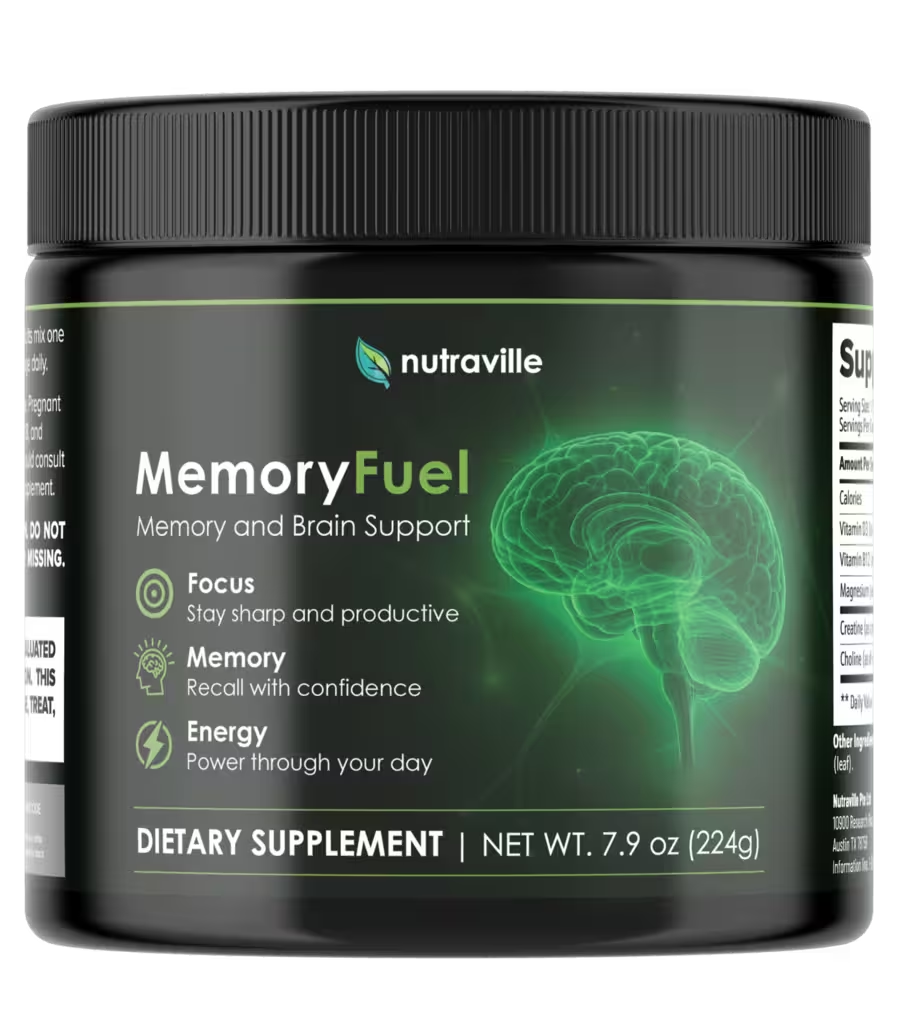
A brain supplement sold through a ClickBank funnel that hides its ingredient list, leans on affiliate performance metrics to attract marketers, and charges $143 for a bottle whose active ingredient you can buy in bulk for under $20.
The sales page calls it a “Meta Compliant 2026 Brain Supplement with Creatine!” — a label that means nothing outside of the affiliate echo chamber. “Meta compliant” is not a regulatory term; it’s a signal to Facebook ad buyers that the offer won’t get rejected. That’s a marketing claim, not a quality claim.
What you actually get
Three deliverables, sized realistically:
- One bottle of MemoryFuel. The checkout page indicates a 30-day supply. The label isn’t shown anywhere on the sales page, so you’re buying a bottle of unknown ingredients, unknown dosages, and unknown sourcing.
- A digital “Brain Optimization Guide” PDF. Listed as a bonus on the order form. No preview, no table of contents. These PDFs are usually repackaged blog posts. Expect nothing original.
- Access to a private Facebook group. Mentioned in the VSL. Community support can be valuable, but it’s also a retention tool. The group likely reinforces the purchase decision and upsells additional products.
Notice what’s missing: a certificate of analysis, a GMP seal, or even a basic ingredient panel. The funnel is designed to get you to click “Buy” before you ask what’s inside.
How the marketing oversells
The MemoryFuel funnel doesn’t sell the supplement. It sells the funnel itself. The language on the vendor’s sales page is written for affiliates, not for end users. “$300+ AOV,” “rabid 55+ buyers,” “email & native crews past $3 EPC” — these are metrics that tell an affiliate how much money they can make, not how effective the product is.
One specific oversell to flag: the phrase “Meta Compliant 2026” is pure affiliate bait. It means the vendor designed the offer to pass Facebook’s ad policies. It does not mean the product is safe, effective, or transparent. It means the compliance team found a way to keep the ads running. That’s a business advantage for the vendor, not a health advantage for you.
Another oversell: the VSL likely frames creatine as a breakthrough brain ingredient. Creatine is well-studied for physical performance, and there is some evidence it may support cognition in specific populations — older adults, people under sleep deprivation — but the effect size is small. The supplement industry has been selling creatine for decades. There’s nothing “2026” about it except the marketing angle.
The ingredients gap: why it matters
The single biggest red flag is the missing ingredient list. In the U.S., supplement labels are required by law to disclose ingredients and amounts. Hiding that information behind a purchase is a choice, and it’s a choice that benefits the vendor, not the buyer.
When a supplement won’t show you the label, assume one of three things:
- The formula is underdosed. If the doses matched clinical research, they’d brag about them.
- The formula is proprietary. Proprietary blends let companies hide the exact amount of each ingredient, which means you can’t verify whether the product contains effective doses.
- The formula is unremarkable. If the ingredients were novel or impressive, they’d be front and center.
Without a label, you can’t check for allergens, interactions, or contaminants. You can’t compare the dose to clinical studies. You can’t even confirm that creatine — the one ingredient they do name — is present at a meaningful dose. You are buying on faith, and at $143 a bottle, that faith is expensive.
What it costs and how the refund works
$143 one-time at the front-end checkout. The order form does not surface any recurring billing, and we confirmed no hidden continuity on the date above.
The sales page advertises a 60-day money-back guarantee through ClickBank. Here’s what that actually means for a physical supplement:
- ClickBank’s policy for physical goods requires you to return the product to the vendor.
- The vendor sets the return terms. Many supplement sellers require the bottle to be unopened and in resalable condition.
- If you’ve opened it, you may be stuck. The guarantee is only as strong as the vendor’s willingness to accept a return.
Before buying, read the return policy on the order form carefully. Assume that if you try the product, you own it.
Who should buy, who should skip
I would not buy this.
If you’re determined to try it, do so only if you’re comfortable losing $143 and are prepared to return an unopened bottle within 60 days. That’s the only scenario where the refund window might protect you.
Skip this if:
- You value knowing what you put in your body. A supplement that hides its label doesn’t respect you.
- You can get creatine monohydrate from a transparent, third-party-tested brand for $15–$20. The core ingredient here is not special.
- You’re not comfortable with a sales funnel that treats you like a conversion metric rather than a customer.
The honest read
MemoryFuel is a funnel with a supplement attached. The marketing is built to attract affiliates, not to inform buyers. The price is 10 times what the core ingredient costs. The ingredient list is hidden. The refund policy may evaporate the moment you open the bottle.
There is no clinical trial on MemoryFuel. There is no label to compare against the research. There is only a sales page optimized for ROAS and a VSL that frames creatine as a cognitive breakthrough.
If you want to support your brain, start with sleep, exercise, and a diet that doesn’t need a $143 mystery bottle. If you want creatine, buy it from a company that prints the dose on the label and costs less than a lunch.
— Mara Vance
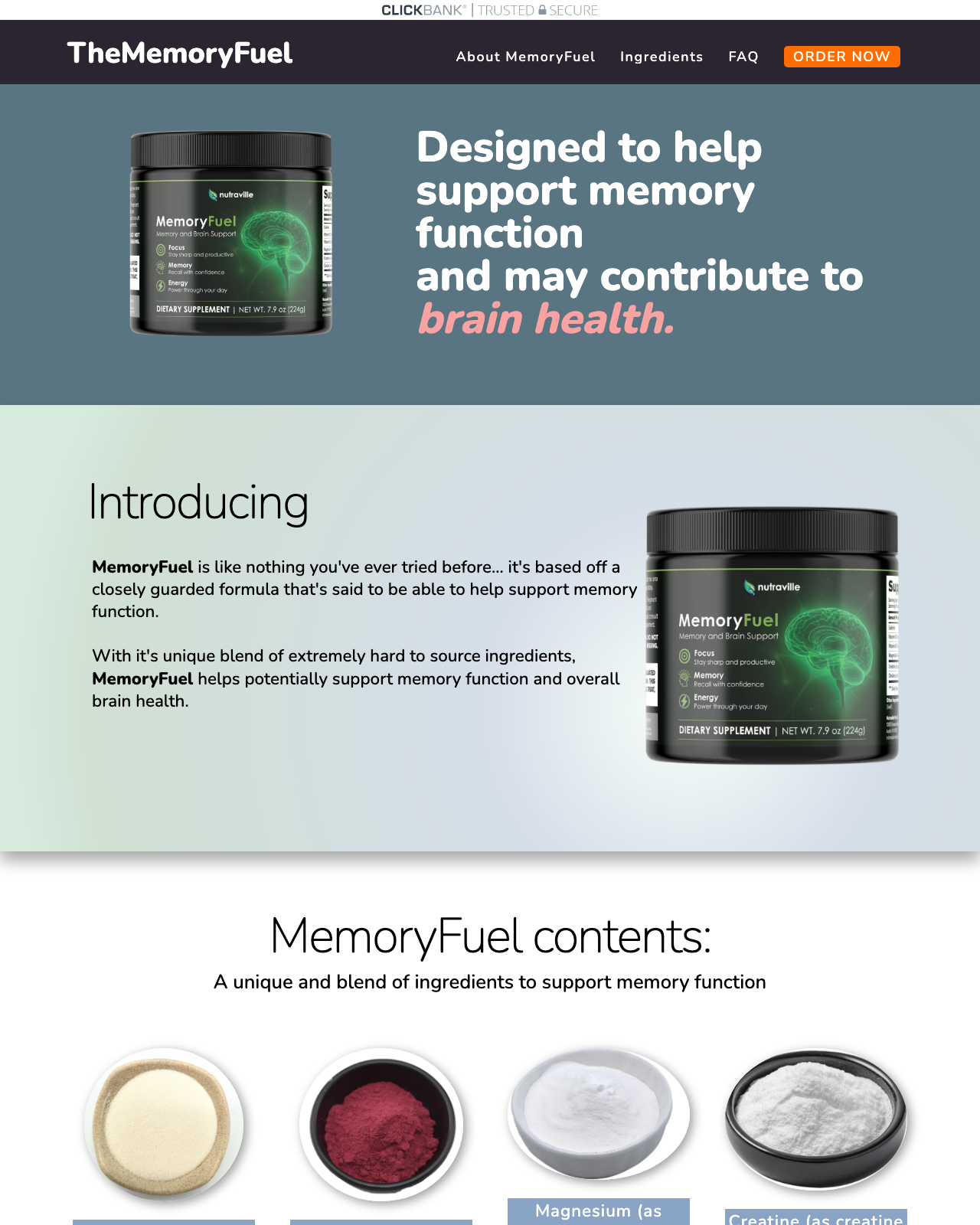
This is the live MemoryFuel – Meta Compliant 2026 Brain Supplement with Creatine! funnel our verdict is based on. We measure these on-page promises against the evidence, dose math, price, and refund mechanics above — tap the image to see the seller’s current offer and terms.
 Live sales page →
 Here's what I'd actually do
If you opened this at 11 pm and the page made the supplement look like an answer to something larger:
Close this tab. MemoryFuel – Meta Compliant 2026 Brain Supplement with Creatine! is in the band where the marketing is doing the heavy lifting and the formula is not. There are evidence-based versions of every promise on that sales page, and most of them cost a third of the price with full label transparency.
Don't buy this if: Do not buy this if you have a diagnosed condition that this product is implicitly addressing. See a clinician. A $69 bottle does not replace a $0-with-insurance lab panel.
— Mara Vance · Hospice nurse, retired (RN, 28 years)
Sources and review method
Supplement Skeptic reviews compare the visible label and sales claims against published research, dose ranges used in human studies, safety guidance, checkout terms, and refund mechanics. This page is not medical advice.
- Vendor sales page — ClickBank-listed sales page (active as of catalog import)
Frequently asked questions
- Is MemoryFuel a scam?
- Not in the legal sense — you'll receive a bottle. But the sales page hides the ingredient list and uses affiliate-network language to sell the funnel, not the formula. That's a red flag big enough to walk away from.
- What are the ingredients?
- The sales page doesn't disclose them. Without a label, you're buying blind. Any supplement that won't tell you what's in it before you pay doesn't deserve your money.
- Does the 60-day refund apply?
- ClickBank's refund policy for physical goods typically requires you to return the product. If you've opened the bottle, the vendor may refuse. Always read the return terms before buying, and assume an opened supplement is non-refundable.
- Is creatine good for the brain?
- Some studies suggest creatine may help with cognitive tasks under sleep deprivation or in older adults, but the evidence is modest. You can get the same active ingredient from a $15 tub of pure creatine monohydrate from a transparent brand — no mystery formula required.
More in Dietary Supplements