Review · Women's Health
Cortisol AM: Is Cortisol AM worth the money?
Skeptical is the right call on Cortisol AM: WellMe actually prints every dose on the label, which most funnel supplements don't bother doing, but the 125 mg of ashwagandha and 100 mg of phosphatidylserine are roughly a quarter to a half of the amounts shown to move cortisol in the cited human trials. The 180-day refund is real and clearly documented, so trying it mostly costs you a return-shipping bill if it doesn't help. At $39 to $59 a jar, you're paying full price for a subclinical dose of the two ingredients doing the actual work.
Skeptic read
Skeptical4.3/10
Skeptical is the right call on Cortisol AM: WellMe actually prints every dose on the label, which most funnel supplements don't bother doing, but the 125 mg of ashwagandha and 100 mg of phosphatidylserine are roughly a quarter to a half of the amounts shown to move cortisol in the cited human trials. The 180-day refund is real and clearly documented, so trying it mostly costs you a return-shipping bill if it doesn't help. At $39 to $59 a jar, you're paying full price for a subclinical dose of the two ingredients doing the actual work.
- Price checked
- From $39 (single bottle $59)
- Dose visibility
- Better than average: key doses are disclosed enough to compare
- Main risk
- Ashwagandha (125 mg) and phosphatidylserine (100 mg) are roughly a quarter to a half of the doses used in the trials that show a measurable cortisol effect
- Better use case
- Someone who wants a stimulant-free, low-dose adaptogen powder to test for a few months and will actually use the 180-day refund if it does nothing
- Skip if
- You have a thyroid condition, especially hypothyroidism, or liver disease — ashwagandha has documented case reports of thyrotoxicosis and cholestatic liver injury
- Evidence file
- 12 sources attached
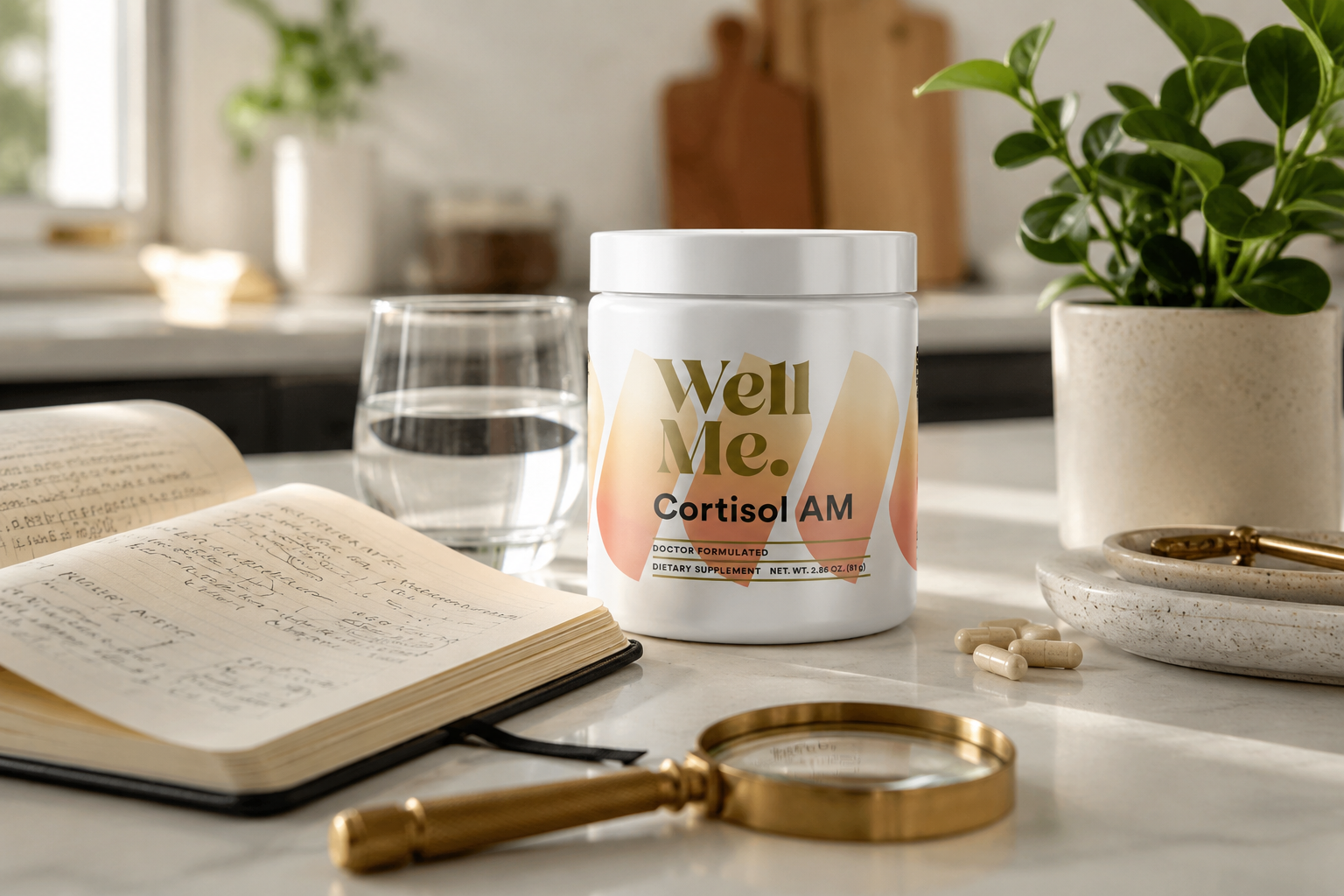
Cortisol AM is a $59 stress-support powder from WellMe that discloses every ingredient dose on the label, a rarity in this category, but two of its three headline actives land well under the amounts used in the human trials that show a cortisol effect. The 180-day refund is real and the procedure is published in writing, which is the main reason this earns a cautious Skeptical rather than an outright pass.
What it costs today
| Tier | Per jar | Total | Shipping | Cost per day |
|---|---|---|---|---|
| 1 jar (30-day supply) | $59.00 | $59.00 | $9.95-$19.95 | $1.97 |
| 3 jars (90-day supply) | $49.00 | $147.00 | $9.95-$19.95 | $1.63 |
| 6 jars (180-day supply) | $39.00 | $234.00 | Free | $1.30 |
The sales page uses “$129 $59” anchor pricing on the single-jar checkout, framing $59 as an already-discounted price against a reference figure the page never explains or substantiates elsewhere. No separate upsell products showed up on the checkout path we reviewed; the only choice offered is which jar quantity to buy. Each jar holds a 30-serving supply based on the one-scoop-per-day directions printed on the label (1 scoop mixed into 6-8 ounces of water).
What is in it
| Ingredient | Disclosed dose | Studied dose (cortisol-relevant) |
|---|---|---|
| Ashwagandha root extract | 125 mg | 250-600 mg/day (Chandrasekhar 2012, Lopresti 2019) |
| Phosphatidylserine (soybean) | 100 mg | 400 mg/day for stress-cortisol (Starks 2008) |
| Rhodiola root extract | 50 mg | 50-576 mg/day, mostly 3% rosavins extracts |
| L-Theanine | 100 mg | 100-200 mg/day typical calming dose |
| Coenzyme Q10 | 50 mg | 100-300 mg/day; no cortisol-specific trials |
| Hydrolized bovine collagen | 1 g | 2.5-10 g/day in skin trials; no cortisol evidence |
The label also lists 200 mg vitamin C, 35 mg vitamin B6, 30 mcg vitamin B12, and 4.5 mg iron, none of which carry cortisol-specific evidence at these amounts; they read as a general multivitamin layer on top of the five stress-focused actives. Notably absent: magnesium, one of the minerals most consistently studied alongside cortisol and stress physiology, doesn’t appear anywhere on this label. None of the three plant extracts discloses a standardization percentage (no withanolide content for ashwagandha, no rosavins percentage for rhodiola), so even the doses that are printed can’t be fully compared to branded extracts like KSM-66 or Shoden.
The B-vitamin doses are worth a second look on their own: 35 mg of B6 is over 2,000% of the daily value, and 30 mcg of B12 is over 1,200%. Neither is dangerous at these levels for most healthy adults, since both are water-soluble and B6 toxicity thresholds sit well above 35 mg/day for short-term use, but the megadosing looks more like a formulation habit borrowed from energy-drink marketing than a choice tied to cortisol physiology specifically. If you’re already taking a separate multivitamin or B-complex, these amounts stack on top of it.
The real complaints
We checked BBB, Trustpilot, Reddit, and ConsumerAffairs for “Cortisol AM” and “WellMe” and found no BBB profile or Trustpilot page specific to this product, and no active Reddit threads discussing it by name. What surfaces instead is a wall of near-identical articles from sites like inmybowl.com, chamberlainsun.com, bestsuggestor.com, and press-release reprints on newswire.com, all of which repackage the vendor’s own marketing copy as a “review” rather than reporting independent customer experience. Plainly stated: no substantive third-party complaint record exists for this specific product as of this writing. The ClickBank gravity score of 0.13 is consistent with low sales volume, which itself explains the thin trail in either direction, praise or complaint. That absence cuts both ways for a buyer: there’s no documented pattern of refund denial or shipped-but-not-delivered complaints to warn you off, but there’s also no volume of satisfied repeat buyers to point to as evidence the underdosed formula works in practice. Treat the lack of complaints as “unproven,” not as a clean bill of health.
The sales page, audited
The pitch is built around energy, mood, and skin, not weight loss, so it skips the “cortisol belly” trope that shows up on many competing stress-supplement pages; endocrinologists note that “cortisol belly” isn’t a term physicians actually use. What the page does lean on: anchor pricing (“$129 $59”), urgency language (“for a very limited time”) without a visible countdown timer or stock counter, and an “As Featured On” media-logo strip that carries its own disclaimer that WellMe “is not endorsed by, sponsored by, or affiliated with any of these organizations.” The copy also cites “a recent study from doctors at Harvard Medical School” without naming the study, its authors, or linking to it anywhere on the page. On the positive side, the formulator, Dr. Erin Kinney, N.D., is credited by name rather than left as an anonymous “doctor,” which is more transparent than the norm for this kind of sales page. The bigger claims-versus-label gap: the copy promises ingredients “in the exact dosages listed on the bottle” and calls them “clinically-effective dosages.” The dosages are indeed listed, but two of the three key actives sit below the amounts shown to move cortisol in the cited trials, so “clinically effective” oversells what’s actually in a single scoop.
How the refund actually works
The guarantee window is 180 days from the order date, not the delivery date. To use it: email WellMe support with your first name, last name, the email used on the order, and your order confirmation number. Mail back any remaining unopened bottles, along with the shipping packing slip, to WellMe, 285 Northeast Ave, Tallmadge, Ohio 44278. Opened or empty bottles do not need to be returned. Return shipping is the customer’s cost, not WellMe’s. Once WellMe receives the returned bottles, refunds post within 5-7 business days. Because ClickBank is the retailer of record on checkout, the line on your card statement will read as a ClickBank charge rather than “WellMe,” which matters if you’re trying to locate the transaction later.
The cheaper way to get the same ingredients
| Ingredient | Commodity product | Full studied dose | Approx. monthly cost |
|---|---|---|---|
| Ashwagandha | NOW Foods KSM-66, 600 mg, 90 caps, $26.39 | 600 mg/day (1 cap) | ~$8.80 |
| Phosphatidylserine | NOW Foods Phosphatidyl Serine, 100 mg, 60 caps, $36.99 | 400 mg/day (4 caps) | ~$73.98 |
Buying just those two ingredients separately at full clinical doses runs roughly $83 a month, more than a single $59 jar of Cortisol AM. That’s the honest catch: Cortisol AM is cheaper than the commodity route only because it’s giving you a fraction of each dose, not because it’s a better deal at equal potency. If ashwagandha is the ingredient you actually care about, a standalone 600 mg KSM-66 capsule alone runs under $9 a month, well below even Cortisol AM’s best per-jar price, for nearly five times the dose.
Bottom line
Cortisol AM is a real, disclosed-dose product from a real company with a genuinely long and documented refund window, which separates it from a lot of what’s sold through this channel. It doesn’t earn better than Skeptical because the two ingredients most responsible for its cortisol claim, ashwagandha and phosphatidylserine, are dosed at a fraction of what the cited trials used, and none of the three plant extracts discloses a standardization percentage. If you’re comparing stress-and-sleep approaches more broadly, our reviews of Breathing for Sleep and The Anxiety Roadmap cover non-pill methods for the same stress cycle Cortisol AM is trying to address.
Here's what I'd actually do
If you have already read the label and you are willing to test it for six weeks against your own lab work, not against how you feel:
Cortisol AM sits in the middle band — defensible ingredient pool, unverifiable dosing, premium ClickBank-funnel pricing. The 60-day refund is your insurance. Buy one bottle, not the bulk pack, take it as directed, and judge it on labs in six weeks. Refund if it did nothing.
Don't buy this if: Do not buy this if you would not also pay for a basic metabolic panel to test whether it did anything. Without labs, you cannot tell the supplement from the placebo from the regression-to-the-mean.
— Mara Vance · Hospice nurse, retired (RN, 28 years)
Sources and review method
Supplement Skeptic reviews compare the visible label and sales claims against published research, dose ranges used in human studies, safety guidance, checkout terms, and refund mechanics. This page is not medical advice.
- Cortisol AM vendor sales page — Pricing tiers, refund claims, formulator credit, and marketing language as fetched 2026-08-27
- Cortisol AM Supplement Facts label — Source of every disclosed per-serving dose used in the ingredient table
- WellMe Return Policy — 180-day guarantee terms, return address, processing time, and who pays return shipping
- Chandrasekhar et al. 2012, ashwagandha and cortisol RCT (PMC3573577) — KSM-66 600 mg/day trial showing a significant cortisol reduction
- Salve et al. 2019, ashwagandha dose-response RCT (PMC6979308) — 250 mg/day and 600 mg/day both reduced cortisol; establishes the low end of the effective range
- LiverTox: Ashwagandha (NBK548536) — Hepatotoxicity likelihood score and typical commercial dosing linked to liver injury
- Case report: ashwagandha-induced thyrotoxicosis (PMC9035336) — Documented thyrotoxicosis case in a patient with preexisting hypothyroidism
- Rhodiola rosea clinical review, dose range and standardization (PMC9228580) — Studied dose range and standardization used to evaluate the disclosed 50 mg rhodiola dose
- Starks et al. 2008, phosphatidylserine and cortisol (PMC2503954) — Studied doses for phosphatidylserine against exercise- and stress-induced cortisol
- Everyday Health: What Is Cortisol Belly? — Endocrinologist quote used to evaluate the 'cortisol belly' marketing claim
- NOW Foods KSM-66 Ashwagandha product page — Current price and per-serving dose for the ashwagandha commodity-cost comparison
- NOW Foods Phosphatidyl Serine product page — Current price and per-serving dose for the phosphatidylserine commodity-cost comparison
Who should skip Cortisol AM
Skip Cortisol AM if you've already taken a full clinical dose of ashwagandha (500-600 mg of a standardized extract like KSM-66) or phosphatidylserine (400 mg) and felt nothing — this bottle delivers roughly a quarter to a half of those amounts, so it won't out-perform doses that already failed you. Skip it if you have a thyroid condition, especially hypothyroidism, or any liver disease; ashwagandha carries documented case reports of triggering thyrotoxicosis and cholestatic liver injury, and this label doesn't screen for either. Skip it if you're pregnant, nursing, or on thyroid medication, since the label itself warns against that. And skip it if you want standardization data, like a named extract or a rosavins percentage, before you buy; Cortisol AM's label lists none of that.
Frequently asked questions
- Is Cortisol AM a scam?
- No. It's a real product from WellMe, sold through ClickBank, and it ships with a label that actually lists doses for every ingredient, which a lot of similar sales pages don't bother doing. The issue isn't fraud, it's that ashwagandha and phosphatidylserine are dosed lower than the amounts used in the human trials that show a cortisol effect.
- How much does Cortisol AM cost?
- A single jar is $59 plus $9.95 to $19.95 shipping. Three jars drop the price to $49 each, $147 total plus shipping. Six jars drop it to $39 each, $234 total, with free shipping. Each jar is a 30-day supply based on the one-scoop-per-day serving size on the label.
- How does the Cortisol AM refund work?
- WellMe offers a 180-day money-back guarantee counted from the order date, not the delivery date. You email support with your name, order email, and confirmation number, then mail any unopened bottles plus the shipping packing slip to WellMe's Ohio return address at your own cost. Refunds post within 5-7 business days after they receive the return, and opened or empty bottles don't need to be sent back.
- Where can I buy Cortisol AM safely?
- Only through the official checkout on the vendor's sales page, which routes through ClickBank as the retailer of record. WellMe doesn't sell Cortisol AM in retail stores, so any Amazon or eBay listing claiming to be this product is a third-party reseller you can't verify against the real label.
- Does Cortisol AM have side effects?
- The label warns it isn't intended for pregnant or nursing women. Ashwagandha, one of its five plant and phospholipid actives, has published case reports linking it to thyrotoxicosis in people with existing thyroid conditions and to rare cholestatic liver injury at typical commercial doses, so talk to a doctor first if you have thyroid or liver disease.
- How long before Cortisol AM works?
- The sales copy claims effects build over months and recommends the 3- or 6-jar option for that reason, but it cites no clinical timeline. The ashwagandha trials that showed a measurable cortisol drop ran about 8 weeks at doses roughly two to five times higher than what's in a single scoop of this formula.
- Is Cortisol AM better than buying ashwagandha and rhodiola separately?
- Not on dose. A standalone 600 mg KSM-66 ashwagandha capsule and a 500 mg standardized rhodiola capsule, bought separately from a commodity brand, deliver several times the amount you get from a full scoop of Cortisol AM, and the ashwagandha alone can cost less per month than a single jar.
More in Women's Health