Review · Dietary Supplements
CogniSurge – 2025 Advanced Memory Supplement Driving High EPC
A proprietary blend with no disclosed doses, a $130 price tag, and marketing that oversells the science. The refund window exists, but you're gambling on a bottle of hope.
Skeptic read
Skeptical3.5/10
A proprietary blend with no disclosed doses, a $130 price tag, and marketing that oversells the science. The refund window exists, but you're gambling on a bottle of hope.
- Price checked
- $130
- Dose visibility
- Limited: key ingredient doses are hidden or hard to verify
- Main risk
- Proprietary blend hides individual ingredient doses — you cannot verify if any of the actives are at clinically meaningful levels
- Better use case
- Buyers who are curious about nootropic blends and can afford to lose $130 on a gamble — and who will document the refund process if it doesn't work
- Skip if
- You expect evidence-backed, transparently dosed supplements — CogniSurge's label won't satisfy that
- Evidence file
- 1 source attached
What CogniSurge actually is
A one-bottle-per-month memory supplement sold through ClickBank for $130, wrapped in language about the glycocalyx, neuronal repair, and “advanced 2025 science.” The sales page is long, the ingredient list is a proprietary secret, and the refund policy is the standard ClickBank 60-day window — which, for a physical supplement, comes with strings.
This is not a prescription nootropic. It’s not a medical breakthrough. It’s a blend of a few herbs and compounds that have some independent research behind them, mixed in unknown amounts and sold at a price that assumes you won’t ask about the milligrams.
What you actually get
One bottle. Sixty capsules. That’s a 30-day supply if you follow the label. The cart page doesn’t mention any bonus guides, digital downloads, or added value — just the bottle. If there’s a PDF tucked into the confirmation email, the sales page doesn’t tell you about it, so I’m not counting it.
You also get access to ClickBank’s refund portal, which is real, but the process for opened supplements is murky. More on that in a moment.
The ingredient story: what’s real, what’s missing
The sales page names four ingredients: Shilajit, Bacopa Monnieri, Lion’s Mane, and DHA. Let’s be fair — those are not random filler. Bacopa has a modest evidence base for memory and attention, with typical clinical doses around 300 mg of a standardized extract (55% bacosides) per day. Lion’s Mane shows some promise for nerve growth factor, with studies often using 500 mg to 1,000 mg of powdered extract. DHA is a well-known omega-3, and Shilajit is an Ayurvedic mineral pitch with a handful of small trials for cognitive fatigue.
The problem: CogniSurge stuffs all of these into a proprietary blend, so you can’t see how much of anything you’re getting. For all you know, the bacopa is 50 mg — a dose that wouldn’t move the needle in any study I’ve read. The Lion’s Mane could be 100 mg. The DHA might be a sprinkle. That’s not science-backed; that’s label decoration.
When a supplement hides behind a proprietary blend, it’s usually because the doses are too low to justify the price, or the manufacturer wants to prevent competitors from copying a formula that isn’t actually special. Either way, you’re buying a mystery.
How the marketing oversells
The sales page leans heavily on the glycocalyx — a thin layer of sugars and proteins that lines your blood vessels. It’s a real thing, and yes, it plays a role in vascular health. But the leap from “glycocalyx health” to “repairing neurons and reversing memory loss” is a long one, and the page doesn’t bridge it with any CogniSurge-specific data. It borrows credibility from general biology and hopes you won’t notice the gap.
There’s also the standard “breakthrough” language, the countdown timer, the “limited stock” warning. These are conversion tactics, not product truths. The supplement isn’t limited; the sales page is.
What it costs and how the refund really works
$130 one-time, no recurring charges. That’s the cart price I saw. ClickBank’s 60-day refund policy applies, but here’s the fine print that matters: for physical goods, the vendor can require you to return the product in resalable condition. That often means unopened. If you’ve taken even one capsule, you may be outside the spirit of the refund, and the vendor can push back. I’ve seen ClickBank refunds for supplements go through, and I’ve seen them denied. It’s a gamble.
If you’re serious about testing the refund, order one bottle, don’t open it, and request the refund on day 50. That’s the safest move. But then you haven’t tried the product, which defeats the purpose.
Who should buy, who should skip
Buy this if you have $130 you’re willing to lose, you’re curious about nootropic blends, and you’ll document the whole experience — including the refund attempt — as an experiment. There’s a small chance the formula is dosed well and you feel something. There’s a larger chance you’ve just paid a premium for a bottle of hope.
Skip this if you expect transparent labeling, clinical proof, or value. You can buy standalone Bacopa Monnieri, Lion’s Mane, and DHA from reputable brands for a fraction of the price, and you’ll know exactly how much you’re taking. That’s a better bet for your brain and your wallet.
The honest read
CogniSurge is a $130 proprietary blend with a slick sales page and a refund policy that looks better on paper than it is in practice. The ingredients aren’t junk, but the lack of dosing turns them into a guess. The marketing is built on a real biological concept stretched far beyond what the product can support.
If this were $30 and transparently labeled, I’d call it a reasonable trial. At $130 with a hidden formula, I’d call it an expensive lesson in supplement skepticism. The 60-day window gives you an escape hatch, but only if you’re willing to navigate the return policy and possibly lose the cost of an opened bottle.
You can do better with less money and more information.
— Mara Vance
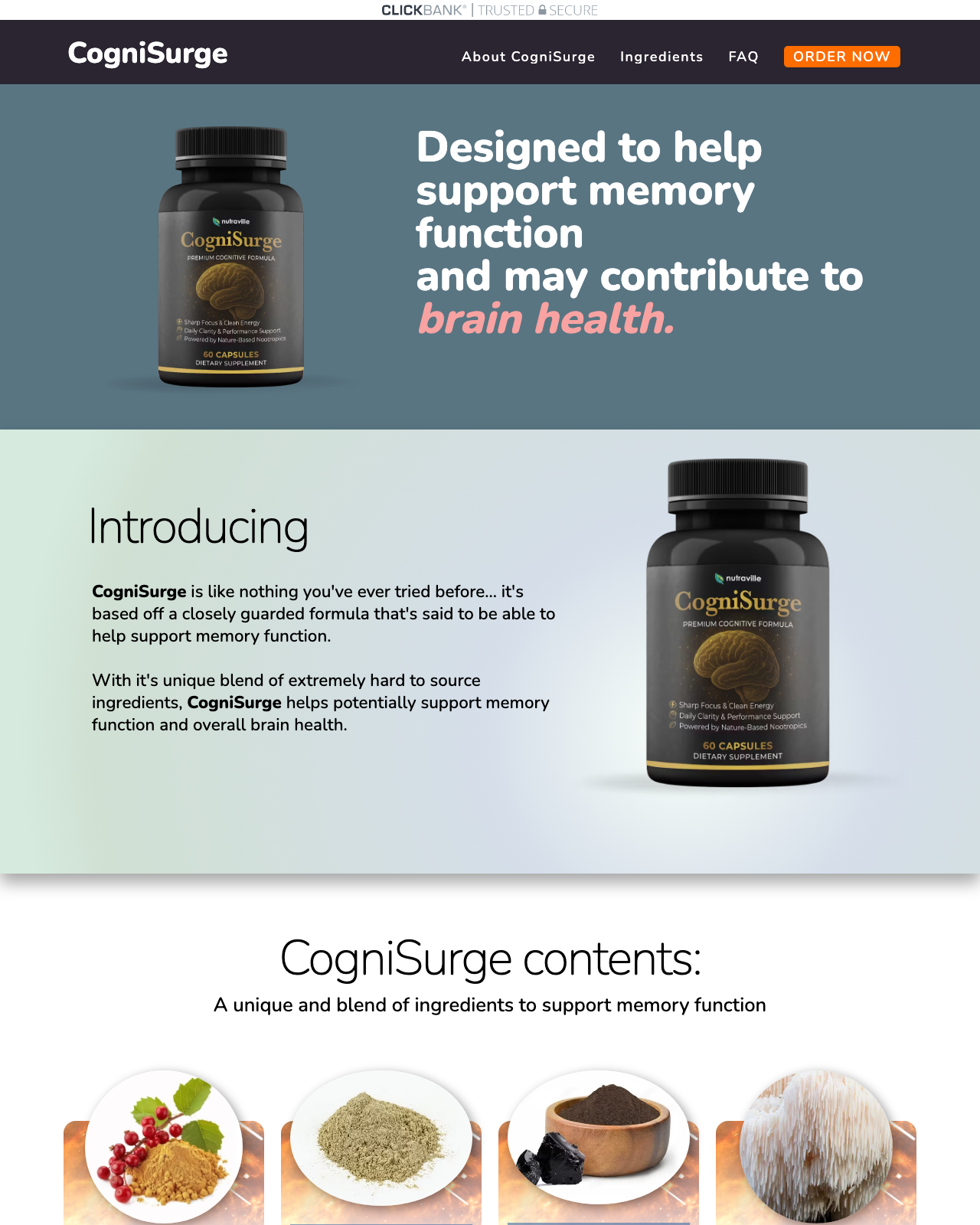
This is the live CogniSurge – 2025 Advanced Memory Supplement Driving High EPC funnel our verdict is based on. We measure these on-page promises against the evidence, dose math, price, and refund mechanics above — tap the image to see the seller’s current offer and terms.
 Live sales page →
 Here's what I'd actually do
If you opened this at 11 pm and the page made the supplement look like an answer to something larger:
Close this tab. CogniSurge – 2025 Advanced Memory Supplement Driving High EPC is in the band where the marketing is doing the heavy lifting and the formula is not. There are evidence-based versions of every promise on that sales page, and most of them cost a third of the price with full label transparency.
Don't buy this if: Do not buy this if you have a diagnosed condition that this product is implicitly addressing. See a clinician. A $69 bottle does not replace a $0-with-insurance lab panel.
— Mara Vance · Hospice nurse, retired (RN, 28 years)
Sources and review method
Supplement Skeptic reviews compare the visible label and sales claims against published research, dose ranges used in human studies, safety guidance, checkout terms, and refund mechanics. This page is not medical advice.
- Vendor sales page — ClickBank-listed sales page (active as of catalog import)
Frequently asked questions
- Is CogniSurge a scam?
- No, in the sense that you'll receive a bottle with some ingredients inside. But calling it a scam misses the real problem: the formula is a black box, the price is inflated, and the marketing implies a level of scientific certainty the product doesn't earn. It's a bad deal, not an empty box.
- What's actually in CogniSurge?
- The sales page highlights Shilajit, Bacopa Monnieri, Lion's Mane, and DHA, but the full ingredient list and exact amounts are locked inside a proprietary blend. Without those numbers, you can't tell if the doses match the studies the marketing cites.
- How does the 60-day refund work for a supplement?
- ClickBank's policy allows refunds within 60 days, but for physical goods, the vendor can require you to return the product — often unopened. The CogniSurge sales page doesn't clarify whether opened bottles qualify. In practice, supplement refunds through ClickBank can be a hassle, and you may eat the cost if you've tried the product.
- Will CogniSurge improve my memory?
- There's no direct evidence that this specific formula improves memory. Some of the named ingredients have small studies suggesting modest cognitive benefits, but those studies used known doses — which CogniSurge doesn't disclose. You're betting $130 that the blend is dosed right, and that's a bet with poor odds.
More in Dietary Supplements