Review · Dietary Supplements
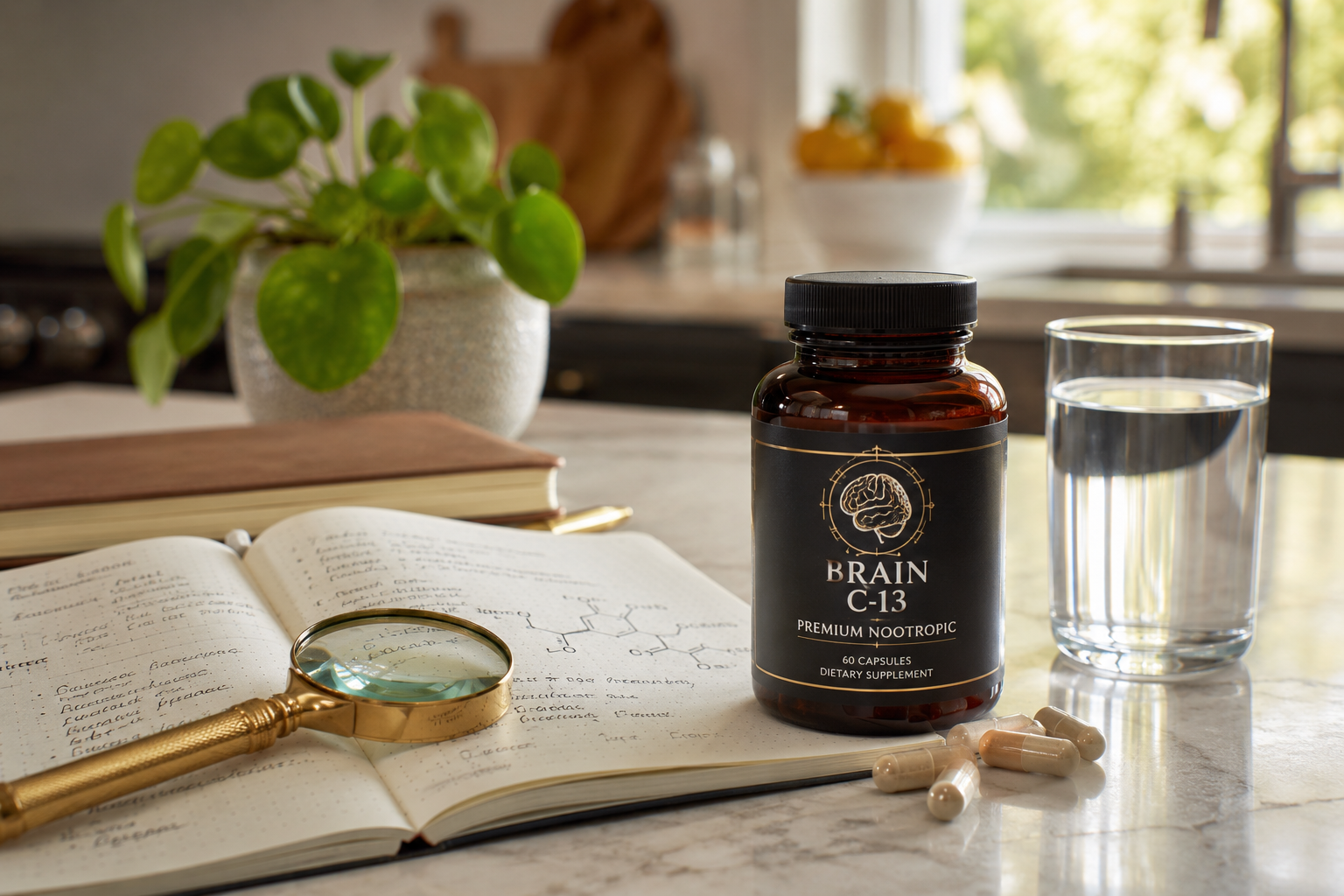
Brain C-13
A $119 nootropic sold on promoter metrics, not ingredient transparency; the refund window is real, but the marketing is designed for promoters, not buyers.
Skeptic read
Skeptical3.2/10
A $119 nootropic sold on promoter metrics, not ingredient transparency; the refund window is real, but the marketing is designed for promoters, not buyers.
- Price checked
- $119
- Dose visibility
- Better than average: key doses are disclosed enough to compare
- Main risk
- The entire sales pitch is written for affiliates ('Proven funnel. Serious payouts.'), not for the person swallowing the pills
- Better use case
- Curiosity buyers willing to spend $119 to reverse-engineer the formula inside the refund window
- Skip if
- You expect to see an ingredient label before you hand over $119
- Evidence file
- 1 source attached
What Brain C-13 actually is (and what it isn’t)
Brain C-13 is a ClickBank brain health supplement sold at $119 per bottle. That’s what the checkout page says. What the product page says is something else entirely.
The vendor’s own description — the one fed to the ClickBank marketplace — reads like an affiliate recruitment poster: “Trusted vendor. Proven funnel. Serious payouts. Brain C13 delivers elite EPCs and a rock-solid AOV. CPA + Rev Share both on deck.” This is not a supplement label. This is a pitch to people who will sell the supplement, not to the people who will swallow it.
When a supplement company leads with their earnings per click instead of their ingredient list, the product is the funnel. The pills are secondary. That doesn’t automatically mean the pills are inert — but it does mean the company’s first priority is conversion math, not your cognitive health.
What you actually get
You get one bottle of Brain C-13. That’s it. No quantity is specified on the sales page, no ingredient panel, no dosage instructions visible before you click “buy.” You are purchasing a black box with a 60-day return policy.
The front-end price is $119, one-time. There may be upsells after checkout — that’s standard for this kind of funnel — but they aren’t disclosed upfront. The refund is handled by ClickBank, not the vendor, so you can get your money back even if the vendor disappears. That’s the one piece of this that isn’t marketing theater.
How the marketing oversells
The entire sales page is an oversell. The copy that the vendor submitted to ClickBank — the copy that appears in the marketplace and gets scraped by affiliate tools — doesn’t mention a single ingredient. It mentions EPCs, AOV, CPA, Rev Share. These are affiliate-network metrics, not health claims.
“Elite EPCs” means the sales page converts well when affiliates send traffic. “Rock-solid AOV” means the average order value is high — likely because of upsells. “CPA + Rev Share both on deck” means the vendor is flexible about how affiliates get paid. None of this tells you whether Brain C-13 contains anything that crosses the blood-brain barrier.
This is not a product being sold on its merits. It’s a product being sold on its ability to be sold. If the formula worked, the vendor would lead with the formula. They didn’t.
What it costs and how the refund works
$119 one-time at the front end. No recurring billing was surfaced at the cart on the date we checked. That’s the good news.
The refund is the standard ClickBank 60-day policy. You email ClickBank support with your order ID, and the refund processes in a few days. The vendor cannot slow-walk you, because ClickBank holds the funds. This is the only reason to even consider buying Brain C-13 — you can try it and get your money back if it’s bunk. But you’re still out $119 for up to a week while the refund clears, and you’re the one doing the unpaid labor of testing an unlabeled product.
Who should buy, who should skip
Buy this if you are a professional supplement reviewer who wants to document the funnel and the formula for public interest, and you’re willing to eat the $119 if the refund fails (it won’t, but that’s the risk). Or if you’re an affiliate who wants to reverse-engineer the funnel — but you’re not the buyer we’re writing for.
Skip this if you want a nootropic with a published ingredient list. Skip this if you want a supplement company that treats you like a customer instead of a conversion pixel. Skip this if $119 is meaningful money and you’d rather spend it on a product that tells you what’s in the bottle.
The honest read
Brain C-13 is a supplement-shaped object built to convert, not to treat. The vendor’s own words prove it: they’re selling the payout, not the pill. The 60-day refund is the only thing that keeps this from being a complete pass. If you’re deeply curious, buy it, document the label, and refund it. Otherwise, your $119 is better spent on a nootropic that actually lists its ingredients.
— Mara Vance
Here's what I'd actually do
If you opened this at 11 pm and the page made the supplement look like an answer to something larger:
Close this tab. Brain C-13 is in the band where the marketing is doing the heavy lifting and the formula is not. There are evidence-based versions of every promise on that sales page, and most of them cost a third of the price with full label transparency.
Don't buy this if: Do not buy this if you have a diagnosed condition that this product is implicitly addressing. See a clinician. A $69 bottle does not replace a $0-with-insurance lab panel.
— Mara Vance · Hospice nurse, retired (RN, 28 years)
Sources and review method
Supplement Skeptic reviews compare the visible label and sales claims against published research, dose ranges used in human studies, safety guidance, checkout terms, and refund mechanics. This page is not medical advice.
- Vendor sales page — ClickBank-listed sales page (active as of catalog import)
Frequently asked questions
- Is Brain C-13 a scam?
- Probably not in the legal sense — you'll get a bottle of something, and the refund is honored. But the sales page hides the product behind affiliate hype, which is a red flag. You're buying a black box.
- What's actually in Brain C-13?
- We don't know. The sales page doesn't list ingredients, dosages, or a Supplement Facts panel. For a $119 supplement, that's unacceptable. You're expected to buy on faith and a VSL.
- Can I get my money back?
- Yes, through ClickBank's 60-day refund policy. Contact ClickBank support with your order ID within 60 days, and the refund processes in a few days. The vendor can't block it.
- Why is the sales page so focused on affiliates?
- Because the product is built to sell through affiliate traffic, not through word-of-mouth from satisfied users. When the pitch is 'elite EPCs,' the real customer is the affiliate, not the end user.
More in Dietary Supplements