
From the Supplement Skeptic desk · our own diagnostic report
Weight Loss Supplement Buyer's Gauntlet
Compare 10+ weight-loss supplements ranked by dose transparency, refund safety, and affiliate risk.
Weight-loss supplements like caffeine+EGCG show modest effects (1.3–1.4 kg average) in 12-week studies at documented doses, yet most retail bottles underdose or hide amounts in "proprietary blends." This diagnostic audit ranks 10+ popular brands by dose transparency, third-party testing, refund-guarantee honesty, and affiliate-risk flags—so you can stop guessing and know exactly what science says your money is buying.
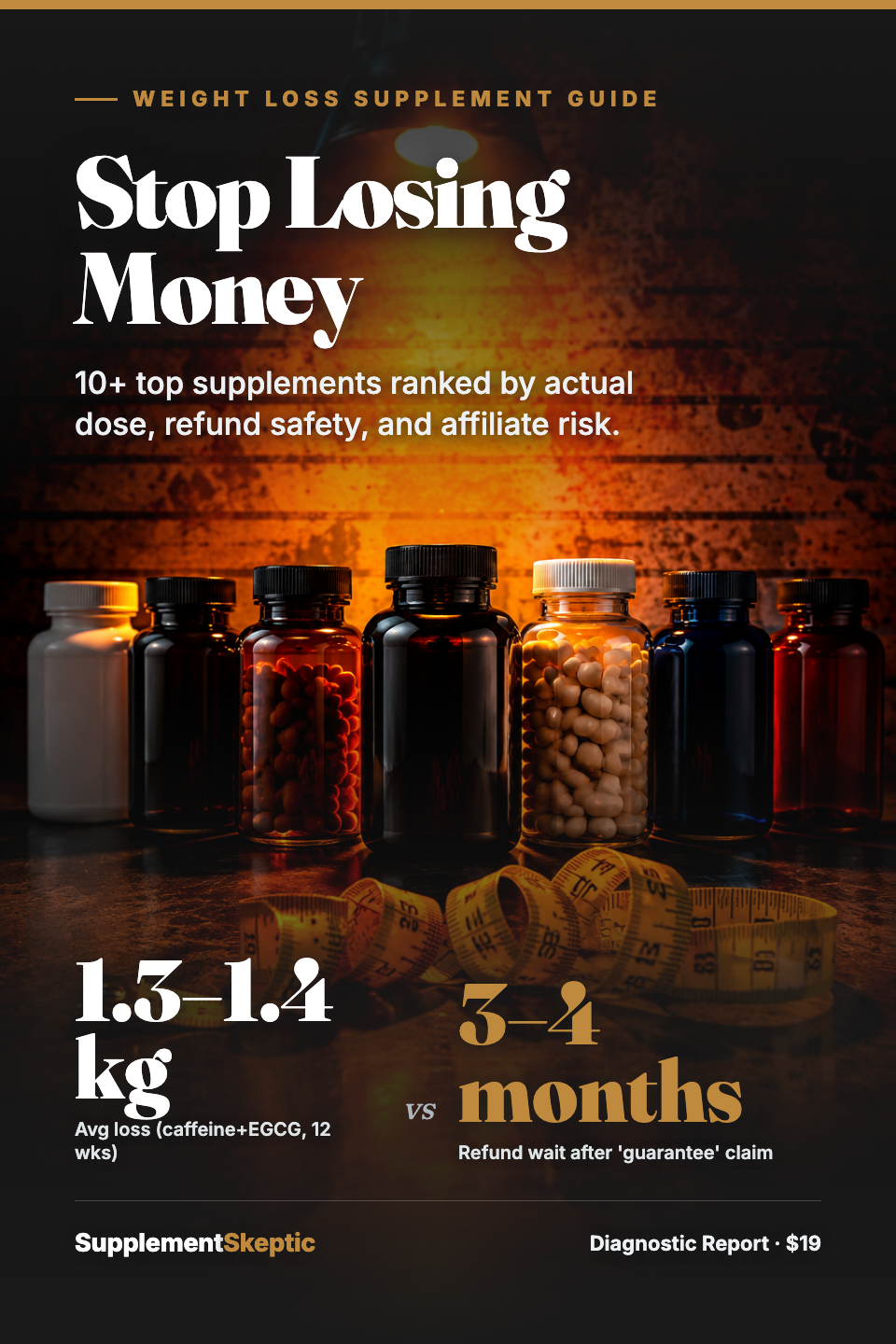
- 1.3–1.4 kg
- Avg weight loss in caffeine+EGCG meta-analyses (12 weeks)
- 57%
- Powder supplements hold market share—but dose hiding common
- 3–4 months
- Actual refund timelines after 'money-back guarantee' claims
- $0
- Affiliate commission — we sell no supplements
- Format
- diagnostic report
- Price
- $19
- Delivery
- Instant download
- Refund
- 30 days
- See the exact studied dose for 10+ ingredients (caffeine, EGCG, chromium, etc.) and check if your label matches.
- Spot the five refund-trap tactics: fake guarantees, buried cancellation policies, slow processing, fake-review sites, and affiliate deepfakes.
- Compare cost-per-studied-dose across top brands—reveal the overpriced and underdosed products.
- Verify third-party testing status (NSF, USP, ConsumerLab) and spot labels hiding ingredient amounts.
- Get a plain-English 'is this worth it?' scorecard—not a sales pitch or influencer hype.
- Understand the affiliate risk behind each product's marketing (which sellers benefit from commissions).
Free 60-second audit
Which weight-loss supplement mistake are you about to make?
Answer 4 quick questions about your goals, budget, and health. We'll predict which trap you're most likely to fall into—and show you the gauntlet audit.
-
1 What's your primary goal with a weight-loss supplement?
-
2 How much are you willing to spend per month?
-
3 When you've bought supplements before, what usually happened?
-
4 How important is a real refund guarantee to you?
-
Your result
Here's your personalized audit path
Get the gauntlet audit — $19 →Based on your answers, the Buyer's Gauntlet report is tailored to highlight the traps most likely to catch you. If you're budget-conscious, the audit shows cost-per-studied-dose comparisons. If you've been burned by subscriptions before, it teaches you the five refund-trap tells.
The full diagnostic includes the side-by-side dose table, the refund-trap decoder, and the third-party testing checklist—so you walk into the supplement aisle (or online store) knowing exactly which products are evidence-backed and which are hype.
The gauntlet
You’ve narrowed it down to a few weight-loss supplements. One promises “clinically proven” results. Another costs half as much but hides the dose. A third says you can cancel anytime but refund complaints flood Reddit. A fourth went viral on TikTok but a quick Google reveals affiliate commissions of 50%.
This is the gauntlet. And most buyers lose money in it.
What the evidence actually says
Caffeine + EGCG (green tea catechin) together produce an average weight loss of 1.3–1.4 kg over 12 weeks in meta-analyses of randomized controlled trials. That’s real, but modest — roughly 3–5 pounds for most people, and only if:
- The dose matches studies (100–460 mg EGCG + 80–300 mg caffeine).
- You take it consistently for at least 12 weeks.
- Your diet and activity stay the same (the supplement adds a small boost, not a transformation).
Chromium picolinate shows about 0.5 kg average loss — below the clinical threshold of meaningful weight reduction.
Most retail weight-loss supplements either underdose these ingredients or hide the amount entirely in a “proprietary blend.” That’s not a safety measure; it’s a red flag.
The five traps
1. The fake guarantee. “Money-back guarantee” sounds safe until you try to claim it. Real refunds take 3–4 months, have buried conditions in privacy policies, and many companies simply deny them or send a replacement shipment instead of a refund. The FTC has issued multiple enforcement actions for this exact tactic.
2. The subscription trap. A “discounted first bottle” quietly enrolls you in monthly billing. Cancellation is deliberately hard to find (sometimes only via phone or chat). By the time you notice the charge, you’ve already been billed 2–3 times.
3. The proprietary blend. When a label says “proprietary blend 500mg,” you have no way to know how much caffeine, EGCG, or filler you’re actually getting. Studies use specific doses. A proprietary blend could have 50 mg of the active ingredient buried under “other botanicals.”
4. The affiliate deepfake. Many weight-loss supplements are sold primarily through affiliate commissions (15–75% per sale). High commissions incentivize extreme marketing: fake before/after photos, deepfake celebrity endorsements, fake review sites, and LLM-generated testimonials. The product isn’t designed for results; it’s designed to be sold.
5. The interaction risk. Caffeine, synephrine, and thermogenic ingredients can interact with blood pressure meds, thyroid meds, heart conditions, and stimulant medications. Rare, but serious. Most labels don’t even mention this.
Who this is for
People shopping for weight-loss supplements who want to:
- Know which products actually have the studied dose (and which are underdosed or hiding it).
- Spot refund traps before they buy.
- Understand affiliate risk and discount the hype accordingly.
- Verify third-party testing claims.
- Review medication/supplement interactions before starting.
- Make an informed decision: “Is this worth my money and my time?”
The gauntlet audit runs you through all of this in 32 pages — so you walk out with clarity instead of regret.
This is consumer education, not medical advice. Weight-loss supplements and medications carry real risks and interactions. Review any supplement changes with a licensed clinician, especially if you take medications or have underlying health conditions.
What's inside
- 32-page PDF diagnostic report (instant download)—compare side-by-side, bookmark, share.
- The Ingredient Dose Audit table—10+ popular weight-loss supplements vs. studied doses (60-second check).
- The Refund Trap Decoder—5 deceptive tactics and how to spot them on any label or sales page.
- The Third-Party Testing Checklist—NSF, USP, ConsumerLab verified; which brands pass, which hide it.
- The Affiliate Risk Guide—which products are sold primarily via commission, and what that means for marketing claims.
- A YMYL-safe 'talk to your doctor' checklist—drug interactions, contraindications, baseline bloodwork recommendations.
Frequently asked
Do any weight-loss supplements actually work?
Yes, but modestly and only at studied doses. Caffeine + EGCG (green tea extract) together show roughly 1.3–1.4 kg of average weight loss over 12 weeks in meta-analyses—a real but small effect. Chromium picolinate shows about 0.5 kg average loss, which doesn't meet the clinical threshold of ≥5%. The problem is most retail bottles underdose, hide amounts in 'proprietary blends,' or stack ingredients at non-studied levels. The gauntlet helps you spot what actually has data.
What's the most-studied weight-loss supplement dose?
Caffeine + EGCG studies typically use 80–300 mg caffeine daily with 100–460 mg EGCG for at least 12 weeks. Most retail 'fat burners' either hide the dose or use sub-studied amounts. The gauntlet has a 60-second dose-audit worksheet so you can check your bottle against the real research.
Why do so many weight-loss supplements offer 'money-back guarantees' that never pay?
It's a marketing tactic. Real refunds take 3–4 months, have buried conditions in privacy policies, and many companies simply deny them or send a replacement instead. The FTC has issued multiple enforcement actions. The gauntlet decodes the five most common refund traps so you know what to look for before you buy.
What's an 'affiliate risk' and why does it matter?
Products sold primarily through affiliate commissions (often 15–75% per sale) incentivize extreme marketing claims, fake reviews, and deepfake celebrity endorsements. Affiliate-driven sites don't control their marketing but profit from inflated promises. The gauntlet shows which products have high affiliate risk so you can discount the hype accordingly.
What does 'third-party testing' actually mean?
Third-party testing (NSF, USP, ConsumerLab) means an independent lab verified the label claims and checked for contaminants, banned substances, or undeclared ingredients. Most weight-loss supplements skip this (it costs $500–2,000+ per product). The gauntlet shows which brands pass testing and which hide it.
Should I take a weight-loss supplement if I'm on blood pressure or thyroid medication?
Many weight-loss ingredients (especially caffeine, synephrine, and thermogenics) interact with heart and thyroid medications. The gauntlet includes a YMYL-safe checklist to review with your doctor before starting. This is not medical advice—always consult a licensed clinician.
Get Weight Loss Supplement Buyer's Gauntlet — $19
Secure checkout · card details stay on this page · 30-day money-back guarantee · instant download.
Sources
- EGCG and Caffeine for Weight Loss: Meta-Analysis of Randomized Controlled Trials (PMC) — 1.3–1.4 kg average weight loss with caffeine+EGCG at 100–460 mg EGCG + 80–300 mg caffeine over 12 weeks.
- Chromium Picolinate for Weight Loss: Meta-Analysis (PMC) — 0.50 kg average weight loss; 11 RCTs, 866 subjects. Doses 137–1,000 mcg/day for 8–24 weeks.
- FTC: Refunds to Consumers Harmed by Weight-Loss Supplement Marketers' Deceptive Claims (2025) — Enforcement action documenting refund denials, fake review practices, and deceptive guarantee tactics.
- FTC Consumer Alert: New Year, New Weight Loss Scams (2023–2026) — Common deceptive tactics: free trial traps, subscription locks, fake reviews, affiliate deepfakes.