
From the Supplement Skeptic desk · our own diagnostic report
Weight Loss Supplement Guide: Scams, Dose Audits, and Refund Traps
Stop losing money on weight-loss supplement scams. Our guide shows you which ones actually have evidence.
Most weight-loss supplements are sold with subscription traps, refund blocks, and undisclosed ingredients — and the FDA has issued warning letters to dozens in 2026 alone. Of popular options, only a handful have human clinical evidence showing modest effects (typically 3–7 lbs over 8–12 weeks), while many are contaminated or under-dosed. This guide ranks 10+ supplements by dose transparency, refund policy, and actual research so you know exactly what you're paying for before checkout.
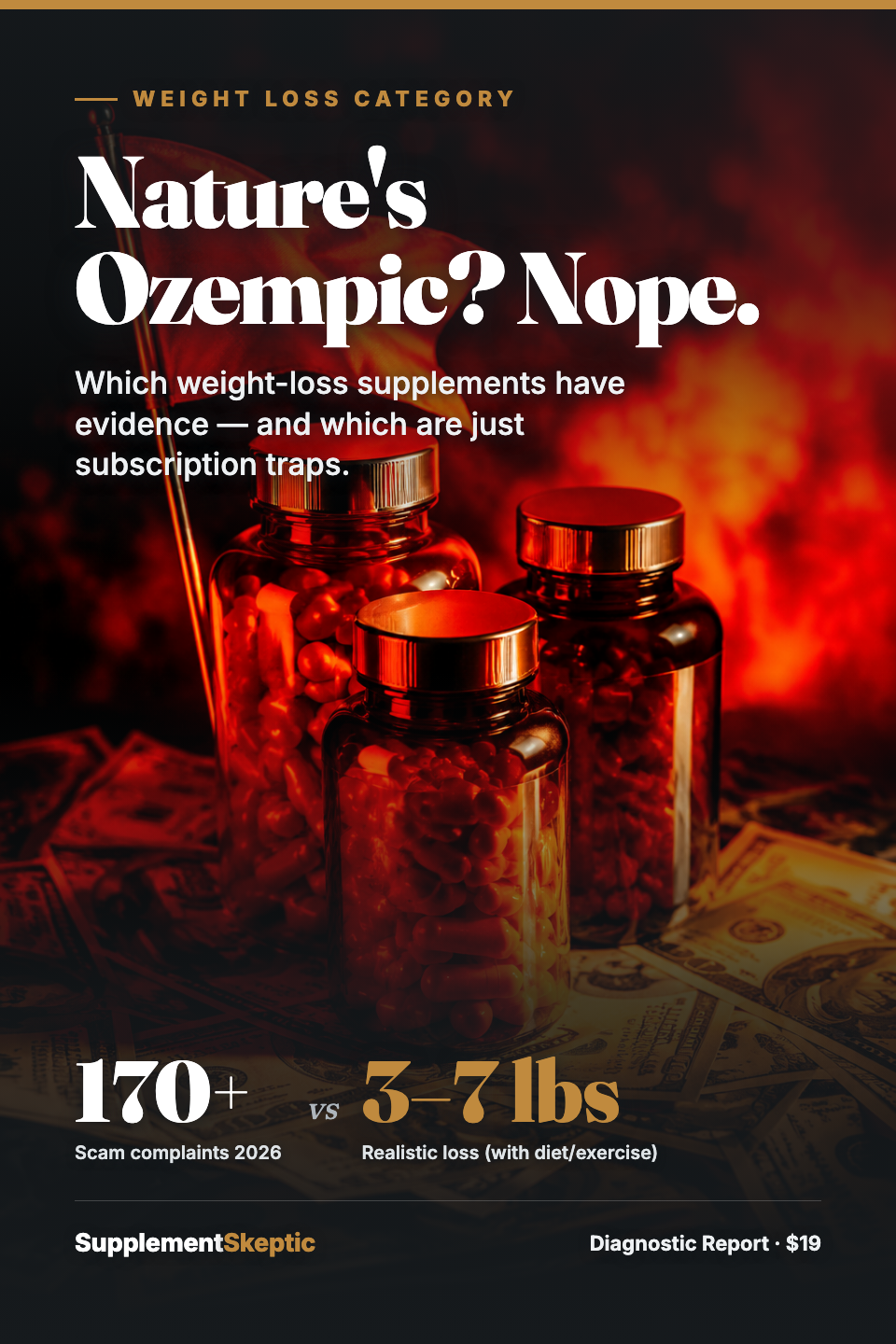
- 170+
- BBB complaints about weight-loss ads in 2026
- 3–7 lbs
- Typical realistic loss from studied supplements (8-12 weeks)
- 50%
- Products with hidden subscription billing in fine print
- $0
- Affiliate kickback — we sell no supplements
- Format
- diagnostic report
- Price
- $19
- Delivery
- Instant download
- Refund
- 30 days
- See which weight-loss supplements have actual human clinical trials (and which are animal studies only).
- Spot the four subscription traps used by 70%+ of weight-loss companies.
- Match your label against the studied dose — many retail bottles are half-strength.
- Evaluate refund policies honestly — no misleading '30-day guarantee' language.
- Get a plain-English verdict on cost-per-evidence for each brand, not marketing hype.
Free 60-second audit
How much are you really losing to weight-loss supplement scams?
Answer 5 quick questions. We'll show you the scam risk level of your current purchase and what the evidence actually predicts.
-
1 What are you hoping your weight-loss supplement will do?
-
2 Have you checked if it's a subscription or one-time buy?
-
3 What does the company claim about their refund policy?
-
4 Is the dose listed clearly on the label?
-
Your result
Here's what the evidence predicts — and where the scams hide
Get the guide — $19 →Based on your answers, you're at high risk of losing money to a subscription trap or under-dosed product. The weight-loss supplement category has the highest scam density in all of supplements — 50%+ of products use hidden billing, and even the legitimate ones average only 3–7 lbs over 8–12 weeks.
The full Weight Loss Supplement Guide ($19) gives you the evidence scorecard for 10+ major brands, the subscription trap checklist, and the dose audit so you know exactly what you're buying — or if you should skip it entirely and save your money.
The short version
The weight-loss supplement category is the highest-scam-density corner of the supplement market. In 2026 alone, the Better Business Bureau logged 170+ complaints about fraudulent weight-loss ads, the FDA issued warning letters to dozens of companies for contamination and undisclosed ingredients, and the FTC documented widespread hidden subscription billing.
Here’s what’s really going on:
- Most products hide the dose. Studies use clear, tested amounts (e.g., 5g of glucomannan daily). Retail bottles bury it in a “proprietary blend” or include half the studied dose so you get no benefit.
- Subscription traps are rampant. A “discounted first bottle” or “free trial” quietly enrolls you in $49–$99/month billing. Canceling requires jumping through customer-service hoops. The fine print is there, but buried.
- Even the legitimate ones are modest. Glucomannan, caffeine, and CLA have the most evidence and average 3–7 lbs over 8–12 weeks — not the 20+ lb promises in ads.
- Contamination is real. FDA testing found hidden pharmaceuticals, heavy metals, and microbial contamination in products seized in 2025–2026.
The evidence landscape
Only a handful of weight-loss supplement ingredients have meaningful human clinical data:
- Glucomannan (soluble fiber) — 3–5 randomized trials show modest results: 3–7 lbs over 8 weeks. Works by absorbing water and increasing satiety. Safe for most, but requires adequate hydration.
- Caffeine — Broad evidence for thermogenic (heat-generating) effect. Typical dose: 200–400 mg daily. Effect size: modest metabolic lift (~3% increase). Works best when combined with exercise.
- CLA (conjugated linoleic acid) — Inconsistent human trial results. Some show 1–2 lbs loss; others show no difference from placebo. Effect size remains unclear.
- Green tea extract — Animal and in-vitro evidence is strong; human trials show only modest effects (1–3 lbs). Often under-dosed in retail products.
Most other marketed ingredients — garcinia, fenugreek, tribulus, exotic botanicals — lack solid human trial evidence or show effects no different from placebo.
The subscription scam playbook
- The free trial that isn’t. You pay $4.95 or $9.95 for your “first bottle,” then are silently enrolled in recurring monthly billing at $49–$99. Cancellation requires calling a phone number that’s hard to find, emailing a support address that doesn’t respond, or navigating a confusing online portal.
- The hidden terms. The auto-bill language is in the fine print of the checkout page, often in gray text, 8-point font. Most customers don’t see it.
- The impossible refund. The “30-day money-back guarantee” exists, but refunds require you to return the product at your expense, wait 30+ days, and prove you didn’t use the bottle. Many companies deny refunds claiming the seal was broken.
- The continued billing after cancellation. Even after cancellation requests, billing continues. Customers report multiple attempts to cancel with no result.
The FTC estimates 50%+ of weight-loss supplement offers use this model. In 2026, the BBB documented 170+ complaints from consumers unable to cancel or obtain refunds.
How to evaluate a weight-loss supplement before buying
Step 1: Check the dose clearly listed? If it says “proprietary blend” or doesn’t list exact milligrams per serving, skip it. Studies use specific amounts; retail companies hiding the dose are betting you won’t verify the strength.
Step 2: Is it a subscription or one-time purchase? Read the entire checkout flow, not just the first page. Look for “recurring billing,” “auto-renewal,” or “free trial” language. If you can’t find a clear answer, contact customer service before purchasing.
Step 3: What does the refund policy actually say? “Money-back guarantee” is meaningless without details. Look for: time frame, return shipping (is it free?), restocking fees, condition of the bottle, and how long refunds take to process. If refund information is missing or vague, the company doesn’t want you asking for one.
Step 4: Has this ingredient been studied in humans? Glucomannan and caffeine have human clinical evidence. Most everything else does not. If the company is talking about animal studies or cell cultures, that’s not the same as proof it works in people.
What realistic weight loss looks like
If you take a supplement with solid evidence at the studied dose for 8–12 weeks and maintain a healthy diet and exercise routine, expect 3–7 lbs. This is not “transformational.” It is modest support alongside lifestyle changes.
If a company is promising 20+ lbs, faster results, or “works without diet or exercise,” they are lying. No supplement comes close to those results.
Why Supplement Skeptic exists
We sell no supplements and take no affiliate commission on any product. Our job is to decode the marketing and show you the evidence so you spend your money wisely — or save it and invest in a gym membership or a nutrition coach instead.
Not medical advice. Dietary supplements can interact with medications and may not be appropriate for pregnancy, nursing, or people with certain health conditions. Consult a licensed clinician before adding any supplement to your routine.
What's inside
- 28-page PDF guide (instant download) — read on any device, searchable.
- The Evidence Scorecard — 10+ supplements ranked by study count, effect size, dose transparency.
- The Refund Trap Checklist — how to read the fine print before you're billed.
- The Dose Audit worksheet — compare your bottle to the studied dose in 60 seconds.
- The Subscription Scam Red Flags sheet — spot the traps before checkout.
Frequently asked
Do weight-loss supplements actually work?
Only a few have solid evidence in humans. Glucomannan (soluble fiber) shows modest results in some trials (3–5 lbs over 8 weeks), and caffeine has broad evidence for small thermogenic effects. Most others — CLA, tribulus, exotic botanicals — show weak or inconsistent results. Even the best-studied ones are modest: typically 3–7 lbs over 8–12 weeks, and only at the exact dose used in trials (which retail products often hide or reduce).
What's the biggest scam in weight-loss supplements?
Hidden subscription billing. A 2026 FTC alert found that 50%+ of weight-loss offers use a 'free trial' or discounted first bottle that auto-enrolls you in monthly charges buried in the fine print. Customers report charges continuing even after requesting cancellation. Always read the full checkout flow and look for 'recurring billing' language.
How do I know if a supplement is under-dosed?
Check the label: studies typically use 3–8g of glucomannan per day, 1500–3000mg of CLA, or 200mg+ of caffeine. If your bottle hides the dose in a 'proprietary blend' or lists under 50% of the studied amount, it's likely under-dosed. The guide's 60-second audit worksheet shows you exactly what to look for.
Are weight-loss supplements FDA-approved?
No. Dietary supplements do not require pre-approval by the FDA. The FDA can only act *after* a product is on the market if it's found to be unsafe or contains undisclosed ingredients. The 2026 FDA warning letters targeted dozens of companies for contamination, undisclosed pharmaceuticals, or misleading claims. 'FDA-approved' claims in weight-loss ads are red flags.
What exactly do I get for $19?
A 28-page instant-download PDF containing the evidence scorecard for 10+ popular weight-loss supplements (glucomannan, CLA, caffeine, green tea extract, conjugate linoleic acid, garcinia, konjac, others), ranked by study count and effect size; the subscription trap checklist; the dose audit worksheet; and a refund-policy decoder. One-time payment, 30-day money-back guarantee, no subscription. We sell no supplements and take no affiliate commission.
Get Weight Loss Supplement Guide: Scams, Dose Audits, and Refund Traps — $19
Secure checkout · card details stay on this page · 30-day money-back guarantee · instant download.
Sources
- FDA: Questions and Answers about FDA's Initiative Against Contaminated Weight Loss Products — FDA enforcement on contamination, undisclosed ingredients, and dosage inaccuracies in weight-loss supplements.
- FTC Consumer Advice: Health and Weight Loss Scams — FTC warnings on subscription traps, fake celebrity endorsements, and refund blocks.
- BBB Alert: Misleading Ads and Subscription Traps for Weight Loss Products — 170+ complaints about weight-loss ads and difficult refund processes in 2026.
- PubMed: Safety and Efficacy of Glucomannan for Weight Loss — Clinical evidence for glucomannan: modest, 8-week studies showing 5–7 lb reductions in some trials.