
From the Supplement Skeptic desk · our own diagnostic report
Third-Party Testing Verification & Audit Report
NSF? USP? ConsumerLab? Learn what third-party testing actually means—and which supplements pass.
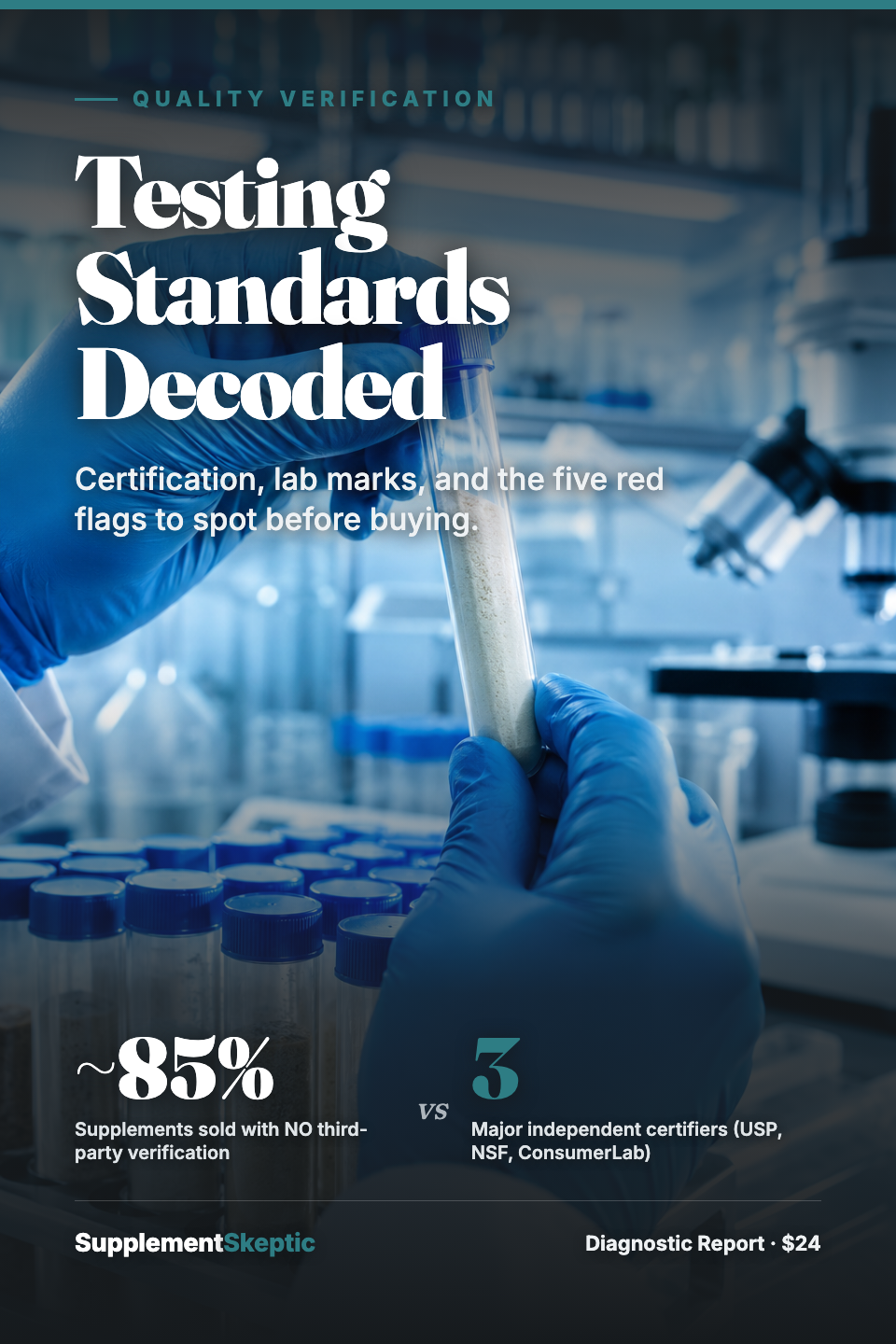
Most supplements are never independently tested. NSF, USP, and ConsumerLab are the major third-party certifiers, each with different testing models—USP and NSF audit manufacturing facilities, while ConsumerLab buys products off-shelf without manufacturer knowledge. A supplement displaying one of these logos is more likely to contain what the label claims and be free of major contaminants; however, the absence of certification doesn't automatically mean a product is counterfeit or unsafe—it means you have no independent verification.
- 3
- Major third-party certification programs
- 314
- FDA warning letters issued in 2025
- Heavy metals, pesticides, microbes
- Common contaminants tested
- $0
- Affiliate kickback — we sell no supplements
- Format
- diagnostic report
- Price
- $24
- Delivery
- Instant download
- Refund
- 30 days
- Understand the difference between USP, NSF, ConsumerLab, and Informed Sport — which one matters for your purchase.
- Learn how to read a Certificate of Analysis (COA) and spot a fake or incomplete report.
- Recognize the five red flags of unverified or counterfeit supplements.
- Know which certifications require facility audits vs. product-only testing.
- Get a brand-searchable database of commonly tested and verified supplements.
Free 60-second audit
Do you know what certification is actually on your supplement?
Answer 3 quick questions. We'll show you what the major certifications actually mean—and whether your bottle has real verification or just marketing.
-
1 What certification mark (if any) is on your supplement bottle?
-
2 Do you know what testing was actually done?
-
3 Have you checked if the brand was recalled or flagged by FDA?
-
Your result
Here's what your supplement's certification actually means
Get the audit report — $24 →Most supplements sold in stores have no third-party verification at all. If you see USP Verified, NSF Certified, or ConsumerLab Approved, that's a meaningful quality signal — it means an independent lab tested the product and confirmed it contains what the label claims, without major contaminants.
But the absence of a mark doesn't mean the product is fake — it just means you have no independent proof. The full Third-Party Testing Audit Report teaches you how to read Certificates of Analysis, which certifications matter, and how to spot the red flags that suggest a supplement was never independently tested.
The short version
You can’t tell if a supplement actually contains what the label claims just by looking at it. Counterfeits are rising. The FDA issued 314 warning letters in 2025 for supplement violations alone.
The honest news: Three major independent labs—USP, NSF, and ConsumerLab—test supplements and publish certifications. If you see one of their marks on a bottle, an independent party has verified the contents. If you don’t, you have no proof.
That doesn’t make an uncertified supplement a scam—it just means nobody has independently checked.
This audit report teaches you:
- Which certifications actually matter (and which ones don’t).
- How to read a Certificate of Analysis in 5 minutes.
- The five red flags that suggest a supplement was never verified.
- Which brands have passed major third-party testing (searchable database).
The certification landscape
All three major certifiers verify the same core things: Identity (is this actually what the label says?), Potency (is the dose correct?), and Purity (are there contaminants?). But they differ in model: USP and NSF require manufacturer submission and facility audits. ConsumerLab independently buys from shelves and tests blind. NSF Certified for Sport adds testing for 200+ banned athletic substances.
Red flags: What to watch for
- No certification mark at all (not automatic disqualification, but no independent proof).
- A vague “quality assured” logo with no recognizable certifier name.
- A Certificate of Analysis that doesn’t match the label.
- A COA with no lot number or date.
- The brand was flagged by FDA or appeared in a recall.
Who this is for
People buying supplements who want to know: Is this actually what the label claims? Before spending $30–$100/month on a supplement, you deserve proof that someone independent verified it.
This is consumer education, not medical advice. Supplement quality matters. Review any specific product or health concern with a licensed clinician.
What's inside
- 32-page PDF audit guide (instant download) — read on any device.
- The Third-Party Certification Comparison Table — USP vs NSF vs ConsumerLab decoded.
- Certificate of Analysis (COA) Decoder — how to read one in 5 minutes and spot fraud.
- The 5 Red Flags checklist — spot unverified or counterfeit supplements before purchase.
- The Verified Supplement Database — searchable list of brands that passed major third-party testing.
Frequently asked
What's the difference between USP, NSF, and ConsumerLab?
USP Verified and NSF Certified both require the manufacturer to submit the product, pass testing, and allow ongoing facility audits. ConsumerLab independently purchases supplements from retail shelves without manufacturer involvement and tests them blind. All three verify identity, potency, and purity; ConsumerLab is the only one that tests purchased products without the brand's cooperation. NSF Certified for Sport additionally tests for over 200 banned athletic substances.
Do I need a third-party certification to be safe?
No. Many safe, effective supplements are never third-party tested. However, a certification from USP, NSF, or ConsumerLab is strong evidence that the product contains what it claims and is free of major contaminants. It's especially reassuring if you're buying from an unfamiliar brand or in a category where counterfeits are common.
How do I read a Certificate of Analysis?
Look for: (1) the product name and lot number, (2) the date tested, (3) the lab name and credentials, (4) test results for identity (is it what it claims?), potency (is the dose correct?), and purity (any contaminants?). Red flags include missing lot numbers, undated reports, vague lab names, or results that don't match the supplement's label claims.
What if a brand claims 'made in a GMP facility' but has no third-party mark?
GMP (Good Manufacturing Practice) is a regulatory requirement, not a verification. It means the brand follows FDA guidelines during manufacturing, but no independent party has verified the claim. It's better than nothing, but not as strong as USP, NSF, or ConsumerLab certification.
What exactly do I get for $24?
A 32-page instant-download PDF containing the USP/NSF/ConsumerLab comparison table, how to read a COA, the five red-flag checklist, and a searchable database of commonly tested and verified supplement brands. One-time payment, 30-day money-back guarantee, no subscription. We sell no supplements and take no affiliate commission.
Get Third-Party Testing Verification & Audit Report — $24
Secure checkout · card details stay on this page · 30-day money-back guarantee · instant download.
Sources
- NSF Dietary Supplement and Vitamin Certification — Overview of NSF testing standards and certification marks.
- Quality Certification Programs for Dietary Supplements (JAND peer-reviewed) — Peer-reviewed comparison of USP, NSF, and ConsumerLab programs.
- ConsumerLab: Red Flags When Buying Supplements — Evidence-based guidance on common supplement quality issues.
- FDA: Food and Drug Alerts, Advisories & Safety Information — Current FDA warnings and recalls on adulterated or misbranded supplements.