
From the Supplement Skeptic desk · our own checklist
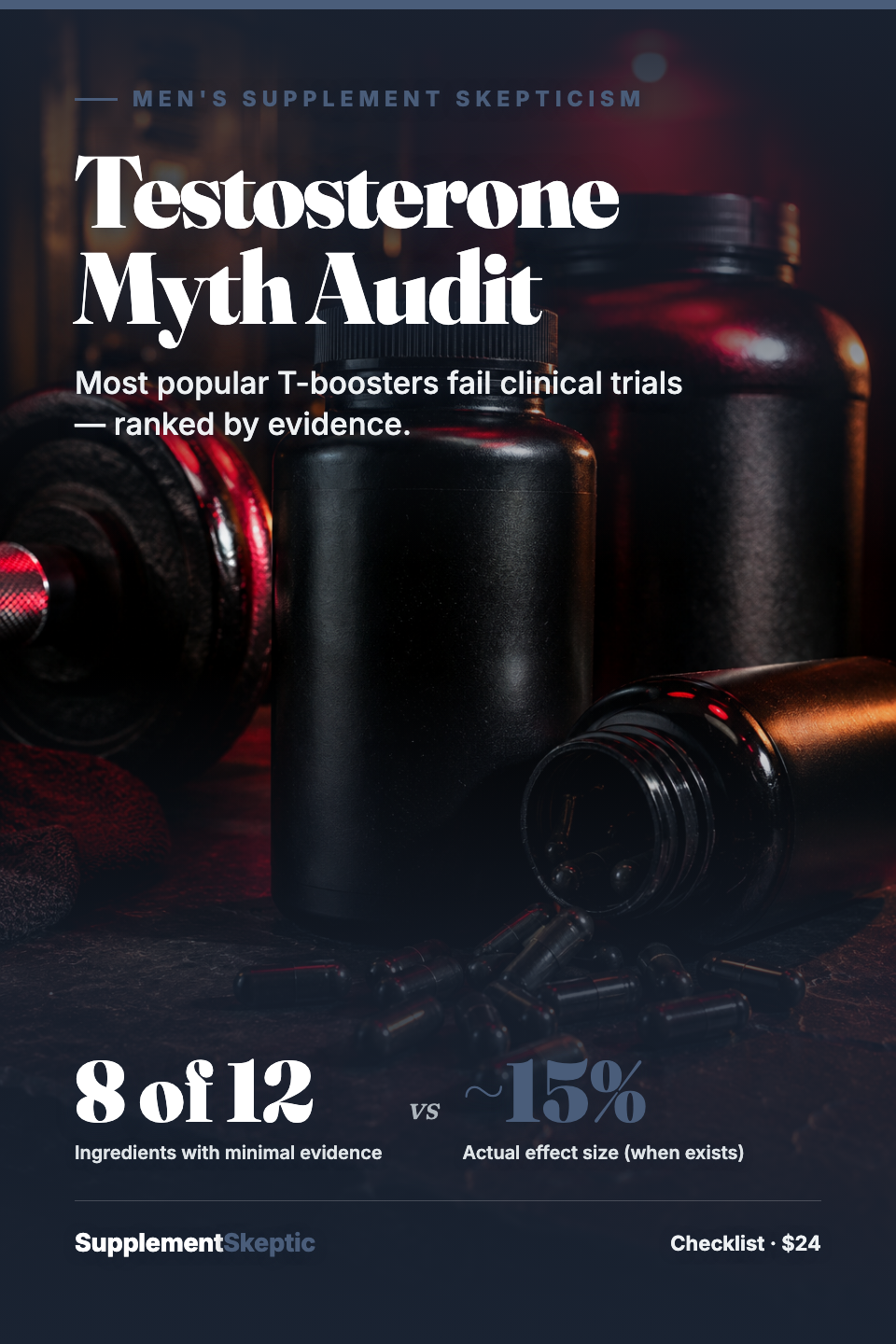
Testosterone Supplement Myth Audit
90% of testosterone boosters are hype. Here's what the research actually shows about T-boosting supplements.
Across clinical trials, most popular testosterone-boosting supplements either lack human evidence or produce only modest, inconsistent testosterone changes. Tribulus terrestris shows minimal effect in controlled studies; DHEA has heterogeneous evidence; fenugreek shows promise in small trials but effect sizes are modest. This audit ranks 12 common ingredients by evidence strength, studied doses, and whether the marketing matches the data.
- 8 of 12
- Popular T-boosters with zero or minimal clinical evidence
- ~15%
- Average modest effect when evidence exists (inconsistent)
- 250–500mg
- Typical studied dose (often underdosed in retail)
- $0
- Affiliate kickback — we sell no supplements
- Format
- checklist
- Price
- $24
- Delivery
- Instant download
- Refund
- 30 days
- Rank 12 testosterone ingredients by strength of clinical evidence and honesty.
- Check your bottle against the dose used in studies (spot under-dosing in 60 seconds).
- Recognize the six marketing red flags of a testosterone-booster scam.
- Understand which ingredients have any evidence and which are pure theater.
- Get a plain-English verdict: does it deserve a spot in your stack, or your money?
Free 60-second audit
Is your testosterone booster actually working?
Answer 3 quick questions. We'll show you what the evidence predicts — and whether your bottle is even dosed right.
-
1 What are you hoping a testosterone booster will do?
-
2 What ingredient(s) does your booster have?
-
3 Have you seen results after taking it?
-
Your result
Here's what the evidence says about your testosterone booster
Get the audit — $24 →Most testosterone-boosting supplements rely on marketing hype rather than clinical evidence. Popular ingredients like tribulus, fenugreek, and DHEA either lack human trials or show only modest, inconsistent testosterone lifts — and that's if your bottle is even dosed at the studied level.
The full Testosterone Supplement Myth Audit ranks 12 common ingredients by evidence, shows you the studied doses, and teaches you the 6 red flags — so you can decide whether your bottle is worth keeping or your money is better spent elsewhere.
The short version
Testosterone-boosting supplements are the most aggressively marketed corner of the supplement world — and also one of the least supported by clinical evidence.
Here is what the actual trials show:
- Most popular ingredients (tribulus, tongkat ali, D-aspartic acid, fenugreek) either have zero human trials or show inconsistent, modest effects on testosterone and sexual function.
- Tribulus terrestris, the category’s #1 ingredient by sales, consistently fails to raise testosterone significantly in controlled studies. Yet it dominates retail shelves.
- DHEA has more data but works inconsistently and carries regulatory concerns (potential estrogen elevation) in many countries.
- Fenugreek actually has the strongest clinical case — several small RCTs show modest improvements in testosterone and sexual function — but even that evidence is thin and studies are small.
- Zinc and vitamin D genuinely support testosterone if you are deficient; supplementing past adequate levels rarely raises it.
The category tricks you by selling the hope of testosterone, not the evidence of testosterone. This audit is a 60-second checklist to tell them apart.
How the category tricks you
- The borrowed-credibility ingredient. Tribulus has been used in Ayurvedic medicine for centuries. That’s not evidence it raises testosterone. Human trials say it does not.
- The hidden dose. Fenugreek studies use 600–1,200 mg daily; many retail bottles contain 250 mg in a proprietary blend. You cannot verify the studied dose.
- The stacked formula. Throwing ten ingredients into one capsule means none of them is at a studied dose, and you cannot tell which (if any) is active.
- The “natural testosterone support” language. “Support” is marketing language meaning “might do something, probably won’t.” Real evidence says “raises testosterone” or “does not.”
- The affiliate spam. Many testosterone-booster reviews are affiliate-driven. If the review recommends a product with a commission link, the review is about sales, not evidence.
- The before/after theater. Dramatic muscle-gain photos are almost never from a testosterone-booster trial. They are from gym plus diet plus sleep, not the bottle.
The full audit turns each into a 60-second check you can run on any label.
This is consumer education, not medical advice. Testosterone and sexual-function supplements carry real risks and can interact with medications or exacerbate hormone-sensitive conditions. Review any testosterone booster with a licensed clinician before starting, especially if you have cardiovascular or prostate concerns.
What's inside
- 24-page PDF checklist (instant download) — read on any device, print the audit checklist.
- The Evidence Scorecard — 12 testosterone ingredients ranked by study count, effect size, and dose transparency.
- The Dose Audit Worksheet — check your label against studied regimens in 60 seconds.
- The 6 Red Flags Cheat-Sheet — spot fake testosterone-booster marketing before you buy.
- A safety checklist — who should avoid T-boosters, common interactions, and when to consult a doctor.
Frequently asked
Do testosterone-boosting supplements actually work?
Some have modest evidence in small trials; most do not. Tribulus terrestris, the most popular ingredient, consistently fails to raise testosterone significantly in controlled studies. DHEA has heterogeneous results and regulatory status varies by country. Fenugreek shows promise in a few small trials for modest testosterone and sexual function support, but effect sizes are modest and study quality varies. Overall, the category is dominated by marketing claims rather than robust clinical evidence.
Which testosterone boosters have the best evidence?
Fenugreek has the strongest clinical case (several small RCTs showing modest improvements in testosterone and sexual function), followed by DHEA (heterogeneous evidence, regulatory status varies). Zinc and vitamin D support testosterone if you are deficient, but supplementing past adequate levels rarely raises testosterone. Tribulus, tongkat ali, and D-aspartic acid lack convincing human evidence despite marketing claims.
Why do most testosterone boosters fail the checklist?
Three reasons: (1) the ingredient has zero human trials; (2) human trials exist but show no or inconsistent testosterone rise; or (3) the retail product under-doses the ingredient relative to the studies. A proprietary blend that hides individual ingredient doses is a major red flag — you cannot verify the studied amount.
Are testosterone boosters safe?
Some ingredients carry real safety concerns — DHEA can raise estrogen and carries regulatory restrictions in many countries; tribulus may affect liver function at high doses; fenugreek can interact with blood thinners. Avoid if you have hormone-sensitive conditions or take medications affecting testosterone. This is general information, not medical advice; review any testosterone booster with a licensed clinician, especially if you have prostate concerns or are on medications.
What's the difference between 'natural testosterone support' and this audit?
'Natural' just means from a plant or food. It does not mean studied, effective, or safe. This audit focuses on evidence — did a controlled trial measure testosterone and sexual function? Most testosterone-boosting supplements fail that test. The audit also grades honesty: is the dose transparent or hidden in a proprietary blend?
What exactly do I get for $24?
A 24-page instant-download PDF containing the evidence scorecard ranking 12 ingredients, a dose-audit worksheet, the 6-red-flags cheat sheet, and a safety and interaction checklist. One-time payment, 30-day money-back guarantee, no subscription. We sell no supplements and take no affiliate commission on testosterone boosters.
Get Testosterone Supplement Myth Audit — $24
Secure checkout · card details stay on this page · 30-day money-back guarantee · instant download.
Sources
- PubMed: tribulus terrestris testosterone meta-analysis — Body of trials showing minimal or no significant effect on serum testosterone in humans.
- PubMed: fenugreek testosterone clinical trials — Modest evidence in small trials; heterogeneous results on testosterone and sexual function.
- PubMed: DHEA supplementation testosterone evidence — Heterogeneous evidence; regulatory status varies; potential for estrogenic effects.