
From the Supplement Skeptic desk · our own quiz report
Quiz: Which Supplement Myths Are You Believing?
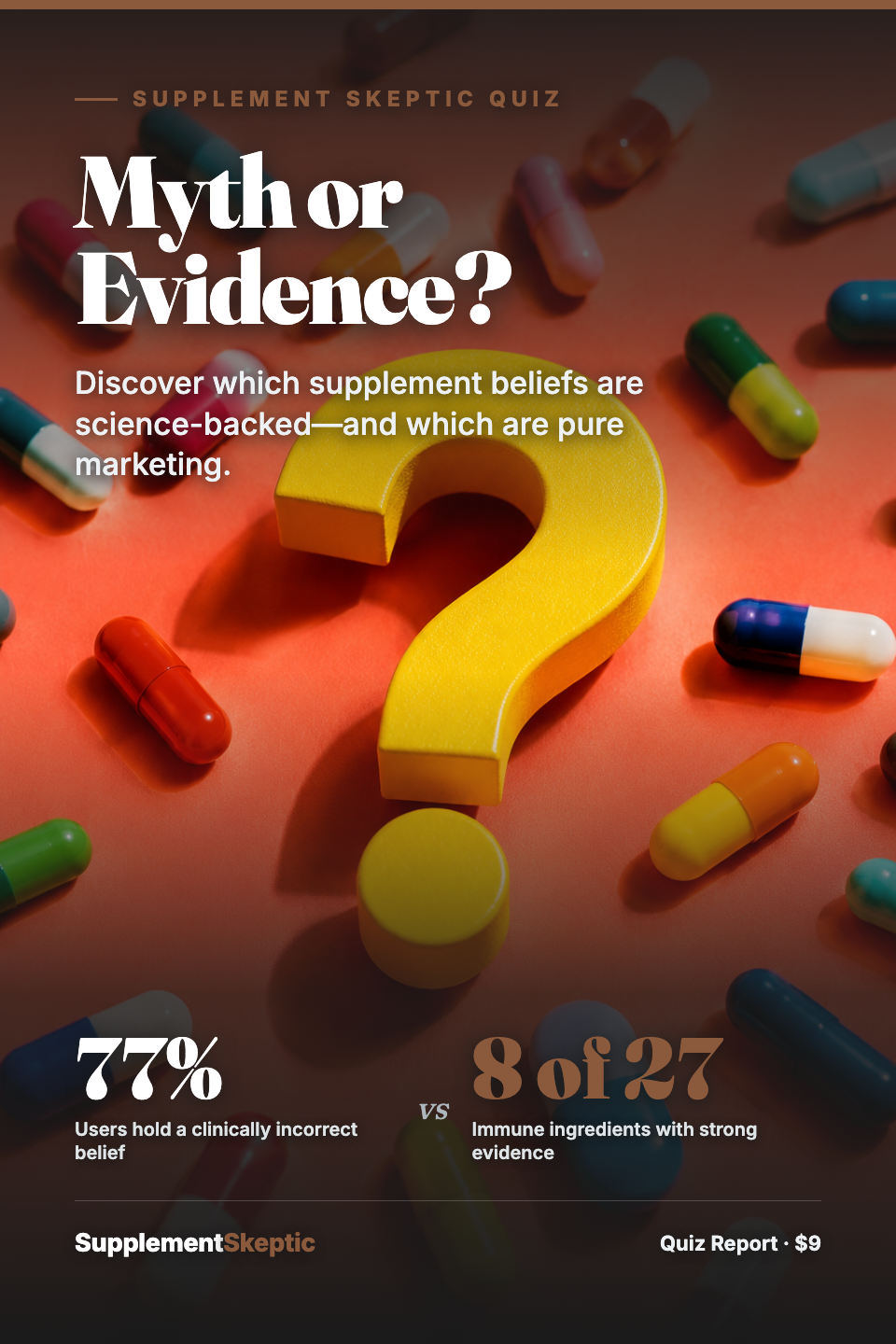
Find out which of your supplement beliefs are backed by evidence (and which are marketing hype).
A 2020 JAMA survey found 77% of supplement users hold at least one clinically incorrect belief about their products. This quiz shows you which common myths have evidence support and which don't — so you stop guessing and start buying based on actual science.
- 77%
- Supplement users with at least one clinically incorrect belief (JAMA 2020)
- 8 of 27
- Immune-support ingredients with strong clinical evidence (NIH 2022 review)
- Format
- quiz report
- Price
- $9
- Delivery
- Instant download
- Refund
- 30 days
- Discover which supplement beliefs are science-backed vs pure marketing.
- See the real evidence (or lack of it) behind 10+ popular supplement claims.
- Get personalized myth scores based on your current supplement habits.
- Learn how to spot red flags in supplement advertising copy.
- Stop wasting money on unproven claims with a myth-by-myth scorecard.
- Get plain-English explanations of what the clinical trials actually show.
Free 60-second audit
Which Supplement Myths Are You Believing?
Answer 4 quick questions about supplement claims you may have heard. We'll score your beliefs against the clinical evidence — no judgment, just honesty.
-
1 Multivitamins prevent chronic disease and extend lifespan in healthy adults.
-
2 If a supplement says 'natural,' it's automatically safer than synthetic versions.
-
3 Echinacea meaningfully prevents or shortens the common cold.
-
4 Megadoses of vitamins (1000% of daily value) are healthier than the recommended amount.
-
Your result
Here's what the science actually shows about your supplement beliefs
Get your personalized myth report — $9 →You've just discovered which of your supplement beliefs align with clinical evidence and which are influenced by marketing. The data is clear: 77% of supplement users hold at least one clinically incorrect belief (JAMA, 2020). You're not alone.
The good news? You can stop guessing. The full Supplement Myths Quiz Report ($9) walks you through the 10 most-believed myths, shows the actual trial data behind each claim, and gives you a personalized scorecard so you know which supplements to reconsider and which ones have real evidence backing them.
This isn't about saying "all supplements are bad." It's about separating the hype from the science — so you spend your money on supplements that actually work, not on ones that sound good in ads.
The Problem: Supplement Myths Are Everywhere
Walking down the supplement aisle (or scrolling through ads), you hear claims constantly: “Multivitamins extend lifespan.” “Echinacea prevents colds.” “Glucosamine repairs cartilage.” “Ginkgo sharpens memory.”
The problem is, most of these claims don’t hold up under clinical scrutiny.
In 2020, researchers publishing in JAMA surveyed supplement users and found a striking result: 77% of them held at least one clinically incorrect belief about what their supplements actually do. That’s not because people are ignorant — it’s because supplement marketing is designed to exploit the gap between what sounds good and what science actually shows.
What the Evidence Really Says
A 2022 NIH review examined 27 ingredients commonly marketed for immune support. The researchers found strong clinical evidence for only 8 of them. For the remaining 19? Insufficient evidence to draw reliable conclusions.
Here are some familiar myths and what the trials actually found:
Echinacea and the common cold: Despite decades of marketing and sales, large-scale trials show echinacea does not meaningfully prevent or shorten cold duration. Marketing won; evidence lost.
Ginkgo biloba and memory: Widely used and heavily promoted for cognitive decline and dementia prevention. The largest trial (GEMS, n=3,069 older adults) found zero benefit for memory or dementia risk.
Glucosamine for arthritis: Sold to millions as a cartilage-rebuilding compound. Mechanism sounds plausible. Trials? The largest studies show glucosamine is no better than placebo for osteoarthritis pain or joint damage progression.
Multivitamins for disease prevention: The consensus among NIH experts is clear: except in rare circumstances, there is insufficient evidence to recommend multivitamins for chronic disease prevention or lifespan extension in generally healthy adults.
Why This Happens
Three reasons supplement myths thrive:
-
The profit motive: Unlike drugs, supplements don’t require FDA pre-approval before sale. Manufacturers can make structure-function claims without rigorous trials. If claims drive sales and liability is low, why invest in costly evidence?
-
The “natural” halo: People conflate “natural” with “safe” and “effective.” Naturalness is a marketing category, not a safety rating. Many botanicals interact with medications — St. John’s wort interferes with oral contraceptives and blood thinners.
-
The megadose myth: If 100% of the daily value is good, surely 1,000% is ten times better, right? Wrong. A meta-analysis of 48,562 people found no mortality benefit from vitamin or mineral supplements at doses exceeding the RDA. High-dose vitamin E was associated with a 4% increase in all-cause mortality.
What This Quiz Does
This report walks you through the 10 most-believed supplement myths, shows you the actual trial data, and gives you a personalized scorecard so you can see which beliefs are science-backed and which are hype.
It’s not about declaring all supplements useless — some have solid evidence. It’s about separating the signal from the noise, so you stop buying based on ads and start buying based on evidence.
This is consumer education, not medical advice. Supplements and medications carry real risks and interactions. Consult a licensed clinician before starting any new supplement.
What's inside
- 16-page interactive PDF report with personalized myth-debunk scorecard.
- The 10 Most Believed Supplement Myths — ranked by belief frequency vs evidence quality.
- Side-by-side comparison: What the ads claim vs what trials show.
- Red-flag checklist for spotting marketing hype in supplement advertising.
- Myth scorecard showing your current beliefs and evidence ratings (0–100%).
- Follow-up guide: How to research supplements independently using NIH and FDA resources.
Frequently asked
What makes this different from just reading supplement reviews?
This quiz is specifically designed to identify which of *your* beliefs don't match clinical evidence — not to judge all supplements as bad or good. You get a personalized report showing which myths you believe, ranked by how much evidence actually supports them. It's targeted myth-busting.
Will this tell me which supplements are safe to take?
This report identifies which popular supplement claims have clinical evidence and which don't. Safety is different from efficacy — a supplement might be safe but not work. The report includes a checklist for reviewing safety with your doctor, but consult a licensed clinician before starting any new supplement.
If a supplement doesn't have strong evidence, should I avoid it?
Not necessarily. The report shows you *what the evidence says*, so you can make an informed choice. Some supplements lack large trials simply because they're less profitable to study. The key is knowing what you're choosing based on — marketing, anecdote, or actual clinical data.
Does this cover all supplements?
The main report focuses on the 10 most-believed myths about common supplements (multivitamins, echinacea, ginkgo, glucosamine, etc.). The full reference includes 40+ ingredients ranked by evidence.
What exactly do I get for $9?
A 16-page personalized PDF report showing your myth-belief scorecard, the 10 most-believed supplement myths ranked by evidence, side-by-side comparisons of claims vs trial data, and a red-flag checklist. One-time payment, 30-day money-back guarantee, no subscription. We sell no supplements and take no affiliate commission.
Is this anti-supplement?
No. This is pro-evidence. Some supplements have solid clinical support; many don't. Our job is to show you what the science actually says, so you stop buying based on ads and start buying based on data.
Get Quiz: Which Supplement Myths Are You Believing? — $9
Secure checkout · card details stay on this page · 30-day money-back guarantee · instant download.
Sources
- Murniece et al., Seven of ten dietary supplement users hold at least one clinically incorrect belief, JAMA, 2020 — Primary source for 77% statistic on supplement user misconceptions.
- NIH NCCIH: Using Dietary Supplements Wisely — Evidence gaps: 2022 review found strong clinical evidence for only 8 of 27 immune-support ingredients; multivitamins show little benefit for disease prevention.
- Five Myths About Dietary Supplements—And the Truth You Should Know (PMC) — Comprehensive myth-busting with citations: echinacea doesn't prevent colds, ginkgo doesn't prevent dementia, high-dose vitamins carry mortality risk.
- FDA compliance: Supplement Label Claims and Regulation Overview — Evidence that supplement labels often violate FDA regulations with unsubstantiated disease claims.