
From the Supplement Skeptic desk · our own diagnostic report
Sleep Supplement Decision Tree
Evidence-based sleep protocols without the melatonin trap — find your path to better sleep.
Melatonin carries emerging long-term cardiovascular concerns (2025 research suggests chronic users face nearly 2× heart-failure hospitalization risk over 5 years), and tolerance develops over months of nightly use. Evidence-based alternatives exist: magnesium glycinate (250mg) reduces insomnia severity by modest but measurable amounts (~18% better than placebo); L-theanine at 200mg shows subjective sleep-quality improvements within 2–4 weeks; ashwagandha 300–600mg helps when anxiety drives poor sleep (4–8 weeks to full effect). This decision tree maps your specific sleep challenge to the evidence-backed stack most likely to work.
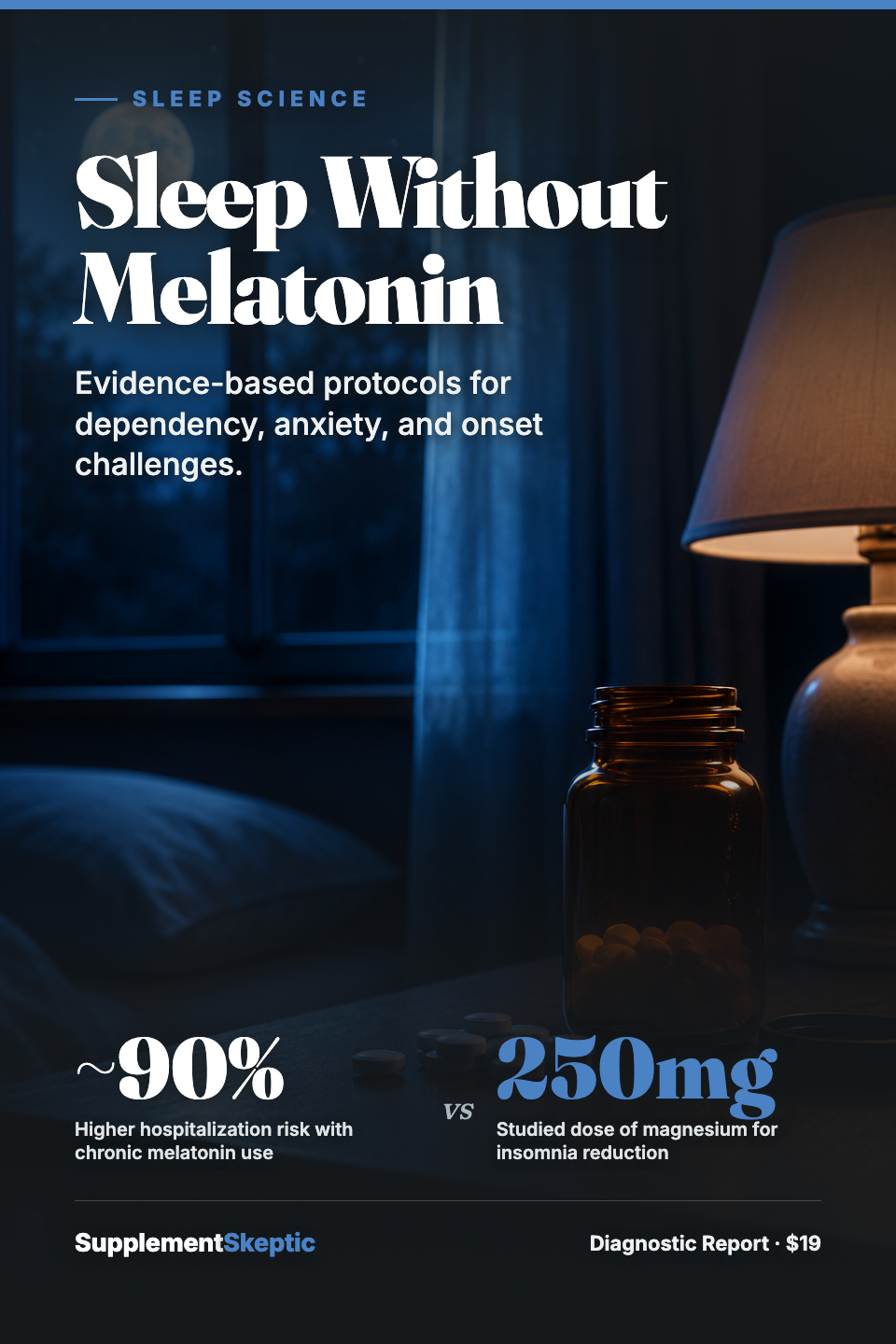
- ~90%
- Higher heart-failure hospitalization risk with chronic melatonin use
- 250mg
- Studied dose of magnesium bisglycinate for insomnia reduction
- 2–4 weeks
- Timeline for L-theanine subjective sleep improvements
- 300–600mg
- Evidence-backed ashwagandha range for sleep-linked anxiety
- Format
- diagnostic report
- Price
- $19
- Delivery
- Instant download
- Refund
- 30 days
- Map your sleep challenge (dependency burnout, anxiety-driven, slow onset, frequent waking) to an evidence-backed protocol — not a generic stack.
- See exact dosages matched to the studies that proved them (magnesium 250mg daily, L-theanine 200mg+, ashwagandha 300–600mg).
- Understand the real risks: melatonin tolerance, potential long-term cardiovascular concerns (2025 data), and when to seek professional support.
- Get a safe taper protocol if you are coming off melatonin dependency — plus interaction warnings with alcohol and stimulants.
- Learn the evidence gap: what does not work, which form matters (glycinate vs. threonate), and why timing is critical.
- Track your sleep metrics (latency, quality, wake-ups) using the included biomarker template.
Free 60-second audit
What is your sleep challenge right now?
Answer 3 quick questions. We'll show you which evidence-backed stack is most likely to work for you — and what the timeline really looks like.
-
1 What is your main sleep problem?
-
2 How long have you had this problem?
-
3 What is your sleep budget per night?
-
Your result
Here is your evidence-based sleep protocol
Get your personalized protocol — $19 →Based on your answers, the research points to a specific stack with the highest likelihood of helping you without the melatonin trap.
The full Sleep Supplement Decision Tree breaks down each component (dose, timing, expected timeline), explains what the trials actually showed, and includes a safe melatonin-taper protocol if you need it.
This is YMYL-safe consumer science, not medical advice — but it is built on the most current clinical evidence (2024–2026 RCTs and meta-analyses).
The melatonin trap nobody talks about
Melatonin is everywhere. It is cheap, over-the-counter, and culturally normalized as a safe sleep aid. But the evidence for long-term safety is thinner than most people realize.
A 2025 advisory from the American Heart Association raised a significant flag: people who use melatonin chronically (12 months or longer) showed a roughly 90% higher risk of heart-failure hospitalization over a five-year window, compared to non-users. They were also nearly twice as likely to die and 3.5 times more likely to be hospitalized for heart failure. The study has not been peer-reviewed yet, so treat it as a preliminary signal rather than proven causation. But the likely mechanism is not that melatonin causes heart disease — it is that melatonin masks underlying cardiac symptoms, allowing serious problems to go undetected.
More subtle: tolerance develops. Melatonin does not cause physical dependence (there is no withdrawal), but psychological reliance is real. Users report diminishing returns after weeks or months of nightly use, and a cycle begins: higher doses, more tablets, more cost, less sleep.
This is where the decision tree comes in.
What the evidence actually shows
Magnesium glycinate (250mg daily)
A 2025 randomized controlled trial of 155 adults with poor sleep compared magnesium bisglycinate (250mg elemental magnesium + glycine) to placebo. The magnesium group saw their Insomnia Severity Index drop by about 4 points; the placebo group dropped 2.3 points. Statistically significant? Yes (p=0.049). Clinically dramatic? No — the effect size was small (Cohen’s d=0.2), representing modest real-world benefit.
Who benefits most? People with low baseline dietary magnesium intake. If your diet is already rich in leafy greens, nuts, and seeds, the boost may be smaller.
Timeline: Most improvement appeared within the first two weeks.
L-theanine (200mg+, nightly)
A 2025 systematic review of L-theanine supplementation found that 9 of 11 trials using 200mg or more per day reported benefits on subjective sleep onset latency and daytime sleepiness. That is, people felt they fell asleep faster and slept better — but objective measures (polysomnography, the gold standard) did not consistently improve. This matters: L-theanine is a subjective sleep-quality tool, not a measured sleep-architecture changer.
Timeline: Full subjective benefits build over 2–4 weeks of nightly use. Many users notice calming effects within 30–60 minutes of a single dose (helpful for pre-bed anxiety), but sleep-pattern improvements take weeks.
Ashwagandha (300–600mg daily)
A 2024–2026 body of meta-analyses (22 RCTs, n=1,391) showed that ashwagandha at 300–600mg daily reduces anxiety and stress significantly, with dose-dependent effects. Why include it in a sleep protocol? Because anxiety and poor sleep are bidirectional — anxiety disrupts sleep, and poor sleep worsens anxiety. Ashwagandha does not directly sedate; it calms the nervous system.
Timeline: 4–8 weeks for full effect. Premature judgment (after one week) will disappoint.
What does not work (the evidence gap)
- Passionflower, valerian root, hops: Limited evidence; most trials are small and older.
- High-dose melatonin (10mg+): Higher doses do not improve sleep better than 0.5–3mg and carry more side effects.
- Proprietary blends: If the label does not list individual doses, you cannot tell if you are getting studied amounts.
Who this is for
People who are:
- Currently taking melatonin nightly and feeling dependent or concerned about long-term safety.
- Struggling with sleep onset (taking 30–60+ minutes to fall asleep).
- Experiencing anxiety-driven poor sleep and looking for a non-pharmaceutical approach.
- Waking frequently and not sure which supplement might help.
- Budget-conscious and want to know which supplement offers the best evidence-to-cost ratio.
This is not a replacement for medical evaluation if you have severe, persistent insomnia or undiagnosed sleep disorders. The decision tree includes a checklist for when to see a sleep specialist.
The decision-tree approach
Instead of a one-size-fits-all “sleep stack,” this report maps your specific challenge:
- If melatonin dependency: Gradually reduce melatonin over 2–4 weeks while starting magnesium glycinate 250mg + L-theanine 200mg. Include a safe taper schedule.
- If anxiety-driven poor sleep: Prioritize ashwagandha 300mg (once daily, morning or evening depending on your cortisol pattern) + magnesium glycinate 250mg at night. Timeline: 4–8 weeks for full effect.
- If slow sleep onset (30+ minutes): L-theanine 200mg 30–60 minutes before bed; add magnesium glycinate 250mg at bedtime. Timeline: 2–4 weeks.
- If frequent waking: Magnesium glycinate 250mg at bedtime; consider glycine 3–5g additional if waking persists. Lower overall caffeine intake (stimulants extend throughout the day).
- If inconsistent schedule (shift work, travel): Melatonin at 0.5–1mg only for short-term adjustment; prefer magnesium + L-theanine for baseline sleep support.
Each branch includes the exact dose, timing, expected timeline, and safety checks (drug interactions, alcohol, stimulant conflicts).
Safety and drug interactions
- Magnesium + alcohol: Avoid on the same night; both affect GABA signaling.
- L-theanine + caffeine: L-theanine is sometimes paired with low-dose caffeine for focus, but not at night.
- Ashwagandha + SSRIs/sedatives: No major interactions, but monitor for excess sedation.
- Ashwagandha + blood thinners: Very limited evidence of interaction; mention to your provider.
The full checklist in this report maps 15+ common medications and herbal interactions.
What you get
- A 24-page PDF decision tree (flowchart + evidence tables + timelines).
- Sleep-onset-latency calculator (personalized by age, current sleep time, challenge type).
- Melatonin taper protocol (safe withdrawal for long-term users).
- Drug-interaction checklist (15+ medications, herbal products, alcohol).
- Biomarker-tracking template (sleep latency, quality, wake-ups, energy—track weekly for 12 weeks).
- One-time payment, 30-day money-back guarantee, no subscription.
We sell no supplements and take no affiliate commission on any sleep product. This is evidence-first consumer education.
This is general consumer information, not medical advice. Sleep disorders and medication interactions require professional evaluation. Review any changes with a licensed clinician or sleep specialist.
What's inside
- 24-page PDF decision tree (instant download) — read on any device.
- Interactive flowchart: answers 3 quick questions → your personalized protocol recommendation.
- The Evidence-Backed Stack Table: magnesium, L-theanine, ashwagandha, glycine ranked by study strength and dosage.
- Sleep Onset Latency Calculator: your age, current challenge, timeline → expected improvement window.
- Melatonin Taper Schedule (if applicable): safe withdrawal protocol for long-term users.
- Safety & Drug-Interaction Checklist: alcohol, caffeine, SSRIs, blood thinners, and more.
Frequently asked
Is melatonin actually dangerous?
Melatonin does not cause physical dependence (no withdrawal syndrome), but psychological reliance is real — many users believe they cannot sleep without it. More concerning: 2025 research suggests chronic users (12+ months) face nearly 90% higher hospitalization risk for heart failure over 5 years, though this is preliminary and not yet peer-reviewed. The likely mechanism is not that melatonin causes heart problems, but that it masks underlying cardiac risk. This decision tree prioritizes alternatives for anyone concerned about long-term use.
What dose of magnesium actually works for sleep?
The most studied dose is 250mg elemental magnesium (often in glycinate form, paired with glycine) taken daily. A 2025 RCT showed this reduced Insomnia Severity Index scores by ~4 points versus placebo (~2.3 points), with most improvement seen within the first two weeks. The effect is modest (Cohen's d=0.2) but consistent. Benefits are strongest if you have low baseline dietary magnesium.
How long does L-theanine take to work?
Subjective sleep improvements (falling asleep faster, feeling more rested) build over 2–4 weeks of nightly use at 200mg+. A 2025 systematic review found that 9 of 11 trials using ≥200mg daily reported benefits on sleep onset latency and daytime function. Objective measures (polysomnography) did not consistently improve, so this is a subjective sleep-quality tool.
Can I combine ashwagandha with magnesium and L-theanine?
Yes. No major interactions are documented between these three. Typical stack: magnesium glycinate 250mg daily + L-theanine 200mg nightly + ashwagandha 300mg (if anxiety is your main driver). Ashwagandha takes 4–8 weeks to show full effect. The decision tree maps the best sequence and timing for your specific challenge.
What if I want to stop melatonin? Can I taper it?
Yes. Because melatonin does not cause physical dependence, you can stop directly, but gradual tapering (e.g., 10% dose reduction every 1–2 weeks) can ease psychological adjustment and give your natural circadian rhythm time to re-establish. This decision tree includes a safe taper schedule. Healthcare provider consultation is recommended.
What exactly do I get for $19?
A 24-page instant-download PDF containing the interactive decision-tree flowchart, the evidence-backed stack table (dosages, study citations, timelines), a sleep-onset-latency calculator, melatonin-taper protocol, and a comprehensive drug-interaction checklist. One-time payment, 30-day money-back guarantee, no subscription. We sell no supplements and take no affiliate commission on any sleep product.
Get Sleep Supplement Decision Tree — $19
Secure checkout · card details stay on this page · 30-day money-back guarantee · instant download.
Sources
- Magnesium Bisglycinate Supplementation in Healthy Adults Reporting Poor Sleep: A Randomized, Placebo-Controlled Trial — 2025 RCT (n=155): 250mg elemental magnesium reduced Insomnia Severity Index by 3.9 points vs 2.3 placebo (p=0.049); Cohen's d=0.2 (modest effect).
- Examining the effect of L-theanine on sleep: a systematic review of dietary supplementation trials — 2025 systematic review: 200+ mg/day showed subjective improvements in sleep onset latency and quality over 2–4 weeks; effects primarily on subjective measures.
- Long-term use of melatonin supplements to support sleep may have negative health effects — 2025 American Heart Association advisory: chronic melatonin users (12+ months) showed ~90% higher risk of heart-failure hospitalization; preliminary, not peer-reviewed.
- Ashwagandha: Adaptogenic and Anxiolytic Effects in Healthy Adults — 2024–2026 meta-analyses of 22 RCTs (n=1,391): 300–600mg daily effective for anxiety and stress reduction; effects on sleep secondary to mood improvement (4–8 week timeline).