
From the Supplement Skeptic desk · our own decoder
The Proprietary Blend Decoder
Upload a label. We decode the proprietary blend and show you what you're actually getting—and what might be hiding.
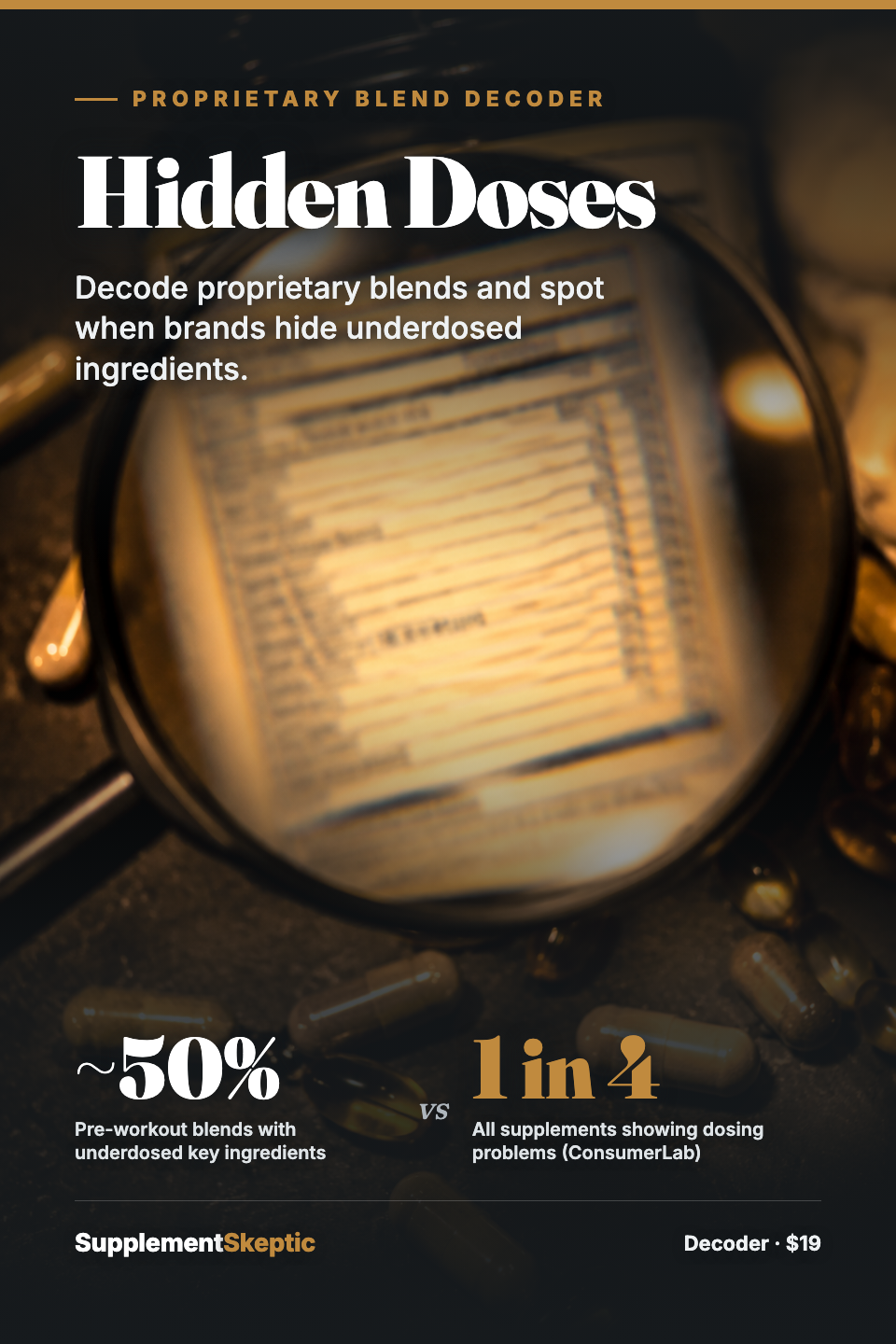
A proprietary blend allows manufacturers to list impressive ingredient panels while hiding the individual amounts—a structural economics problem that encourages underdosing. About 1 in 4 supplements tested by independent labs show dosing problems; in pre-workout and blend-heavy categories, that rate climbs to 50%. This decoder teaches you the math to decode any label in 60 seconds and spot when a brand is listing premium ingredients at amounts too small to matter.
- ~50%
- Pre-workouts & blends with underdosed key ingredients
- 1 in 4
- All supplements with dosing problems (ConsumerLab data)
- 60 sec
- Time to audit any label with this decoder
- $0
- Affiliate kickback — we sell no supplements
- Format
- decoder
- Price
- $19
- Delivery
- Instant download
- Refund
- 30 days
- The math to decode proprietary blends — how to estimate individual ingredient amounts from total blend weight.
- A 4-step checklist to spot when a brand is hiding an expensive ingredient at a non-effective dose.
- How to compare a label against the studied dose (the dose gap audit).
- Red flags specific to blends: fanciful naming, ingredient order tricks, and the premium ingredients, underdosed formula pattern.
- A plain-English verdict on whether the bottle is likely to work as advertised or is a waste of money.
Free 60-second audit
Is your proprietary blend formula actually dosed right?
Upload your supplement label or tell us what you see. We'll decode whether the blend is likely at clinically-studied amounts or if it's a cost-cut formula hiding behind marketing.
-
1 What does your label say about the proprietary blend?
-
2 Is the total blend weight listed on the label?
-
3 Does the label show individual doses for any of the key ingredients?
-
Your result
Here's what your label is telling you
Decode your label — $19 →Proprietary blends are legally allowed but structurally encourage underdosing. When a label hides ingredient amounts, you cannot verify whether you're getting a clinically-studied dose.
The Proprietary Blend Decoder gives you the math to estimate ingredient amounts from blend weight, the checklist to spot cost-cutting patterns, and the dose-gap audit so you know whether this bottle is likely to work or is a waste of money.
The short version
Proprietary blends are legal. They are also where supplement brands hide cost-cutting.
When a label lists a “proprietary blend” without breaking out individual ingredient amounts, you cannot verify whether you’re getting a clinically-studied dose of anything in it. The ingredient list tells you what’s in the bottle; the blend format hides how much. And that gap is where underdosing lives.
The facts
- About 1 in 4 supplements tested independently show dosing problems (ConsumerLab, 20+ years of data).
- In pre-workouts and blend-heavy categories, nearly 50% of key ingredients are underdosed — buried in proprietary blends at amounts too small to produce a studied effect.
- Proprietary blends are structurally designed to hide cost: A brand lists curcumin, CoQ10, or chondroitin alongside 12 other ingredients in a 2-gram blend. You have no way to know if curcumin is 500 mg (studied dose) or 50 mg (cost-cut dose).
This decoder teaches you to run the math yourself, spot the patterns, and know whether your bottle is dosed like the studies or dosed like a cost-management spreadsheet.
How brands hide with blends
- The impressive ingredient list. “Contains curcumin, CoQ10, resveratrol, and turmeric extract” sounds powerful until you realize it’s all 2 grams total—and you don’t know the breakdown.
- The ingredient order trick. Ingredients are listed by weight, but when they’re bundled in a blend with a total weight, the order is mostly theater because the dose of each is unknown.
- The fanciful blend name. “Proprietary Recovery Matrix®” or “Peak Performance Blend™” sounds unique and exclusive. It’s actually the legal format that hides doses.
- The budget pricing. If a bottle is $20 and lists 15 active ingredients in a blend, simple math says most are subclinical. Brands count on you not doing that math.
- The transparency theater. Some brands now show a few ingredient amounts while hiding others in a “proprietary blend”—a half-transparent format that looks credible but still obscures cost-cutting.
This decoder turns each pattern into a 60-second audit so you know exactly what you’re paying for.
This is consumer education, not medical advice. Supplements carry real risks and interactions. Review any new supplement with a licensed clinician before starting.
What's inside
- 24-page PDF decoder (instant download) with real, annotated supplement labels showing the hiding patterns.
- The Proprietary Blend Math Worksheet — a template to estimate actual ingredient amounts in seconds.
- The Dose-Gap Audit Checklist — check your label against clinically-proven doses for 30+ common ingredients.
- The Red Flags Scorecard — 8 brand patterns that signal underdosing.
- The Is This Worth My Money? verdict template — decision logic for blend-heavy products.
Frequently asked
What is a proprietary blend, exactly?
A proprietary blend is a mixture of ingredients where manufacturers are allowed to hide the individual doses and list only the total weight of the blend. This is legal under FDA regulations, but it creates an information asymmetry: consumers cannot verify whether ingredients are at clinically-studied amounts. Brands use blends for one reason: to list impressive ingredient panels while using subclinical doses of expensive ingredients.
Is a proprietary blend always a bad thing?
Not always, but it is a red flag. Some brands use blends transparently (disclosing some ingredient amounts) and dose them properly. But the structural incentive is to underdose, so proprietary blends are correlated with underdosing—especially in pre-workout and sports supplement categories. If a brand can list ingredients transparently (with individual amounts), they usually do, because transparency is now a competitive advantage.
How do I know if the blend is underdosed?
This decoder teaches the math: you take the total blend weight (e.g., 2 grams) and the ingredient list, and you estimate whether expensive active ingredients are likely at clinically-studied amounts based on their position in the ingredient order and the total weight available. The Dose-Gap Checklist walks you through this for 30+ common ingredients, showing what a clinically-proven dose is.
What makes this different from just reading the label myself?
Reading a label yourself, you see ingredient names but have no context for whether the dose matters. This decoder gives you the framework: the studied dose for each ingredient, the math to estimate what's likely in that blend, and the red-flag patterns manufacturers use. You'll decode any label in 60 seconds instead of guessing.
What exactly do I get for $19?
A 24-page instant-download PDF with the proprietary blend math explained, real annotated labels showing hiding patterns, a worksheet to estimate ingredient amounts, a 30+ ingredient dose-gap checklist, and the red-flags scorecard. One-time payment, 30-day money-back guarantee, no subscription. We sell no supplements and take no affiliate commission.
Get The Proprietary Blend Decoder — $19
Secure checkout · card details stay on this page · 30-day money-back guarantee · instant download.
Sources
- FDA Dietary Supplement Labeling Guide — Chapter IV. Nutrition Labeling — FDA's official guide to proprietary blend label requirements and ingredient disclosure.
- 21 CFR 101.36 — Nutrition labeling of dietary supplements — Current federal regulation allowing proprietary blend label format.
- ConsumerLab: What to Watch Out For When Buying Vitamins and Supplements — Independent testing data showing 1 in 4 supplements have dosing issues; proprietary blends are a major risk factor.
- Proprietary Blends in Dietary Supplements | CRN Best Practices — Industry perspective on proprietary blend regulation and transparency standards.