
From the Supplement Skeptic desk · our own comparison tool
Joint Health Recovery Protocol
Glucosamine vs. collagen: evidence-based protocol for joint support — ranked by dose, testing, and realistic timeline.
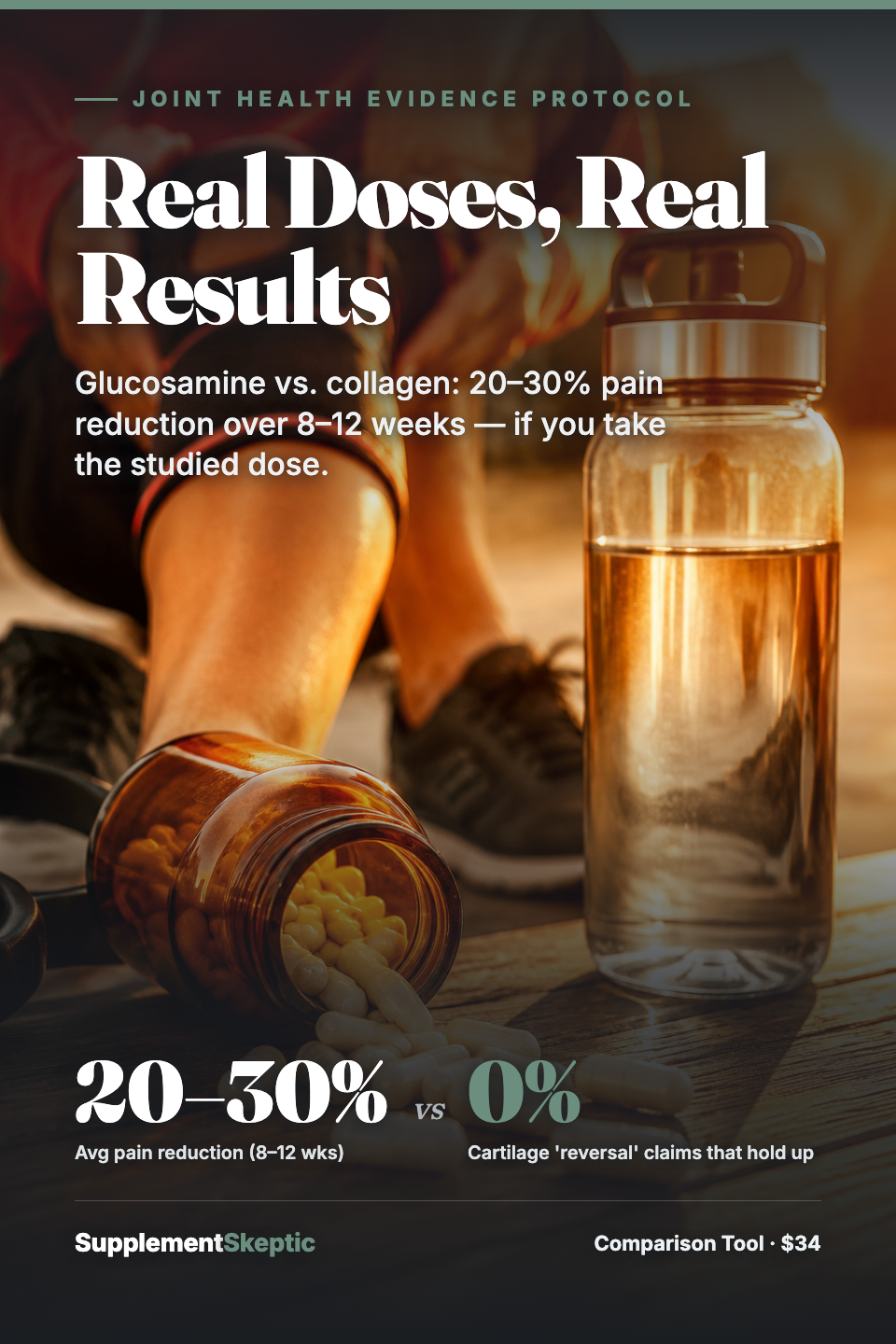
Glucosamine sulfate at 1,500 mg daily and collagen hydrolysate at 5–10 g daily each show modest evidence for reducing joint pain by roughly 20–30% over 8–12 weeks in knee osteoarthritis trials. Neither reverses cartilage loss, but they may slow progression and support function in early-to-moderate arthritis. This protocol shows you the studied doses, which formulations work, how to verify third-party testing, and realistic timelines before committing $30–80 per month.
- 20–30%
- Avg pain reduction in glucosamine/collagen trials
- 1,500 mg
- Crystalline glucosamine sulfate daily dose (studied)
- 5–10 g
- Collagen hydrolysate daily dose in effective trials
- 8–12 weeks
- Timeline to meaningful results
- Format
- comparison tool
- Price
- $34
- Delivery
- Instant download
- Refund
- 30 days
- See the real effect sizes head-to-head — glucosamine vs. collagen vs. placebo vs. NSAIDs.
- Match any joint supplement label to the dose actually used in studies (spot underdosed products).
- Identify which third-party testing certifications (NSF, USP, ConsumerLab) actually matter for joint products.
- Understand the early-stage vs. late-stage arthritis decision tree — which approach works for your condition.
- Get a plain-English 'is this worth my money?' verdict with a realistic 6–12 week timeline.
Free 60-second audit
Is your joint supplement even dosed like the studies?
Answer 3 questions about your current (or planned) joint supplement. We'll show you how it stacks up against the evidence.
-
1 What's your main joint concern?
-
2 What does your supplement label show as the daily dose?
-
3 Does your bottle show third-party testing (NSF, USP, ConsumerLab)?
-
Your result
Here's the reality check on your supplement
Get the protocol — $34 →Based on the research, glucosamine sulfate and collagen hydrolysate show modest benefits — but only at the doses actually studied. Many retail products under-dose or hide amounts in proprietary blends, making it impossible to verify effectiveness. Combined with lack of third-party testing, you could be paying $40–80/month for an under-effective product.
The Joint Health Recovery Protocol gives you the dose audit table, testing verification checklist, arthritis stage decision tree, and realistic timeline — so you know exactly what you're buying.
The short version
Joint pain is real, and the supplement aisle is full of misleading claims. “Cartilage regeneration,” “reverses arthritis,” “guaranteed relief” — none of these are true, and they cost you money based on lies.
Here is what the evidence actually shows:
- Glucosamine sulfate (crystalline, 1,500 mg daily) reduces joint pain by roughly 20–30% on average in studies — over 8–12 weeks, not overnight.
- Collagen hydrolysate (5–10 g daily) shows similar modest benefits in a recent meta-analysis of 11 randomized trials.
- Neither reverses cartilage damage. Both may slow progression and support function in early-to-moderate arthritis, but they are not cures.
- Most retail bottles under-dose or hide the amount inside a “proprietary blend,” which means you don’t even know if you’re getting a studied amount.
The protocol exists so you can tell the difference between evidence-based dosing and marketing theater — and commit to the right supplement (if any) with realistic expectations.
How the joint category tricks you
- The “cartilage regeneration” myth. No supplement rebuilds cartilage. Marketing claims this constantly. It is false.
- The wrong glucosamine form. Studies used crystalline glucosamine sulfate at 1,500 mg daily. Retail products often use cheaper glucosamine HCl or NAG, which have different (weaker) evidence.
- The proprietary blend fog. A bottle claims “joint complex” but hides the actual dose of each ingredient. You cannot tell if it’s 50 mg or 500 mg of collagen.
- The “pharmaceutical grade” lie. There is no FDA standard for “pharmaceutical grade.” This phrase is marketing, not regulation.
- The timeline trap. Ads show “before/after” results in 2–3 weeks. Realistic results take 8–12 weeks, and they are modest.
The protocol turns each of these into a 60-second check on any label.
Who this is for
People with early-to-moderate joint pain or arthritis who are considering glucosamine or collagen and want a straight answer before spending $40–80 per month — and people already taking these supplements who suspect they might not be getting a studied dose.
This is consumer education, not medical advice. Joint pain has many causes, some serious. Discuss any supplement and baseline metrics with a licensed clinician.
What's inside
- 28-page PDF protocol with dose audit table — shows which brands meet studied doses.
- Testing Verification checklist — NSF, USP, ConsumerLab certifications explained.
- Joint Stage Decision Tree — early vs. moderate vs. severe arthritis recommendations.
- Realistic Timeline tracker — when to expect results and biomarkers to discuss with clinician.
Frequently asked
Does glucosamine actually work?
Crystalline glucosamine sulfate at 1,500 mg daily reduces joint pain by roughly 20–30% over 8–12 weeks in osteoarthritis studies. The effect is modest and clearest in moderate arthritis. It does not reverse cartilage damage but may slow progression. Evidence is specific to the 1,500 mg crystalline sulfate form; other forms are less studied.
What about collagen supplements — do they rebuild cartilage?
No supplement rebuilds cartilage. Oral collagen hydrolysate (5–10 g daily) reduces joint pain and improves function, likely by stimulating collagen synthesis and reducing inflammation. A recent meta-analysis of 11 trials found significant pain and function improvements. Like glucosamine, it is a support tool, not a cure.
What's the difference between glucosamine sulfate, HCl, and N-acetyl glucosamine?
The strongest evidence is for crystalline glucosamine sulfate at 1,500 mg daily. Glucosamine HCl and NAG have weaker evidence. Supplements often use these alternate forms because they're cheaper, but they are not equivalent to sulfate. Always check the label.
How long until I see results?
Realistic expectation: 6–12 weeks for meaningful pain reduction. Expect roughly 20–30% average pain reduction, not dramatic relief. If no change after 12 weeks at studied dose, it is reasonable to stop. Discuss timelines and biomarker tracking with your clinician.
Should I take glucosamine AND collagen together, or just one?
Evidence on combinations is limited. Observational studies suggest combining glucosamine, collagen, and chondroitin may enhance benefit, but large controlled trials do not exist. If combining, ensure each ingredient is at a studied dose, not diluted in a proprietary blend.
What exactly do I get for $34?
28-page instant-download PDF with dose audit table (which brands meet studied doses), third-party testing verification checklist, arthritis stage decision tree, realistic timeline tracker, and head-to-head effect-size comparison. One-time payment, 30-day money-back guarantee, no subscription. We sell no supplements and take no affiliate commission.
Get Joint Health Recovery Protocol — $34
Secure checkout · card details stay on this page · 30-day money-back guarantee · instant download.
Sources
- Effect of collagen supplementation on knee osteoarthritis: an updated systematic review and meta-analysis of randomised controlled trials — 2024 meta-analysis of 11 RCTs (870 participants); significant pain and function improvements.
- Efficacy and safety of glucosamine sulfate in the management of osteoarthritis: Evidence from real-life setting trials and surveys — Comprehensive review supporting 1,500 mg daily crystalline glucosamine sulfate for knee pain.
- Crystalline glucosamine sulfate in the management of knee osteoarthritis: efficacy, safety, and pharmacokinetic properties — Evidence that 1,500 mg daily glucosamine sulfate may prevent joint space narrowing over 5 years.
- Open, Observational, Single-Arm, Multicenter Study: Hydrolyzed Collagen, Chondroitin Sulfate, and Glucosamine for Osteoarthritis Pain Reduction — 2023 study showing combination efficacy; pain reduction 1.99 at 3 months, 3.57 at 6 months.