
From the Supplement Skeptic desk · our own database
Ingredient Dosage Reference Guide (Clinical vs. Commercial Audit)
See exactly how much of each ingredient you're actually getting vs. what the studies used.
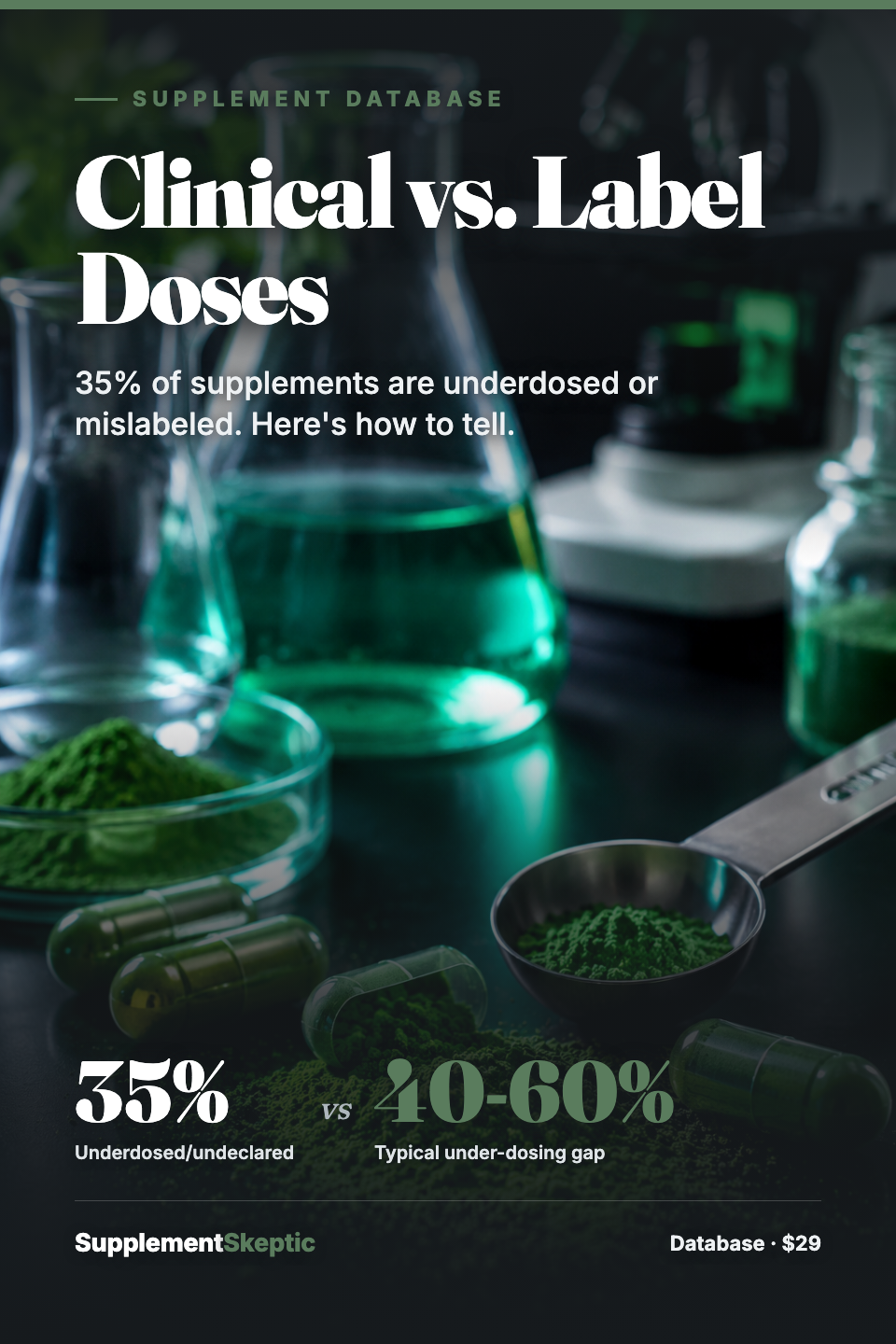
Roughly 35% of online sports supplements contain undeclared or improperly dosed ingredients, and many retail formulas under-dose by 40-60% compared to the amounts actually studied. This database audit shows you the studied dose for each ingredient, the typical retail dose on labels, the gap, and the cost per studied-amount—so you can spot whether your bottle is actually evidence-backed.
- 35%
- Sports supplements with undeclared/underdosed ingredients
- 40-60%
- Average under-dosing vs. studied amounts
- 40+
- Ingredients in searchable database with study citations
- $0
- Affiliate kickback — we sell no supplements
- Format
- database
- Price
- $29
- Delivery
- Instant download
- Refund
- 30 days
- Instantly compare any supplement label dose to the dose that was actually studied.
- Spot under-dosing in 30 seconds—see the cost-per-studied-dose for each ingredient.
- Learn which magnesium form (glycinate vs. threonate) crosses the blood-brain barrier and at what dose.
- Get real clinical dosages for green tea extract, chromium picolinate, and 40+ other common ingredients.
- Understand elemental vs. compound weight—so you know if your bottle is hiding the real amount.
- Identify when proprietary blends are a red flag (ingredient hidden, dose unknown).
Free 60-second audit
Are your supplements actually dosed like the studies?
Answer 3 quick questions. We'll show you what dose transparency looks like—and whether your bottle matches the evidence.
-
1 Pick an ingredient you're currently taking.
-
2 Does your label clearly show the milligram dose per serving?
-
3 How confident are you that your dose matches what researchers actually studied?
-
Your result
Your supplement transparency score
Get the database — $29 →Most retail supplement labels don't match the doses used in clinical research. On average, 40-60% under-dosing is common, and 35% of online sports supplements contain undeclared or improperly dosed ingredients entirely.
The Ingredient Dosage Reference Guide gives you the complete audit: what each major ingredient was actually dosed at in studies, what retail labels typically show, the gap, and the cost per studied dose. So you stop guessing and know exactly whether you're buying evidence or paying for a label.
The short version
Most supplements on retail shelves are under-dosed compared to what researchers actually studied. Many labels hide the real amount inside a proprietary blend. Roughly 35% of online sports and weight-loss supplements contain undeclared or improperly dosed ingredients entirely, making dose verification nearly impossible without expert help.
This database does that work for you: it shows the clinical dose for each major ingredient, what retail labels typically claim, the gap, and what you’re actually paying per studied dose.
How the category tricks you
-
The hidden dose. Studies use 500 mg of magnesium threonate; retail bottles say “2000 mg magnesium threonate” but deliver only ~144 mg elemental magnesium. That’s 71% less than it sounds.
-
The proprietary blend wall. When five ingredients are crammed into a “proprietary blend,” the label shows only the total weight, not the per-ingredient dose. You have no way to know if you’re getting a clinically studied amount or 10% of it.
-
Elemental vs. compound confusion. Most magnesium, zinc, and iron supplements list compound weight, not elemental weight. A 2000 mg bottle might contain only 200 mg of actual mineral your body can use.
-
The under-dose norm. Because supplement companies are not required to match clinical doses, many deliberately use 40-60% less than studies used—cutting costs while implying efficacy.
-
The contamination silence. 35% of online supplements tested contain undeclared substances or doses, often without any label warning.
The full database turns each of these into a searchable lookup you can run in 30 seconds on any bottle.
Who this is for
Anyone who:
- Currently takes supplements and suspects they’re under-dosed
- Is shopping and wants to know if a label’s dose actually matches research
- Has ever been confused by “2000 mg” on a bottle but gotten only a fraction of that
- Wants cost-per-studied-dose to make smarter buying decisions
- Cares about dose transparency and can spot affiliate-driven hype
The database is structured data, not opinion. It cites real studies, real doses, and real gaps.
Why this matters right now
The FDA crackdown on supplement label claims is escalating in 2025-2026. Consumers increasingly expect evidence. And as more buyers learn to read labels, retailers are pushing back by using proprietary blends, confusing elemental-vs.-compound weight, and under-dosing to protect margins.
This database gives you the map to cut through it.
This is consumer information about supplement dosing and label transparency, not medical advice. Before starting any supplement, review label claims and doses with a licensed clinician. We sell no supplements and take no affiliate commission on products recommended.
What's inside
- Searchable database PDF (40+ ingredients, sortable by cost-per-studied-dose).
- The Clinical Dose Audit table—what each study used vs. what labels claim.
- Form-by-form bioavailability guide (why magnesium glycinate ≠ magnesium threonate).
- The Underdose Checklist—red flags showing when a label is hiding doses in proprietary blends.
- Cost-per-studied-dose calculator—see which brands give you evidence-backed doses per dollar.
- Interaction and elemental-weight quick-reference sheet.
Frequently asked
What's the difference between 'elemental' and 'compound' weight on a label?
Supplement labels often list the total compound weight (e.g., '2000 mg magnesium glycinate'), not the actual magnesium you're getting. Magnesium glycinate is magnesium bonded to glycine; only a fraction is elemental magnesium. A 2000 mg capsule of magnesium glycinate typically contains only ~200 mg of elemental magnesium. This database explains the conversion for each form and form in the database.
Why does my magnesium threonate bottle say 2000 mg but the database says I'm only getting 144 mg elemental?
Magnesium threonate is magnesium bonded to threonic acid. The 2000 mg refers to the whole compound; the elemental magnesium is approximately 7.2% of that mass. Clinical studies using 1.5-2 grams of threonate deliver roughly 72-144 mg elemental magnesium. This database breaks down each form so you can compare apples to apples.
How do I know if my supplement is under-dosed?
Look up your ingredient in the database, find the 'Clinical Dose' column, then check your label. If your label shows less than the studied dose, or if the dose is hidden in a proprietary blend, it's under-dosed. The database shows the gap as a percentage and the cost-per-studied-dose to help you decide if the product is worth buying.
Why do 35% of supplements contain undeclared ingredients?
Testing by ConsumerLab and systematic reviews (Frontiers in Sports and Active Living, 2026) show that quality control gaps allow contamination and mislabeling, especially in sports and weight-loss categories. This database focuses on dose transparency, not adulterants, but it flags when a label hides doses—often a sign of poor oversight.
What exactly do I get for $29?
An instant-download PDF database with 40+ clinically studied ingredients, the studied dose for each, typical retail doses, the % gap, cost-per-studied-dose ranking, bioavailability form notes, and an elemental-vs.-compound weight guide. One-time payment, 30-day money-back guarantee, no subscription. We sell no supplements and take no affiliate commission.
Get Ingredient Dosage Reference Guide (Clinical vs. Commercial Audit) — $29
Secure checkout · card details stay on this page · 30-day money-back guarantee · instant download.
Sources
- Systematic review of undeclared prohibited substances and pharmacological adulterants in dietary supplements: prevalence, detection, and risks in sport — Frontiers in Sports and Active Living (2026): 35% of sports supplements contain undeclared/underdosed ingredients; 9-15% contamination with prohibited substances.
- Magnesium L-Threonate and Cognitive Function: Clinical Research — PubMed: Studies showing magnesium threonate dosing (1.5-2g daily) and elemental equivalents vs. other forms.
- ConsumerLab 2026 Supplement Testing and Verification — Independent third-party testing of vitamin and supplement brands; reference for properly tested vs. underdosed products.
- FDA Supplement Labeling and Compliance Guidance — FDA guidance on supplement label claims and dose disclosure requirements.