
From the Supplement Skeptic desk · our own diagnostic report
Colostrum Myth Exploder (Bioavailability & Growth Factor Reality Check)
Colostrum costs $80/mo but has weak evidence. Here's what actually works for gut health.
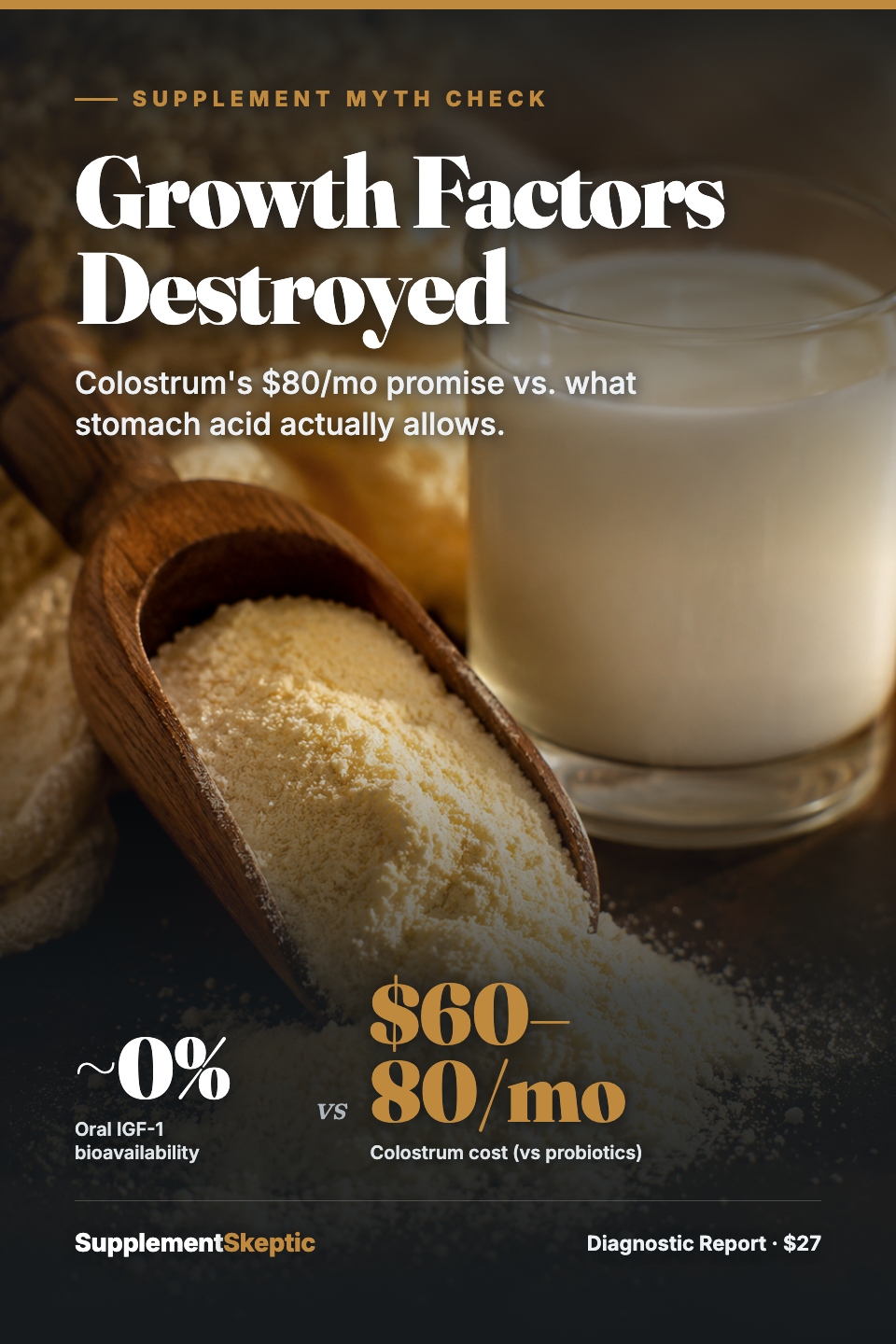
Bovine colostrum's starred ingredient, IGF-1, faces a hard bioavailability wall: stomach acid denatures peptides before absorption, rendering oral IGF-1 delivery essentially inert unless specially encapsulated. Real gut-health benefits appear mainly in infants and athletes under acute immune stress; adult non-athlete evidence is limited and heterogeneous. At $60–$80 per month, colostrum costs 4–8× more than probiotics with equal or stronger evidence—making the category's hype-to-data ratio one of the worst in supplements.
- ~0%
- Oral IGF-1 bioavailability (acid-denatured)
- $60–80/mo
- Typical colostrum cost vs probiotics
- Limited
- Adult non-athlete GI-health trials
- $0
- Affiliate kickback—we sell no supplements
- Format
- diagnostic report
- Price
- $27
- Delivery
- Instant download
- Refund
- 30 days
- Understand why IGF-1 claims fail the bioavailability test—and what actually absorbs.
- See the real evidence: athlete immune support versus gut-health hype in adults.
- Match any colostrum label to what the studies actually used (and spot underdosing).
- Compare colostrum head-to-head with probiotics, bone broth, and other proven alternatives.
- Get a plain-English 'is this worth $80/month?' verdict—not a sales pitch.
- Recognize the four red flags of colostrum overhyping in ads and influencer posts.
Free 60-second audit
Should you actually be taking colostrum?
Answer 3 quick questions. We'll show you what the evidence predicts—and whether a $70/month bottle makes sense for your situation.
-
1 What are you hoping colostrum will do?
-
2 Are you a high-endurance or intense-training athlete?
-
3 How long have you been considering colostrum?
-
Your result
Here's what the evidence predicts for your situation
Get the myth exploder—$27 →Colostrum's real strength is in athletes under acute training stress and infants (where data is clear). For most adults seeking general gut health, the evidence is weak and the cost is steep—4–8× the price of probiotics with comparable or better support.
The IGF-1 you're paying for? Stomach acid destroys it. Unless your label specifically mentions acid-resistant encapsulation, you're absorbing almost none of the growth factors the marketing promises.
The full Colostrum Myth Exploder breaks down the bioavailability science, shows you the real trial data, and gives you an honest cost-benefit verdict—so you know whether to buy, skip, or switch to proven alternatives like probiotics or bone broth.
The short version
Colostrum is a real substance with real immune-support data—but almost entirely in athletes under training stress. For general adult gut health, it is also the most over-hyped supplement of the 2025–2026 wellness boom, sold on promises of “growth factor delivery” that stomach acid destroys before absorption.
Here is the honest comparison the ads leave out:
- Colostrum IGF-1 claims: Marketed as absorbed via the gut, but stomach acid denatures peptides. Bioavailability is essentially zero unless specially encapsulated (rare, would be labeled).
- Colostrum cost: $60–$80 per month.
- Probiotics cost: $10–$15 per month, with stronger adult gut-health evidence.
- For athletes: Colostrum shows modest immune-support benefits during intense training. Probiotics also work, for less.
- For sedentary or lightly active adults seeking gut health: Probiotics are evidence-based and cheaper. Colostrum’s promise is bioavailability fiction.
That doesn’t make colostrum a fraud—it makes the marketing one. The myth exploder exists so you can tell the difference and skip (or re-allocate) your money to proven alternatives.
How the category tricks you
- The growth-factor pitch. “IGF-1 and growth factors” sound powerful, but peptides don’t survive stomach acid intact. You absorb almost none of it.
- The athlete evidence sleight-of-hand. Showing studies in high-intensity athletes and implying the benefits apply to everyone taking it.
- The microbiome nostalgia. Infant colostrum is critical for neonatal microbiome seeding. This does not translate to adults with established microbiomes.
- The price-as-premium cue. “Premium colostrum” at $80/mo signals quality; reality is supply-chain costs plus marketing markup, not clinical superiority.
- The influencer echo. Celebrity athletes and wellness influencers cite colostrum; none cite the actual trial data or cost-per-benefit math.
The full myth exploder turns each of these into a 60-second check you can run on any label or ad claim.
Who this is for
People who are considering colostrum and want an honest answer before spending $70+ monthly—and people already taking it who suspect the growth-factor promises aren’t real (they aren’t, at standard oral doses).
This is consumer education, not medical advice. All supplements carry risks. Review any new supplement use with a licensed clinician before starting.
What's inside
- 28-page PDF myth-exploder (instant download)—read on any device.
- The Bioavailability Reality Table—colostrum vs. probiotics vs. bone broth, ranked by absorption and evidence.
- The Label Audit Worksheet—check your bottle's dose claim against studied amounts in 60 seconds.
- The Four Red Flags Cheat-Sheet for spotting inflated colostrum marketing.
- The Adult-Specific Evidence Summary—why infant/athlete data doesn't translate to most adults.
- A YMYL-safe reference guide: when colostrum might make sense, and when to skip it.
Frequently asked
Doesn't colostrum deliver growth factors like IGF-1 to my gut?
Not orally. IGF-1 is a large peptide that gets broken down by stomach acid—a process called denaturation. Unless a product specifically uses acid-resistant encapsulation or liposomal technology (which is rare and would be prominently labeled), the IGF-1 you swallow is essentially inert by the time it reaches your intestines. This is a hard bioavailability wall, not a marketing limitation.
Is there any good evidence colostrum helps adults with gut health?
The evidence is mixed and modest. Most robust studies focus on athletes during intense training (where immune support is shown) or infants (where transfer of maternal antibodies is clear). For general adult gut health or digestion, the trials are small, heterogeneous, and often short. Probiotics have stronger adult evidence and cost 4–8× less.
What does the research actually show colostrum does?
The clearest signal is in athletes under acute training stress: some studies show modest reductions in upper-respiratory infections during heavy training blocks. The 'gut barrier' claims are less robust in adults. In infants, colostrum is critical for passive immunity and microbiome seeding—but that doesn't translate to adult benefit.
Why is colostrum so expensive if the evidence is weak?
Marketing. The 'growth factors' and 'bioavailable IGF-1' narrative sells bottles, even though the bioavailability is poor. Supply-chain costs are real (collecting colostrum takes timing and care), but the retail markup reflects demand driven by influencer posts and hype, not clinical superiority over cheaper alternatives.
Colostrum vs. probiotics—which should I choose?
For most adults: probiotics. Better-established evidence in adults, 4–8× cheaper, no bioavailability issues. Colostrum might make sense if you're an intense athlete managing training-related immune dips or if you have a very specific clinical reason (rare). Probiotics are your evidence-based starting point.
What exactly do I get for $27?
A 28-page instant-download PDF containing the bioavailability reality table, a label-audit worksheet, the four red-flags cheat sheet, the adult-specific evidence summary, and a cost-benefit reference guide. One-time payment, 30-day money-back guarantee, no subscription. We sell no supplements and take no affiliate commission on colostrum.
Get Colostrum Myth Exploder (Bioavailability & Growth Factor Reality Check) — $27
Secure checkout · card details stay on this page · 30-day money-back guarantee · instant download.
Sources
- PubMed: bovine colostrum immune function athlete meta-analysis — Body of trials showing modest effects in training stress; limited adult gut-health data.
- National Institutes of Health (NIH): Lactoferrin and oral bioavailability — Peptide degradation and bioavailability challenges in oral delivery systems.
- Examine.com: Colostrum—evidence summary — Independent supplement research aggregator; transparent on evidence quality and clinical applicability.
- PubMed: Probiotic randomized controlled trials adult gut health 2024–2026 — Comparative evidence base for probiotics as lower-cost alternative.