Review · Diets & Weight Loss
VENOPLUS 8 - TRENDING Heart Health & Nitric Oxide Offer
A powdered supplement with trademarked ingredients at unknown doses, sold on heart-health claims that outpace the evidence. The $79 price tag is hard to justify when you can't verify what you're swallowing.
Skeptic read
Avoid3.8/10
A powdered supplement with trademarked ingredients at unknown doses, sold on heart-health claims that outpace the evidence. The $79 price tag is hard to justify when you can't verify what you're swallowing.
- Price checked
- $79
- Dose visibility
- Better than average: key doses are disclosed enough to compare
- Main risk
- The sales page does not disclose exact amounts of any active ingredient—you're buying a mystery blend
- Better use case
- People who want to try a powdered heart supplement and are comfortable losing $79 if it doesn't work, knowing they can refund within 60 days
- Skip if
- You expect to see a supplement facts panel before buying—skip it and look for a product that discloses doses upfront
- Evidence file
- 1 source attached
What VenoPlus 8 actually is
A powdered drink mix sold in a jar with 30 servings, priced at $79. The vendor, Truegenics, markets it as a heart health and nitric oxide booster. The ingredient list includes MenaQ7 (a branded vitamin K2), RedNite (beetroot extract), Pomella (pomegranate extract), and magnesium. The sales page leans heavily on the phrase “nitric oxide” and frames the product as a solution for sluggish circulation, blood pressure concerns, and low energy.
The problem: the exact doses of each ingredient are hidden. Not a single milligram or microgram is shown on the front-end sales page. That’s not an oversight—it’s a decision. And for a supplement that costs $79 a jar, that decision tells you more than any bullet point ever could.
What you actually get
The core deliverable is one jar of VenoPlus 8 powder. The vendor throws in digital bonuses, but those are the usual upsell PDFs—likely diet guides or heart-health tip sheets—that most buyers never open. The sales page mentions no physical extras, no ongoing subscription (at least not at the initial checkout), and no money-back guarantee beyond the standard ClickBank refund window.
That refund window is 60 days, and it’s processed through ClickBank, not the vendor. That’s the one consumer protection worth leaning on. If you buy, you can try the product for nearly two months and still get your money back. But be aware: you may have to return the jar, and shipping costs usually aren’t refunded. The vendor’s return policy isn’t spelled out clearly on the sales page, so assume you’ll eat the shipping both ways.
The ingredient problem: doses are everything
Let’s walk through the four named ingredients and why dose matters.
MenaQ7 (vitamin K2 as MK-7). This is a well-studied form of vitamin K2. At 180–360 mcg per day, it helps direct calcium into bones and out of arteries. That’s a real mechanism for arterial health. But if VenoPlus 8 contains only 50 mcg, the effect is negligible. Without a number, you can’t know.
RedNite (beetroot extract). Beetroot is a nitric oxide precursor because it’s rich in dietary nitrate. Studies showing blood pressure benefits use doses that deliver around 500 mg of nitrate. RedNite is a branded extract standardized to a certain nitrate level, but if the scoop only gives you 100 mg, you’re not getting the studied effect. Again, no number.
Pomella (pomegranate extract). Pomegranate polyphenols have antioxidant and potential blood-flow benefits. Clinical doses are often in the 500–1000 mg range of extract. Without a label, you’re guessing.
Magnesium. Magnesium is essential for hundreds of enzymatic reactions, including those regulating blood pressure. But the form matters—citrate, glycinate, oxide—and the dose matters. A therapeutic dose for blood pressure might be 300–400 mg of elemental magnesium. If VenoPlus 8 uses a cheap form and a tiny dose, it’s window dressing.
When a supplement company hides the doses, the most generous interpretation is that they’re protecting a proprietary blend. The more realistic interpretation is that the doses are too low to justify the price tag, and they know it.
How the marketing oversells
The vendor description in the ClickBank marketplace reads: “Monster offer for heart health - Fully optimized & battle tested. Top affs are hitting EPC $2+. Contact [email protected] for best comms.” That’s affiliate recruitment language. It tells you the sales page converts well and affiliates are making money. It does not tell you the product works.
The sales page itself uses phrases like “scientifically formulated” and “100% natural,” which are regulatory gray areas. The structure/function claims (“supports healthy blood flow,” “balanced blood pressure”) are allowed without FDA approval, but they sound like drug claims to a consumer who doesn’t know the difference. The page also leans on the trademarked ingredient names to borrow credibility—MenaQ7, RedNite, Pomella—without proving the doses reach clinically relevant levels.
One specific oversell: the implication that this powder will “revitalize your cardiovascular system.” That’s a big promise for a jar of flavored powder. Real cardiovascular revitalization involves exercise, diet, smoking cessation, and sometimes medication—not a scoop of beetroot extract.
What it costs and how the refund works
$79 one-time. No recurring billing surfaced at the cart on the date we checked. That’s a premium price for a 30-day supply. For comparison, a high-quality standalone vitamin K2 supplement with a known dose costs around $15–$25 for a month. Beetroot powder in bulk is even cheaper. You’re paying a hefty markup for the convenience of a pre-mixed powder and the marketing story.
The 60-day refund window is your only real safety net. ClickBank handles refunds, so the vendor can’t stonewall you. Email ClickBank support with your order ID within 60 days, and you’ll get your money back. But again, factor in potential return shipping and the hassle of mailing back an opened jar. Some supplement vendors don’t require returns, but VenoPlus 8’s terms aren’t transparent on the sales page. Assume the worst.
Who should buy, who should skip
Buy this only if you’re comfortable spending $79 on a mystery dosed supplement, you intend to use the refund window aggressively, and you’re curious enough to test it for a few weeks. If you feel no difference, refund it on day 50.
Skip this if you want to know what you’re putting in your body. There are plenty of heart-health supplements that disclose their doses. Look for a product with a transparent supplement facts panel—ideally one that uses the exact studied doses of these ingredients. You’ll likely pay less and know more.
Also skip if you’re managing a diagnosed condition. This is not a substitute for prescribed medication, and the doses here (whatever they are) haven’t been proven to treat anything.
The honest read
VenoPlus 8 is a well-marketed powder with a promising ingredient list and a glaring omission. The trademarked ingredients are real, and at the right doses they might do something. But the company won’t tell you the doses, and at $79 a jar, that’s a dealbreaker.
The affiliate hype around this product is strong—gravity 11.9, high EPCs—but that’s a signal of a converting funnel, not a quality supplement. I would not buy this. If you’re going to spend $79 on heart health, spend it on a check-up, a blood test, and a bottle of vitamin K2 with a label you can read.
— Mara Vance
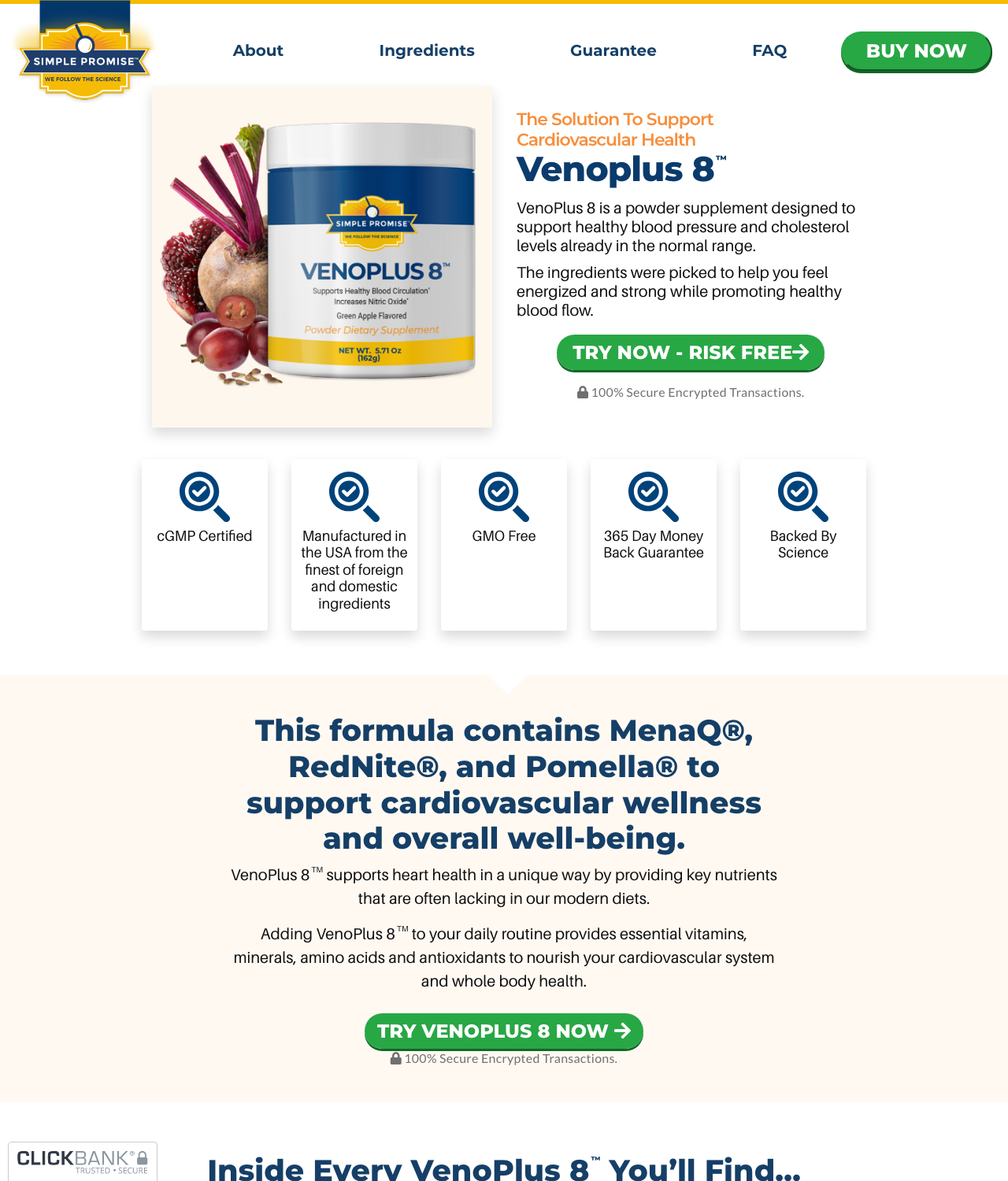
This is the live VENOPLUS 8 - TRENDING Heart Health & Nitric Oxide Offer funnel our verdict is based on. We measure these on-page promises against the evidence, dose math, price, and refund mechanics above — tap the image to see the seller’s current offer and terms.
 Live sales page →
 Here's what I'd actually do
If you opened this at 11 pm and the page made the supplement look like an answer to something larger:
Close this tab. VENOPLUS 8 - TRENDING Heart Health & Nitric Oxide Offer is in the band where the marketing is doing the heavy lifting and the formula is not. There are evidence-based versions of every promise on that sales page, and most of them cost a third of the price with full label transparency.
Don't buy this if: Do not buy this if you have a diagnosed condition that this product is implicitly addressing. See a clinician. A $69 bottle does not replace a $0-with-insurance lab panel.
— Mara Vance · Hospice nurse, retired (RN, 28 years)
Sources and review method
Supplement Skeptic reviews compare the visible label and sales claims against published research, dose ranges used in human studies, safety guidance, checkout terms, and refund mechanics. This page is not medical advice.
- Vendor sales page — ClickBank-listed sales page (active as of catalog import)
Frequently asked questions
- What exactly is in VenoPlus 8?
- The vendor says it contains MenaQ7 (vitamin K2), RedNite (beetroot extract), Pomella (pomegranate extract), and magnesium. But the amounts aren't shown on the sales page. Without a supplement facts panel, you don't know if you're getting 50 mcg or 500 mcg of K2, or whether the magnesium is a meaningful dose or a sprinkle.
- Does VenoPlus 8 really improve blood flow and heart health?
- The ingredients have some research behind them—at specific doses. Beetroot extract, for example, can boost nitric oxide at doses around 500 mg of nitrate. Pomegranate extract has polyphenols. But if VenoPlus 8 underdoses these, you're paying for placebo. Without disclosure, we can't say it works.
- Is the 60-day refund hassle-free?
- ClickBank refunds are processed by ClickBank, not the vendor. You email support with your order ID, and the money comes back in 3–7 business days. The catch: you may have to return the unused product and pay return shipping if the vendor requires it. The sales page doesn't specify return terms, so assume you might eat shipping both ways.
- Why is it so expensive if it's just a powder?
- Trademarked ingredients cost more than generic ones, but the price also reflects the affiliate commission structure. At $79 with a 75% commission, over $59 of your purchase goes to marketing costs and affiliate payouts. You're not just paying for the jar; you're paying for the sales funnel.
More in Diets & Weight Loss