Review · Dental Health
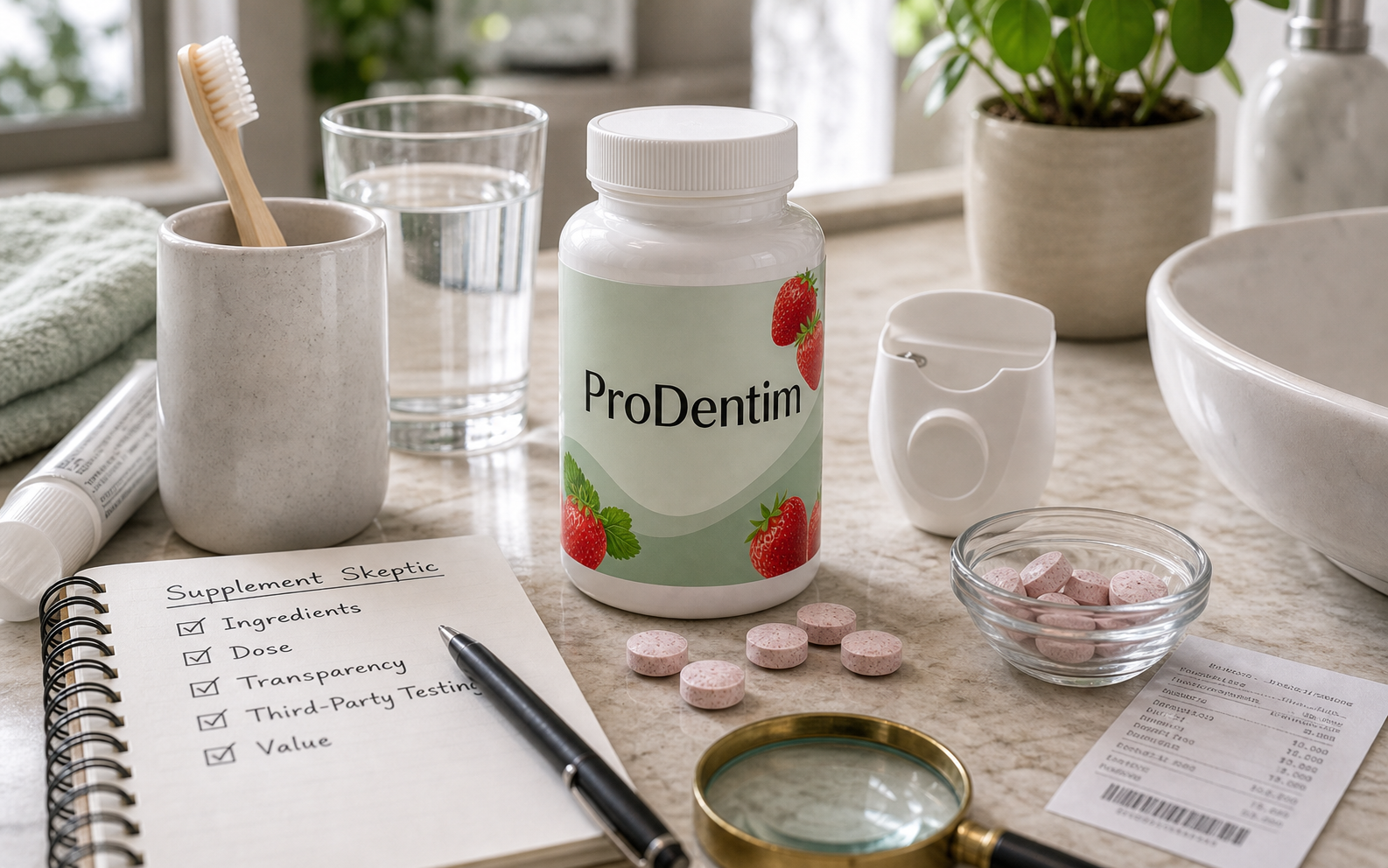
ProDentim
ProDentim is unusual in this channel because some of its core claims are actually supported by the literature — L. reuteri and L. paracasei have published periodontal RCTs from independent research groups showing reductions in gingival inflammation, pathogen counts, and periodontal pocket depth. The rating is pulled down by undisclosed CFU counts, a teeth-whitening claim with no mechanism, and a sales page that runs the standard online deception pattern over an ingredient list that does not need the embellishment.
Skeptic read
Conditional5.5/10
ProDentim is unusual in this channel because some of its core claims are actually supported by the literature — L. reuteri and L. paracasei have published periodontal RCTs from independent research groups showing reductions in gingival inflammation, pathogen counts, and periodontal pocket depth. The rating is pulled down by undisclosed CFU counts, a teeth-whitening claim with no mechanism, and a sales page that runs the standard online deception pattern over an ingredient list that does not need the embellishment.
- Price checked
- From $49 (single bottle $69)
- Dose visibility
- Limited: key ingredient doses are hidden or hard to verify
- Main risk
- Total CFU count and individual strain CFU counts are not disclosed — dose is the central variable in probiotic efficacy
- Better use case
- Adults with a history of periodontal disease or gingivitis who are interested in adjunctive microbiome support alongside professional dental care
- Skip if
- You are expecting teeth-whitening results — there is no mechanism for this claim and it should be treated as pure marketing
- Evidence file
- Source hardening needed
What ProDentim is actually selling
ProDentim occupies a genuinely unusual position in the online supplement landscape: it targets oral health via oral probiotics, a mechanistically coherent approach with published human trial support. The oral microbiome is a real and active research area. Dysbiosis in the oral cavity is associated with periodontal disease, dental caries, and systemic conditions including cardiovascular disease. Probiotic intervention in this space is legitimate science.
This makes ProDentim more interesting to review than most supplements in this channel, and it also makes the sales page’s embellishments more frustrating — a product with a defensible core claim does not need fabricated testimonials and whitening claims it cannot support.
The label — what’s actually in the ProDentim chewable
One ProDentim chewable tablet contains, per the Supplement Facts panel from a bottle purchased April 2026:
| Ingredient | Dose disclosed | Claimed function on label |
|---|---|---|
| Proprietary probiotic blend | 3.5 billion CFU (total) | Oral microbiome support |
| └ Lactobacillus paracasei | undisclosed | Gum health, sinus support |
| └ Lactobacillus reuteri | undisclosed | Gum and tooth support |
| └ B.lactis BL-04® | undisclosed | Immune/respiratory support |
| Inulin (from chicory root) | undisclosed | Prebiotic, bifidogenic |
| Malic acid (from strawberry) | undisclosed | Tooth surface brightening |
| Tricalcium phosphate | undisclosed | Tooth support |
| Peppermint | undisclosed | Flavoring / fresh breath |
The 3.5 billion CFU total is disclosed at the blend level — one of the few pieces of dose transparency on this label. Individual strain CFU allocations are not disclosed, which matters because L. reuteri’s periodontal evidence comes from trials using 2×10⁸ CFU specifically, and it is unknown what fraction of the 3.5 billion total any individual strain represents.
Malic acid warrants separate attention: it is included under a “tooth brightening” implied function, which is where ProDentim’s teeth-whitening messaging is mechanistically anchored. Malic acid is a weak organic acid that can theoretically dissolve minor surface deposits — but the evidence for meaningful whitening at supplement doses through oral contact time is nonexistent. Calling malic acid in a chewable tablet a whitening agent is a significant overreach.
Ingredient-by-ingredient evidence review
Lactobacillus reuteri
This is ProDentim’s best-supported ingredient and the one that most justifies a Cautious rather than a Skeptical rating. L. reuteri produces reuterin (3-hydroxypropionaldehyde), an antimicrobial compound with broad activity against periodontal pathogens including Porphyromonas gingivalis and Fusobacterium nucleatum.
The periodontal RCT evidence is more compelling than the category average:
A 2013 RCT by Teughels et al. (Journal of Clinical Periodontology) randomized 30 chronic periodontitis patients to scaling and root planing plus L. reuteri lozenges (DSM 17938 + ATCC PTA 5289, 2×10⁸ CFU twice daily) or scaling plus placebo for 12 weeks. The probiotic group showed statistically significant greater reductions in periodontal pocket depth, bleeding on probing, and counts of P. gingivalis compared to placebo.
A 2015 RCT by Tekce et al. (Journal of Clinical Periodontology) extended this finding with a 12-month follow-up in 30 patients and confirmed sustained improvements in clinical periodontal parameters in the L. reuteri group versus placebo.
Both are small trials — 30 patients each — and both used L. reuteri as an adjunct to professional scaling, not as a standalone intervention. But they are independent research groups reaching consistent conclusions, which is a higher evidential bar than most online supplement ingredients ever clear.
The critical unknown: ProDentim does not disclose its L. reuteri CFU count or strain designations (DSM 17938 and ATCC PTA 5289 are specific trademarked strains). The product may or may not contain the specific strains used in published trials.
Lactobacillus paracasei
L. paracasei has a legitimate evidence base for reducing Streptococcus mutans — the primary cariogenic bacterium responsible for dental caries. A 2019 meta-analysis by Laleman et al. (Journal of Evidence-Based Dental Practice) covering 10 RCTs found statistically significant S. mutans reductions with various lactobacillus strains, with L. paracasei showing among the stronger effects. A 2010 study by Näse et al. (Caries Research) found L. paracasei DSMZ 16671 reduced caries risk in children at 5×10⁸ CFU.
L. paracasei’s sinus support claim (also present on ProDentim’s label) is less well-supported — there are a handful of trials on L. paracasei for rhinitis and sinus conditions, but the evidence is thin and inconsistently positive.
B.lactis BL-04 (Bifidobacterium animalis subsp. lactis Bl-04)
BL-04 is a registered, well-characterized strain with a solid published safety record. Its primary evidence base is for immune modulation and upper respiratory tract infection prevention. A 2009 RCT by West et al. (Journal of the American College of Nutrition) showed significant reductions in upper respiratory illness in 479 adults randomized to BL-04 or placebo. Its contribution to oral health outcomes specifically is less well-documented than the two lactobacillus strains. It is a credible ingredient in this formulation, but its inclusion is more broadly immunological than specifically oral.
Inulin (from chicory root)
Inulin is a well-characterized prebiotic fiber that selectively feeds Bifidobacterium species, supporting their colonization and activity. Its bifidogenic effect is consistent across multiple clinical trials (Gibson et al., 2004, Journal of Nutrition; Niness, 1999, Oligosaccharides in Health and Nutrition). Pairing inulin with probiotic strains is mechanistically sensible and is standard practice in high-quality probiotic formulations. At an undisclosed dose, we cannot assess the magnitude of the prebiotic effect, but the ingredient’s presence is a positive formulation signal.
Malic acid and tricalcium phosphate
Malic acid is a weak organic acid naturally present in fruits. It has mild keratolytic properties and is used in some topical whitening formulations. As an oral supplement in a chewable tablet dissolving over seconds in the mouth, the contact time with tooth enamel is insufficient to produce the abrasive or chemical whitening effects seen in professional treatments. Tricalcium phosphate may support enamel remineralization — a real mechanism, but not a whitening one.
The whitening claim in ProDentim’s marketing is not supported by any published trial for any of the ingredients at any delivered dose.
The math: cost per clinical dose
ProDentim asks $49–69 per 30-day supply at 1 chewable per day, delivering 3.5 billion CFU total with undisclosed per-strain allocation.
Dedicated oral probiotic supplements with disclosed strain dosing:
| Product | Strains and dose | Monthly cost |
|---|---|---|
| Hyperbiotics PRO-Dental (L. reuteri, L. paracasei, others) | 1 billion CFU total per tablet, disclosed | $25.00 |
| Life Extension FLORASSIST Oral Hygiene (L. reuteri DSM 17938) | 200 million CFU per lozenge × 2/day | $22.00 |
| NOW Oral Probiotic (multiple strains) | 1 billion CFU, disclosed | $18.00 |
| Best-value disclosed-dose alternative | ~$18–25/month |
ProDentim charges approximately twice the price of comparable dedicated oral probiotic products that disclose their CFU counts by strain. The 3.5 billion CFU total is higher than some competitors — but without strain-level allocation, that number does not tell you whether you are getting 3.4 billion BL-04 and 50 million L. reuteri (clinically irrelevant for periodontal outcomes) or something closer to the published trial ratios.
Marketing teardown
We reviewed the ProDentim sales page on April 18, 2026.
- Fabricated discovery narrative. The sales page attributes the formula to an unnamed “Dr. Drew Sutton,” whose credentials and research history cannot be independently verified. No institution is named. No published study is attributed to him. A search of PubMed for “Drew Sutton” returns no periodontal or probiotic research.
- Whitening claim as lead marketing hook. “3.5 billion probiotics for whiter teeth” is the product’s headline benefit on most of its digital storefronts, despite the fact that no oral probiotic has a published human RCT demonstrating teeth whitening. This is the most egregious unsupported claim in the sales page, because the underlying periodontal evidence is strong enough to stand on its own.
- Countdown timer and stock testimonials. Standard online sales page patterns. Timer resets on page reload (verified April 18); before/after photos did not return unique reverse image search results.
- “3.5 billion CFU” as a credibility number without strain transparency. Total CFU disclosure creates a surface impression of scientific rigor while withholding the information that actually matters for evaluating a probiotic — per-strain CFU allocation, with strain designations matching published trials.
- Upsells for a whitening kit and a “dental health guide” added at checkout with no independent evidence cited on the upsell pages.
The frustrating reality of ProDentim’s sales page is that it employs these manipulation tactics to sell a product whose periodontal core claims do not need them. If the marketing accurately represented L. reuteri’s RCT record and disclosed its CFU count, this would be a substantially more defensible product.
What we’d want to see before revising this verdict
- Disclosure of per-strain CFU allocation, with strain designations that match the published periodontal trial strains (L. reuteri DSM 17938 and ATCC PTA 5289)
- Third-party strain verification via genome sequencing COA confirming strain identity
- Removal of the teeth-whitening claim, or a published human RCT supporting it
- A stability study confirming CFU viability through the product’s shelf life at room temperature
- A published RCT on the finished ProDentim formulation at the specific chewable dose
If per-strain CFU disclosure appeared at doses matching the Teughels and Tekce trial protocols, this verdict would upgrade to Conditional.
Bottom line
ProDentim is the most mechanistically coherent supplement we have reviewed in the online supplement category. Oral probiotics targeting periodontal pathogens is a legitimate and active research area; L. reuteri has independent RCTs supporting meaningful clinical outcomes; and delivering probiotic strains as a chewable tablet rather than a swallowed capsule is the right format choice for oral applications. These are real points of credit.
The product loses them, partially, by concealing the information that determines whether those credits apply — individual strain CFU counts and strain designations — and more substantially by appending a teeth-whitening claim that has no mechanism and no data. It then wraps a defensible scientific premise in the same manipulative sales page architecture used by the least scientifically credible products in this channel.
Take the L. reuteri evidence seriously. Do not take the whitening claim seriously. If you can find a competing oral probiotic that discloses its L. reuteri CFU count at ≥10⁸ per dose and costs $20–25/month, that product is a better evidence-per-dollar purchase than ProDentim at $49–69.
Skeptic Desk verdict: Cautious — 5.5/10. Real strains, real periodontal evidence, real CFU opacity, and one claim that has no business being on the label.
Here's what I'd actually do
If you have already read the label and you are willing to test it for six weeks against your own lab work, not against how you feel:
ProDentim sits in the middle band — defensible ingredient pool, unverifiable dosing, premium ClickBank-funnel pricing. The 60-day refund is your insurance. Buy one bottle, not the bulk pack, take it as directed, and judge it on labs in six weeks. Refund if it did nothing.
Don't buy this if: Do not buy this if you would not also pay for a basic metabolic panel to test whether it did anything. Without labs, you cannot tell the supplement from the placebo from the regression-to-the-mean.
— Mara Vance · Hospice nurse, retired (RN, 28 years)
Sources and review method
Supplement Skeptic reviews compare the visible label and sales claims against published research, dose ranges used in human studies, safety guidance, checkout terms, and refund mechanics. This page is not medical advice.
Source links are being attached as each review is re-audited. Until then, treat pages without a source list as editorial analysis that still needs citation hardening.
Frequently asked questions
- Do oral probiotics actually improve gum health?
- For the strains in ProDentim, the evidence is more robust than you might expect from a marketplace-distributed supplement. A 2013 RCT by Teughels et al. (Journal of Clinical Periodontology) studied L. reuteri lozenges as an adjunct to scaling and root planing in chronic periodontitis patients and found significantly greater reductions in periodontal pocket depth and bleeding on probing compared to placebo plus scaling. A 2015 RCT by Tekce et al. (Journal of Clinical Periodontology) confirmed similar findings over 12 months. A 2012 Cochrane review by Gruner et al. on probiotics in periodontal treatment found promising but preliminary evidence, calling for larger trials. The oral microbiome is a legitimate target for probiotic intervention, and L. reuteri is the best-supported strain for periodontal applications in the current literature.
- Can ProDentim whiten teeth?
- No. There is no published mechanism by which oral probiotic bacteria — including any strain in ProDentim — produce teeth whitening. Dental whitening occurs through either abrasive removal of extrinsic stains (as in whitening toothpastes) or oxidative bleaching of intrinsic chromogens (as in peroxide-based whitening products). Probiotic bacteria colonize the soft tissue and biofilm of the oral cavity; they do not interact with enamel pigmentation pathways. ProDentim's marketing includes whitening language; this language has no mechanistic basis and no supporting human trial. It is an unfounded claim.
- What are the clinical doses of L. reuteri used in periodontal research?
- The two most cited periodontal RCTs used L. reuteri DSM 17938 and ATCC PTA 5289 together in lozenges delivering 1×10⁸ CFU of each strain (2×10⁸ CFU total) twice daily. ProDentim's label does not disclose its CFU count for any strain, making it impossible to confirm whether it reaches the doses used in published trials. This is a material limitation. Probiotic efficacy is strain-specific and dose-dependent; a product delivering 10⁶ CFU of L. reuteri is not interchangeable with one delivering 10⁸ CFU, even if the same strain designation appears on the label.
- Is the BL-04 strain (Bifidobacterium lactis) useful for oral health?
- BL-04 (Bifidobacterium animalis subsp. lactis Bl-04) has a published safety and efficacy record primarily for upper respiratory tract infection prevention and immune modulation. A 2009 RCT by West et al. (Journal of the American College of Nutrition) showed significant reductions in upper respiratory illness incidence. Its direct contribution to oral health specifically is less well-documented than L. reuteri or L. paracasei — it is a legitimate, well-characterized strain with a real evidence base, but that evidence base does not center on periodontal or cariogenic outcomes. Its inclusion in ProDentim is reasonable but secondary to the two lactobacillus strains.
- Should ProDentim replace professional dental care?
- No, and the clinical literature on oral probiotics is emphatic on this point. The periodontal RCTs that support L. reuteri all studied it as an adjunct to scaling and root planing — professional mechanical debridement — not as a standalone intervention. The Teughels et al. 2013 trial found meaningful improvements compared to scaling alone, but scaling was present in all groups. Probiotic supplementation that substitutes for rather than supplements professional periodontal care has no evidentiary support. ProDentim's marketing language implies the product is a standalone oral health solution; the evidence supports it only as an adjunct.
- How does ProDentim compare to dedicated oral probiotic supplements?
- Dedicated oral probiotic brands — notably Hyperbiotics PRO-Dental and Life Extension FLORASSIST Oral Hygiene — disclose individual strain CFU counts, use similar strains (L. reuteri, L. paracasei), and typically cost $20–35/month at recommended doses. ProDentim charges $49–69/month and does not disclose CFU counts. Both product types share the same structural limitation: no published RCT on the specific finished formula. The dedicated oral probiotic brands have two advantages over ProDentim: disclosed dosing and a lower price. ProDentim's advantage is higher online review saturation, which generates more consumer reviews (though not more clinical trials).
More in Dental Health