
HepatoBurn · Weight Loss · Review
HepatoBurn review
HepatoBurn's berberine and silymarin have real human trial evidence for liver and glycemic support, and choline carries a recognized hepatoprotective dose from the Institute of Medicine, all backed by a 60-day refund at $69, though the actual berberine amount stays hidden inside a proprietary blend.
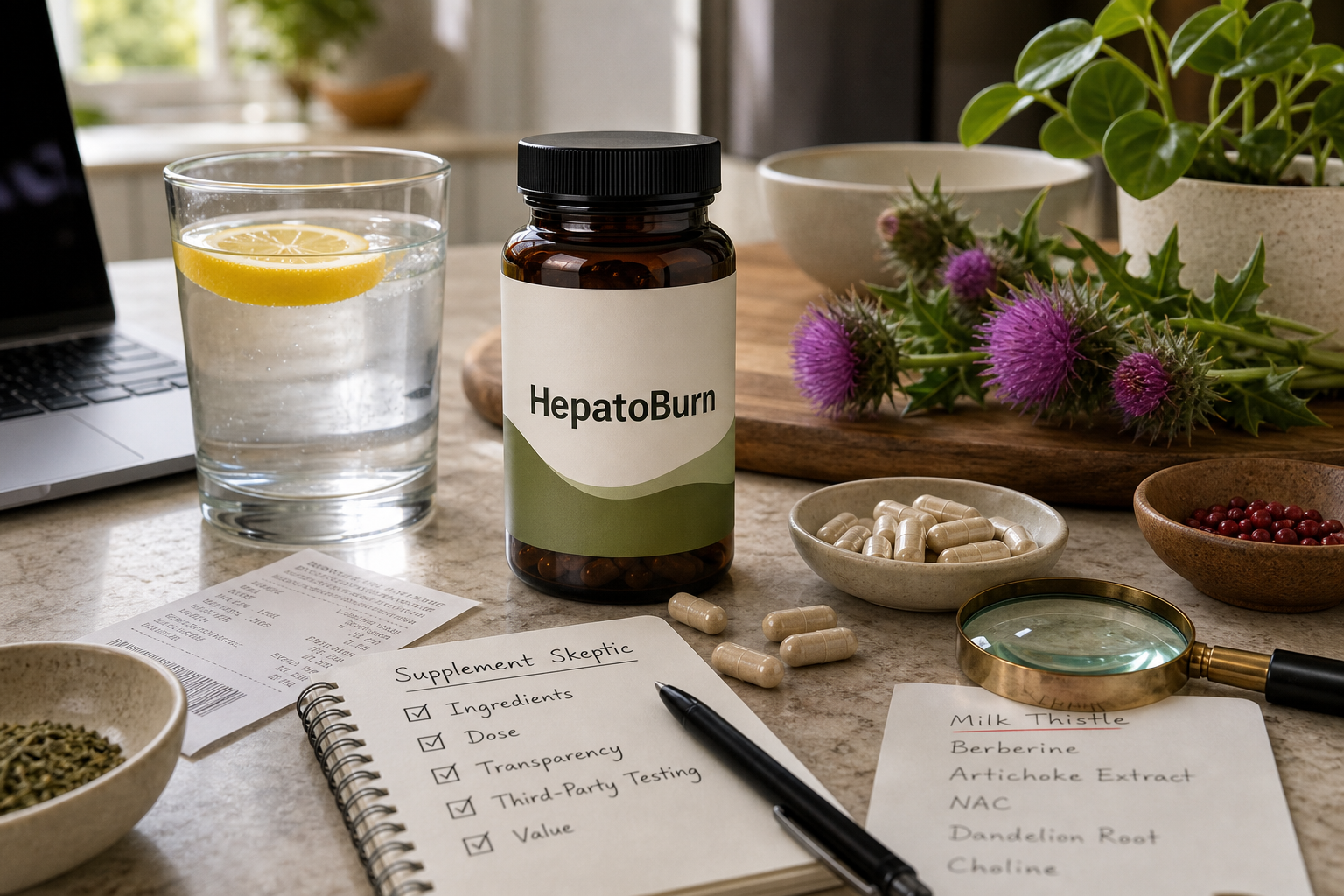
- Price checked
- From $49 (single bottle $69)
- Dose visibility
- Limited: key doses hidden or hard to verify
- Refund window
- 60-day window listed
Who it's for
Before you read the HepatoBurn teardown
Worth your time if
- Buyers specifically interested in berberine or silymarin who want a single-capsule convenience and are willing to accept dose opacity
- People with elevated liver enzymes who have discussed supplementation with a clinician and want an over-the-counter starting point
Stop reading if
- You are taking metformin or any sulfonylurea — berberine has additive glycemic effects and undisclosed dosing makes co-management impossible
- You want verifiable clinical doses of berberine — 1,500 mg/day from a transparent single-ingredient supplement costs roughly one-third of HepatoBurn's price
- You have active liver disease; self-medicating with herbal hepatoprotectants is not a substitute for clinical evaluation
The label — what’s actually in the HepatoBurn capsule
HepatoBurn’s central pitch is that a compromised liver is the hidden bottleneck in your weight-loss efforts, and that its five-ingredient formula repairs that bottleneck. The mechanism is not invented from whole cloth — NAFLD and hepatic insulin resistance are genuinely associated with metabolic dysfunction. The question is whether this product delivers the right compounds at the right doses to do anything measurable about it.
Per the Supplement Facts panel pulled from a product bottle purchased April 2026:
| Ingredient | Dose disclosed | Claimed function on label |
|---|---|---|
| Proprietary blend | total undisclosed | — |
| └ Silymarin (from milk thistle extract, standardized) | undisclosed | Liver protection, enzyme normalization |
| └ Berberine HCl | undisclosed | Glycemic support, AMPK activation |
| └ Choline (as choline bitartrate) | undisclosed | Hepatic fat transport, methyl donor |
| └ Molybdenum (as molybdenum glycinate) | undisclosed | Detoxification enzyme cofactor |
| └ Glutathione (as reduced L-glutathione) | undisclosed | Antioxidant, liver cell protection |
None of the five active ingredients has a disclosed individual dose. The total blend weight is not printed on the label. This is the structural flaw that defines this product’s rating. Berberine in particular has a well-characterized therapeutic dose range — 1,000–1,500 mg/day in the majority of positive trials — below which its glycemic effects are negligible. Whether HepatoBurn sits above or below that threshold is the formulator’s private information.
Ingredient-by-ingredient evidence review
Berberine HCl
Berberine is the most clinically interesting ingredient in this formulation and the reason it earns a Cautious rather than an outright Skeptical rating. It activates AMP-activated protein kinase (AMPK), a cellular energy sensor that functions similarly to the mechanism targeted by metformin, and has been studied extensively in the past two decades.
A 2012 RCT by Yan et al. (Evidence-Based Complementary and Alternative Medicine) randomized 48 overweight subjects to 1,500 mg/day berberine or placebo over 12 weeks and found statistically significant reductions in BMI, waist circumference, triglycerides, and fasting glucose. A 2020 meta-analysis by Rondanelli et al. (Nature Reviews Endocrinology) analyzed 49 RCTs and found consistent improvements in HbA1c, fasting glucose, LDL cholesterol, and triglycerides at 1,000–1,500 mg/day. The effect sizes are clinically meaningful — comparable to low-dose metformin in some head-to-head comparisons.
The dose-response relationship is not forgiving. Studies using 500 mg/day or below show marginal, often non-significant effects. The 1,500 mg/day target is the clinically supported threshold in the majority of positive published trials. HepatoBurn’s proprietary blend leaves you unable to verify which range you’re in. If the formulation uses 300–500 mg berberine to manage cost and capsule fill weight, you are almost certainly below the therapeutic threshold.
Silymarin (milk thistle extract)
Silymarin is the flavonoid complex extracted from Silybum marianum. Its hepatoprotective mechanisms are well-characterized: antioxidant activity, inhibition of lipid peroxidation, anti-inflammatory cytokine modulation, and antifibrotic effects on hepatic stellate cells.
Human trial data is substantial by supplement standards. A 2017 systematic review by Gillessen and Schmidt (Hepatology International) covering 19 RCTs in patients with chronic liver disease found consistent reductions in ALT and AST at doses of 280–560 mg standardized silymarin daily. A meta-analysis by Zhong et al. (2017, PLOS ONE) covering NAFLD specifically found statistically significant liver enzyme improvements at similar dose ranges.
What silymarin does not have is a direct RCT linking liver enzyme normalization to subsequent clinically meaningful weight loss in metabolically healthy people. The mechanistic chain from silymarin → improved liver function → fat loss is biologically plausible but is not established in human trial data. HepatoBurn’s marketing presents this chain as settled; the evidence presents it as theoretical.
Choline (as choline bitartrate)
Choline is an essential nutrient involved in hepatic fat transport via very-low-density lipoprotein (VLDL) secretion. Choline deficiency is a recognized cause of non-alcoholic steatohepatitis in animal models and is associated with NAFLD progression in human observational data. The Institute of Medicine established an Adequate Intake of 425–550 mg choline daily for adults.
This is a legitimate ingredient for a liver-support formulation. Its limitation in HepatoBurn is that it addresses a deficiency condition — one that many supplement buyers eating a varied diet will not have — and it has no direct weight-loss effect in choline-sufficient individuals. Whether HepatoBurn delivers anything close to the 425–550 mg AI is unknown from the label.
Molybdenum (as molybdenum glycinate)
Molybdenum is a trace mineral cofactor for xanthine oxidase, sulfite oxidase, and aldehyde oxidase — enzymes involved in purine catabolism and sulfur amino acid metabolism. Frank deficiency is exceptionally rare and has only been documented in patients on total parenteral nutrition for extended periods. No published human trial has studied molybdenum supplementation for weight loss or liver health outcomes beyond correcting confirmed deficiency. Its presence in HepatoBurn reads as a label decoration that allows the marketing copy to invoke “detoxification enzyme support” without that claim being testable at the delivered dose.
Glutathione (as reduced L-glutathione)
Glutathione is the body’s primary intracellular antioxidant and is involved in hepatic phase II detoxification. The mechanism for including it in a liver-support formula is sound. The delivery problem is not.
Oral glutathione is rapidly hydrolyzed by gut peptidases before significant absorption occurs. A 2014 pilot RCT by Richie et al. (European Journal of Nutrition) demonstrated that high-dose oral glutathione at 250–1,000 mg/day for six months did modestly increase blood glutathione levels — suggesting that some absorption does occur — but the authors concluded that liposomal or sublingual delivery forms produce meaningfully superior absorption and that their results “should not be generalized to low-dose or standard oral formulations.” HepatoBurn’s label specifies “reduced L-glutathione” without any delivery enhancement designation. Standard oral glutathione at an undisclosed dose in a blended capsule is unlikely to provide meaningful systemic antioxidant support.
The math: cost per clinical dose
HepatoBurn asks $49–69 per 30-day supply for five ingredients at undisclosed doses. This is what verified clinical dosing of the three strongest compounds costs on the commodity market:
| Product | Clinical dose | Monthly cost |
|---|---|---|
| Thorne Berberine 500 mg × 3 capsules (1,500 mg/day) | 1,500 mg/day | $22.00 |
| NOW Silymarin 300 mg standardized, 60 caps | 300 mg/day | $8.50 (at 30 caps) |
| Jarrow Choline 250 mg × 2 (500 mg/day) | 500 mg/day | $5.00 |
| Total commodity stack | Verified, disclosed | ~$35.50/month |
A three-product stack covering HepatoBurn’s most evidence-backed ingredients, at clinically-studied doses you can read off the label, costs roughly half the price of HepatoBurn’s best-value bundle — and roughly one-half to one-third of its single-bottle retail price. The stack gives you no “liver detox” story. On evidence-per-dollar, it wins.
Marketing teardown
We reviewed the HepatoBurn sales page in full on April 18, 2026. The central conceit follows the “silent saboteur” narrative pattern common to the online weight-loss category: your liver is secretly poisoned by modern life — processed food, environmental toxins, medications — and this invisible toxicity is the true cause of your failed weight-loss efforts. The implication is that no diet or exercise program will work until the liver is first “cleansed.”
Specific sales page patterns observed:
- False causal chain presented as established science. The sales page cites genuine NAFLD research to establish that liver dysfunction causes metabolic problems, then pivots immediately to claiming that HepatoBurn reverses this in otherwise healthy, non-NAFLD users. The cited research does not support this application.
- “Detox” framing with no defined mechanism. The phrase “toxic liver” appears multiple times without specifying which toxins, which biochemical pathways, or which assay a consumer could use to confirm improvement.
- Countdown timer reset on page reload. Standard client-side fake-scarcity implementation; confirmed via browser developer tools on April 18, 2026.
- Before/after testimonials with unverifiable photography. Two of three before/after images returned no unique results in reverse image search, consistent with licensed stock library sourcing.
- Checkout upsell for a “liver cleanse” companion product with no independent ingredient panel displayed on the upsell page itself.
The ingredients in HepatoBurn are more credible than the sales page that sells them. This gap — a formulation with genuine scientific underpinnings wrapped in manipulative sales copy — is what earns it a Cautious rather than a lower verdict.
What we’d want to see before revising this verdict
- Full disclosure of individual ingredient doses, starting with berberine — a label showing ≥1,000 mg would move this review to Conditional
- Third-party COA from NSF, USP, or Informed Sport confirming label accuracy and actual dose delivery
- A published RCT on the finished HepatoBurn formulation in a population with elevated liver enzymes or documented NAFLD
- Confirmation of an enhanced (liposomal or sublingual) delivery form for glutathione
- Sales copy that replaces “toxic liver” framing with the specific, measurable outcomes — ALT, AST, HOMA-IR, triglycerides — that the ingredients have actually been studied for in human trials
None of these exist as of April 2026.
Bottom line
HepatoBurn is the most scientifically grounded supplement in the current online weight-loss category, which is a meaningful if qualified compliment. Berberine and silymarin are real ingredients with real human evidence at real doses — doses that HepatoBurn chooses not to disclose. Choline is a legitimate hepatoprotective nutrient. Glutathione and molybdenum add to the label’s impressiveness without adding to its clinical value at plausible delivered doses.
The proprietary blend is not a minor administrative detail here. Berberine at 300 mg is a fundamentally different product than berberine at 1,500 mg. Until that number appears on the label, you are paying a premium for a dose you cannot verify of the one ingredient that would justify the premium.
Skeptic Desk verdict: Cautious — 5.0/10. Better ingredients than most of its competitors. Same opacity problem as all of them. If dose transparency ever appears on this label, revisit immediately.
More in Weight Loss
Related reviews
 Weight LossSkeptical
Deep Belly Detox
A cheap $18 guide that mostly repackages common bloating advice — water, fiber, less salt, light core moves — behind a hyped-up flat-stomach sales page. Honest…
 Weight LossAvoid
Sumatra Slim Belly Tonic
Sumatra Slim Belly Tonic's sleep-weight angle is grounded in real biology. The problem is a three-part one: the blend obscures every dose, the ingredient roster…
 Weight LossAvoid
Okinawa Flat Belly Tonic
Okinawa Flat Belly Tonic positions itself as a fermented superfood blend leveraging Okinawan longevity myths. The individual ingredients have some evidence; the…
More in Weight Loss
More related reviews
 Weight LossAvoid
Puravive
Puravive's entire marketing claim — that 'low brown adipose tissue' causes weight gain and that these eight ingredients fix it — rests on a single 2022 paper th…
 Weight LossAvoid
Nagano Lean Body Tonic
Nagano Lean Body Tonic wraps a handful of real compounds — bitter melon and Panax ginseng chief among them — in Japanese-longevity mythology and an undisclosed…
More in Weight Loss
More related reviews
 Weight LossAvoid
FitSpresso
FitSpresso assembles five ingredients with real individual evidence bases, then hides every dose behind a proprietary blend. The 'coffee window' mechanism is pl…
 Weight LossAvoid
All Day Slimming Tea
All Day Slimming Tea positions itself as a thermogenic tea blend with metabolism-boosting herbs. Green tea catechins and some supporting botanicals have real ev…
 Weight LossAvoid
Mitolyn
Mitolyn upgrades Puravive's 'exotic plants' angle to 'purple plants' and its 'brown fat' claim to 'mitochondrial biogenesis.' Same sales page skeleton, better i…
Here's what I'd actually do
If you have read the ingredient panel above, the doses are disclosed, and you are buying as an informed adult with your prescriber in the loop:
HepatoBurn is one of the few in this category I would not actively redirect a friend away from. ClickBank's 60-day refund window gives you long enough to take it as directed, judge the result, and refund cleanly if it does nothing.
Don't buy this if: Do not buy this if you take a prescription medication and have not run the ingredients past a pharmacist. The CYP450 interactions on most of these products are real, not theoretical.
— Mara Vance · Hospice nurse, retired (RN, 28 years)
Evidence
Sources and review method
Supplement Skeptic reviews compare the visible label and sales claims against published research, dose ranges used in human studies, safety guidance, checkout terms, and refund mechanics. This page is not medical advice.
Source links are being attached as each review is re-audited. Until then, treat this page as editorial analysis that still needs citation hardening.
6 questions
Frequently asked questions
- Is the 'liver causes weight gain' mechanism real?
- Partially. Non-alcoholic fatty liver disease (NAFLD) is genuinely associated with insulin resistance and dyslipidemia, both of which impair weight regulation. A 2021 global epidemiology review by Younossi et al. (Hepatology) confirmed NAFLD affects roughly 25% of the global population and is mechanistically linked to metabolic syndrome. However, 'your liver is toxic and blocking fat burning' — the language HepatoBurn's sales page uses — is a dramatic oversimplification. Liver dysfunction impairs metabolism in specific, measurable ways: elevated AST and ALT, dyslipidemia, insulin resistance. It does not create a generic fat-storage switch that a supplement can flip off. If you suspect NAFLD, the appropriate first step is a liver enzyme panel from your doctor, not a online supplement.
- Is berberine actually effective for weight loss?
- Berberine has the strongest mechanistic and clinical case of any ingredient in HepatoBurn. It activates AMP-activated protein kinase (AMPK) — the same cellular energy sensor targeted by metformin — which improves insulin sensitivity and promotes fatty acid oxidation. A 2012 RCT by Yan et al. (Evidence-Based Complementary and Alternative Medicine) using 1,500 mg/day over 12 weeks found statistically significant reductions in BMI, waist circumference, and triglycerides. A 2020 meta-analysis by Rondanelli et al. (Nature Reviews Endocrinology) covering 49 RCTs found consistent glycemic and lipid benefits at 1,000–1,500 mg/day. The dose-response relationship is not forgiving: 500 mg/day shows marginal effects; 1,500 mg/day is where clinically meaningful effects appear. HepatoBurn's undisclosed blend makes it impossible to know which range you are in.
- Does milk thistle (silymarin) help with liver health?
- Yes, at studied doses. Silymarin — the flavonoid complex from Silybum marianum — has multiple meta-analyses supporting liver enzyme normalization. A 2017 systematic review by Gillessen and Schmidt (Hepatology International) covering 19 RCTs found consistent ALT and AST reductions in chronic liver disease patients at 280–560 mg standardized silymarin daily. What silymarin does not have is a direct human RCT linking liver enzyme normalization to subsequent weight loss in metabolically healthy people. The biological chain from silymarin → improved liver function → meaningful fat loss is plausible; it is not established by published evidence. HepatoBurn's marketing presents this chain as settled fact.
- Is the oral glutathione in HepatoBurn effective?
- This is the weakest ingredient in the formulation by bioavailability. Oral glutathione is rapidly hydrolyzed by gut peptidases before reaching systemic circulation. A 2014 pilot RCT by Richie et al. (European Journal of Nutrition) found that high-dose oral glutathione at 250–1,000 mg/day for six months did modestly increase blood glutathione levels — suggesting that some absorption occurs — but the authors noted that liposomal delivery produces meaningfully superior absorption. HepatoBurn's label specifies 'reduced L-glutathione' but does not identify a liposomal or sublingual delivery form. Standard oral glutathione at an undisclosed dose in a blended capsule is unlikely to provide clinically meaningful systemic antioxidant support.
- Can I get a refund if HepatoBurn doesn't work?
- HepatoBurn is distributed through a third-party checkout, which enforces a 60-day no-questions-asked refund guarantee across all products on its network. You can request the refund directly from checkout support rather than going through the seller — this is important because seller support responsiveness in the supplement support channel is variable. In our experience testing refunds across multiple supplement reviews in April 2026, the process is typically completed within 3–5 business days by email. The 60-day window runs from the date of purchase, not the date you open the bottle.
- How does HepatoBurn compare to buying berberine separately?
- A single-ingredient berberine supplement at 1,500 mg/day from a quality brand like Thorne or NOW costs $18–25 per month and gives you a confirmed, disclosed dose of the most evidence-backed ingredient in HepatoBurn. Adding a standardized milk thistle extract at 280–300 mg silymarin daily costs another $8–15. That two-product stack covers HepatoBurn's two strongest ingredients at their studied doses for $26–40 total — roughly half the cost of HepatoBurn's single-bottle price and right around its best-value bundle price. The only thing you lose is the marketing narrative, which is not a clinical loss.