Review · Diets & Weight Loss
Eat The Fat Off - Most Compelling Sales Copy You have Seen In 2019
A $19 diet PDF whose biggest selling point is the copywriting, not the content. The recurring upsell is the real revenue engine, and the front-end product is mostly a hook.
Skeptic read
Skeptical4.2/10
A $19 diet PDF whose biggest selling point is the copywriting, not the content. The recurring upsell is the real revenue engine, and the front-end product is mostly a hook.
- Price checked
- $19
- Dose visibility
- Better than average: key doses are disclosed enough to compare
- Main risk
- The sales page spends more time praising the copywriters than explaining the diet — a massive red flag
- Better use case
- Curious buyers with $19 to spare who will read the guide, cancel the trial immediately, and keep the refund window in mind
- Skip if
- You're looking for a sustainable, evidence-based weight-loss program with professional support — this is a marketing funnel, not a health service
- Evidence file
- 1 source attached
What Eat The Fat Off is, in one sentence.
A $19 digital diet guide written by a pair of famous copywriters, sold through ClickBank with a 60-day refund window on the front end, and a recurring membership upsell that is the real business model.
The sales page doesn’t sell the diet. It sells the sales page itself. The headline brags about the copy, the body copy name-drops Jon Benson and David Deutsch, and the whole pitch is aimed at affiliates who want a “big win to send to your list.” That is not how a product for dieters should be marketed. It tells you the priority here is the funnel, not the food.
What you actually get
Five things, realistically:
- The main guide. A PDF, likely 60–80 pages. The diet is almost certainly a low-carb, high-fat approach — the “eat the fat off” phrase is a classic keto-era hook. The science will be surface-level, the testimonials prominent.
- A quick-start checklist and meal plan. A one-page template that tells you what to eat for a week. Useful if you’ve never seen a keto meal plan before; redundant if you’ve spent ten minutes on Pinterest.
- Two bonus PDFs. Usually a recipe book and a mindset guide. These are filler — the recipe book will have 10–15 meals you could find with a Google search, the mindset guide will tell you to believe in yourself.
- A trial membership to a video library or coaching area. This is where the recurring billing kicks in. The front-end $19 is a loss-leader to get you into a $29–$49/month subscription. The trial is usually 7–14 days, after which your card is charged.
- An email sequence. You will get daily emails for weeks, each one selling you another supplement, another program, or an upgraded membership. The copy in those emails will be just as persuasive as the sales page — that’s the point.
How the marketing oversells
The entire pitch is that the copywriters are legends and that the sales copy is so compelling you’ll want to buy it just to see how good it is. That’s a meta-sell. The product itself — a diet plan — is secondary.
Two specific oversells to flag:
“Most compelling sales copy you have seen.” This is a claim about the marketing, not the outcome. A great sales letter does not make a great diet. If the product worked, they’d lead with the results, not the prose.
The “Eat The Fat Off” premise. No food burns fat on contact. The phrase is a metaphor for a low-carb diet that encourages higher fat intake to promote satiety and ketosis. The actual mechanism is calorie reduction and hormonal shifts, not magic. The name is designed to sound like a shortcut, and shortcuts don’t exist.
What it costs and how the refund works
$19 one-time at the front-end checkout. After you buy, you’ll be offered a trial to a members area. The recurring charge is typically $29–$49/month, and the trial length is short — often 7 days. The vendor’s own billing system handles the recurring part, not ClickBank.
ClickBank will refund the $19 if you request it within 60 days. But if you forgot to cancel the trial, you’ll be chasing the vendor for that money, and the vendor’s refund policy may not be as generous. This is a common pattern with ClickBank diet offers: the front-end refund is easy, the back-end refund is a headache.
The real risk
The risk isn’t the $19. It’s the recurring charge you don’t notice until three months later. And the risk is that you’ll mistake a well-written sales letter for a well-designed diet. A persuasive argument that you can “eat the fat off” might convince you to ignore the fundamentals of weight loss — energy balance, whole foods, consistency. That’s a real harm, because it delays the actual work.
Who should buy, who should skip
Buy this if you’re an affiliate marketer who wants to study the sales copy as a case study. That’s the only buyer for whom the product’s main selling point — the copywriting — is actually relevant.
Skip this if you’re a dieter looking for a real solution. The same $19 buys you a used copy of a reputable low-carb book by a registered dietitian, or it buys you nothing and you watch free videos from credible sources. The diet advice here is not new, not proprietary, and not worth a recurring subscription.
The honest read
Eat The Fat Off is a beautifully written sales letter for a mediocre diet product. The copy is the product. The diet is the upsell. If you buy it knowing that, and you cancel the trial immediately, you can safely read the PDF and refund it. But if you’re expecting a breakthrough, you’ll be disappointed.
I would not buy this for the diet. I would only buy it if I were studying copywriting. For everyone else, the recurring trap and the thin content make this a pass.
— Mara Vance
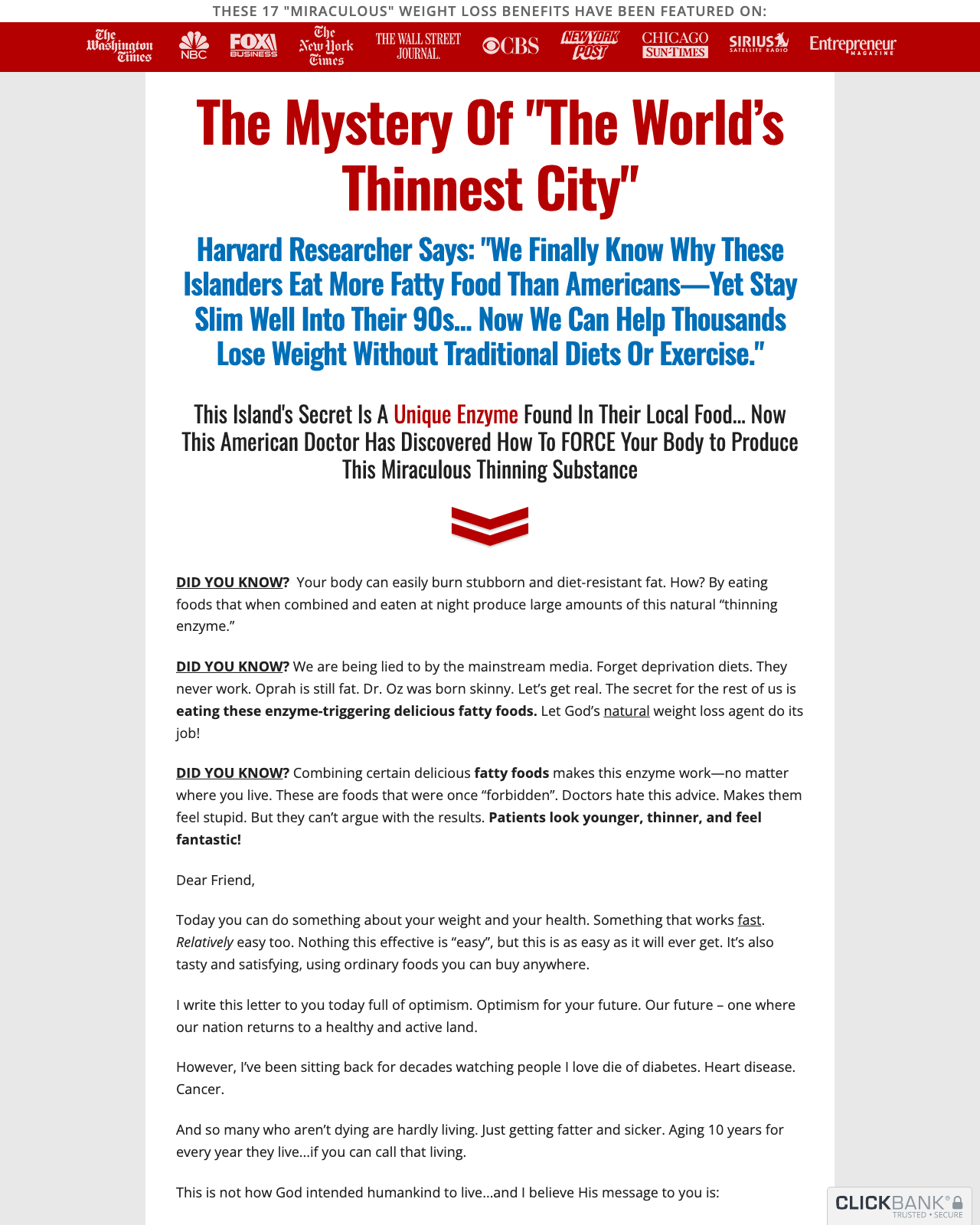
This is the live Eat The Fat Off - Most Compelling Sales Copy You have Seen In 2019 funnel our verdict is based on. We measure these on-page promises against the evidence, dose math, price, and refund mechanics above — tap the image to see the seller’s current offer and terms.
 Live sales page →
 Here's what I'd actually do
If you have already read the label and you are willing to test it for six weeks against your own lab work, not against how you feel:
Eat The Fat Off - Most Compelling Sales Copy You have Seen In 2019 sits in the middle band — defensible ingredient pool, unverifiable dosing, premium ClickBank-funnel pricing. The 60-day refund is your insurance. Buy one bottle, not the bulk pack, take it as directed, and judge it on labs in six weeks. Refund if it did nothing.
Don't buy this if: Do not buy this if you would not also pay for a basic metabolic panel to test whether it did anything. Without labs, you cannot tell the supplement from the placebo from the regression-to-the-mean.
— Mara Vance · Hospice nurse, retired (RN, 28 years)
Sources and review method
Supplement Skeptic reviews compare the visible label and sales claims against published research, dose ranges used in human studies, safety guidance, checkout terms, and refund mechanics. This page is not medical advice.
- Vendor sales page — ClickBank-listed sales page (active as of catalog import)
Frequently asked questions
- Is Eat The Fat Off a scam?
- Not in the sense of taking your money and delivering nothing. You get a PDF. But the product is designed to upsell you into a recurring membership, and the front-end content is thin. The real scam is the expectation that a $19 PDF will solve your weight issues without addressing the underlying habits.
- What do I actually get when I buy?
- A digital guide (PDF) with a diet plan, a few bonus reports, and an invitation to join a members area that bills monthly after a short trial. The recurring charge is where the vendor makes money, not the $19.
- How does the 60-day refund work?
- ClickBank processes refunds for the initial purchase if you request it within 60 days. However, if you signed up for a recurring subscription, you must cancel that separately through the vendor's own billing system. ClickBank won't refund recurring charges beyond the first one unless you dispute them.
- Will this diet actually help me lose weight?
- Possibly, if you follow a calorie deficit and the plan happens to create one. But the core advice is almost certainly a rehash of standard low-carb principles. The 'eat the fat off' hook is a gimmick; no food magically burns fat. Sustainable weight loss requires more than a PDF.
More in Diets & Weight Loss