
Ingredient pillar · Cognitive / sleep
L-theanine: what the evidence actually says
L-theanine is a rare thing in the supplement category: an ingredient with a real, reproducible short-term effect, a clean safety record, and a studied dose that fits comfortably inside a single capsule. It is not a fat burner.
- theanine
- Suntheanine
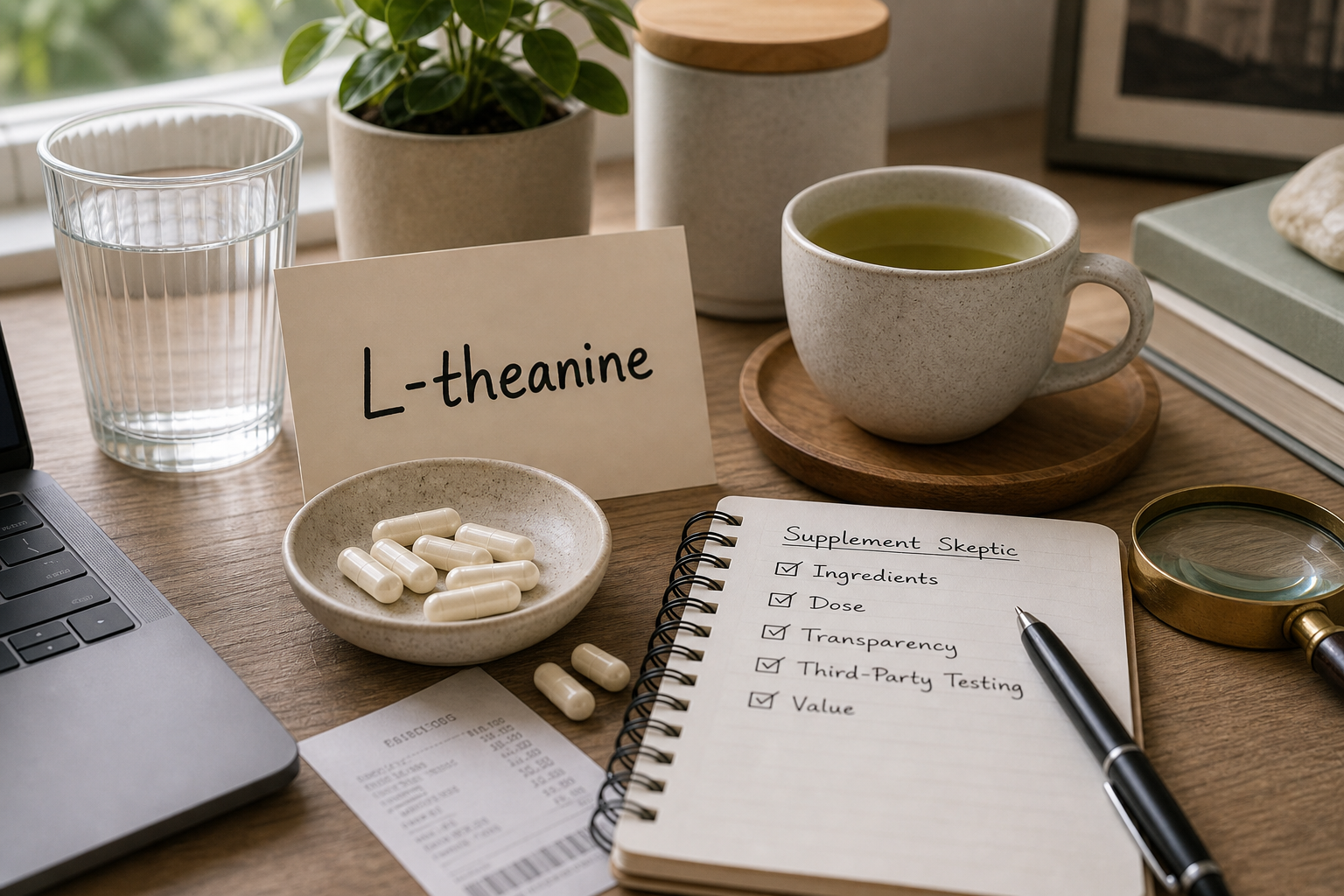
What it is
L-theanine is an amino acid found almost exclusively in tea leaves and a few mushroom species. Black, green, and white tea all contain it; the concentration in a typical brewed cup is 25–50 mg.
Supplemental L-theanine is produced via fermentation. The branded form Suntheanine is the most studied and is what most well-formulated capsules use; generic L-theanine is chemically identical and substantially cheaper.
On a label, look for the actual mg of L-theanine, not "tea leaf extract" with theanine listed as a component. The latter usually delivers a fraction of the dose.
What the marketing claims
The phrasing on a supplement label or sales page tends to recycle a few patterns. L-theanine usually shows up wearing one of these:
- "Reduces stress and anxiety."
- "Calm focus without the crash."
- "Supports sleep quality."
- "Smooths the jitters from caffeine."
What the published evidence actually says
L-theanine reliably increases alpha-band EEG activity in awake adults at 100–200 mg, an effect associated with relaxed alertness rather than sedation. This is one of the more reproducible findings in the consumer supplement literature.
When combined with caffeine, L-theanine consistently smooths the subjective jitter response and modestly improves sustained-attention task performance versus caffeine alone in short-term trials.
Effects on anxiety and on subjective sleep quality are positive but smaller and less consistent. Useful as an adjunct, not a primary intervention for a clinical anxiety or insomnia diagnosis.
Long-term outcome data is sparse. Most trials are single-dose or under four weeks. The compound has been used in food in Japan for decades without a meaningful safety signal.
Effective dose vs typical supplement dose
Most trials use 100–200 mg per dose. The caffeine-smoothing effect is most consistent at 200 mg L-theanine paired with 100 mg caffeine.
For sleep onset, 200–400 mg taken 30–60 minutes before bed is the typical dose in trials reporting any effect. Higher does not appear to be more effective.
In a metabolism proprietary blend, the L-theanine portion is usually well below 100 mg, which is a sub-perceptual dose. The "smooths the jitters" claim on a coffee-based fat-burner only holds if the blend math actually delivers 100+ mg.
Safety profile
Excellent safety profile. The most common reported effects are mild — slight headache or gastrointestinal upset.
Can mildly lower blood pressure. People on antihypertensive medication should monitor when first adding it.
No meaningful interactions with stimulants beyond the intended smoothing effect.
Pregnancy and breastfeeding: limited data. Dietary intake from tea is unlikely to be a concern; concentrated supplemental doses do not have a strong safety record either way.
This is general information, not medical advice. Anyone on prescription medication, pregnant or breastfeeding, or managing a chronic condition should bring an ingredient like L-theanine to their clinician before starting it.
Supplements on this site that contain l-theanine
The following reviewed products list l-theanine on the label, mention it in the ingredient discussion, or are built around the ingredient category. Verdicts are independent of whether the ingredient is present — a product can include l-theanine and still be a "Skeptical" or "Avoid."
Dietary Supplements
Java Burn Reviews 2026: Scam or Legit? We Tested the Metabolism Claims
Real ingredients, real proprietary blend, real pricing problem. Java Burn delivers a handful of metabolism-adjacent compounds at doses you can't verify, for 3–5× the cost of getting them individually from a commodity brand.
Dietary Supplements
Tea Burn - Following in the footsteps of Java Burn - June 2024
A $146 tea-additive with unverified ingredients, a hidden subscription, and a 60-day refund that's hard to use if you don't read the fine print.
Dietary Supplements
NeuroPrime – Built for Aggressive Brain Health Affiliates 2026
A $145 brain health supplement sold through a high-commission funnel. Without a public label, there's no way to verify if the doses match clinical evidence. The refund window is real, but you're paying for a trial, not a proven formula.
Dietary Supplements
Java Brain - The 1000lb Gorilla in Neuro
An overpriced coffee nootropic with an undisclosed formula, sold through an affiliate recruitment pitch rather than evidence of efficacy. The 60-day refund window is real, but the subscription trap and $140 price tag make this a hard pass.
Dietary Supplements
Revive Daily - New!
An expensive, recurring supplement with no disclosed ingredient list from a vendor known for aggressive marketing. The 60-day ClickBank refund window is the only reason it isn't an outright avoid.
Sleep and Dreams
Sleep Like a Rock Until the Sun Comes Up with Sleep Revive
Overpriced mystery capsules with a recurring billing hook. Without an ingredient list, there's no way to evaluate efficacy, and at $103 a bottle, you're financing the VSL, not the science.
Dietary Supplements
Sync - Sun’s Out, Guns Out!!
A $185 recurring supplement with no publicly disclosed ingredient list, sold on a 'sunlight loophole' marketing hook by a known network of serial supplement launchers. You're paying for a story, not a product you can vet.
The skeptic's checklist
Before paying for a supplement that lists l-theanine on the label, the buyer should be able to answer yes to most of these:
- 100–200 mg per serving. Below 100 mg is below the studied dose. Above 400 mg is unnecessary based on existing trials.
- Disclosed mg, not blend. Buried inside a focus or thermogenic blend, the L-theanine dose is almost always a token amount.
- Pure L-theanine, not "tea extract". Tea extracts deliver a small fraction of the L-theanine in a capsule labeled with mg.
- Optional caffeine pairing disclosed. If the product pairs theanine with caffeine, both doses should be on the label.