
Ingredient pillar · Glycemic / weight management
Chromium picolinate: what the evidence actually says
Chromium is the textbook example of a label-credibility ingredient. It has a real, modest evidence base at a specific dose. The dose on a typical metabolism-blend label is usually one-tenth of that — present enough to claim, low enough to do nothing.
- chromium
- trivalent chromium
- Cr(III)
What it is
Chromium is a trace mineral. Trivalent chromium — Cr(III), the form used in supplements — was historically classified as essential for human carbohydrate metabolism, though that essentiality has been challenged in recent reviews.
On a label it appears as chromium picolinate, chromium polynicotinate, chromium chloride, or chromium GTF. Picolinate is the most studied and the most absorbable.
A typical "blood sugar" or "metabolism" formula lists chromium as a percentage of daily value (DV). The current adult DV is 35 mcg for men and 25 mcg for women.
What the marketing claims
The phrasing on a supplement label or sales page tends to recycle a few patterns. Chromium picolinate usually shows up wearing one of these:
- "Supports healthy blood sugar."
- "Reduces sugar cravings."
- "Helps the body use insulin more efficiently."
- "Promotes lean body mass."
What the published evidence actually says
Meta-analyses of chromium for type 2 diabetes management report small, inconsistent reductions in fasting glucose and HbA1c versus placebo. The effect is real but clinically modest.
Systematic reviews of chromium for weight loss in adults without diabetes have reported a small additional weight loss versus placebo (under 1 kg) and have repeatedly flagged the result as not clinically meaningful.
The "sugar craving" claim has limited but non-zero supporting evidence: a small number of trials in adults with atypical depression or carbohydrate cravings reported subjective improvement at higher doses (600–1,000 mcg). The trial base is thin.
There is no compelling evidence that chromium does anything in healthy adults at the daily value (35 mcg). At those doses it is a label ingredient, not a pharmacologically active one.
Effective dose vs typical supplement dose
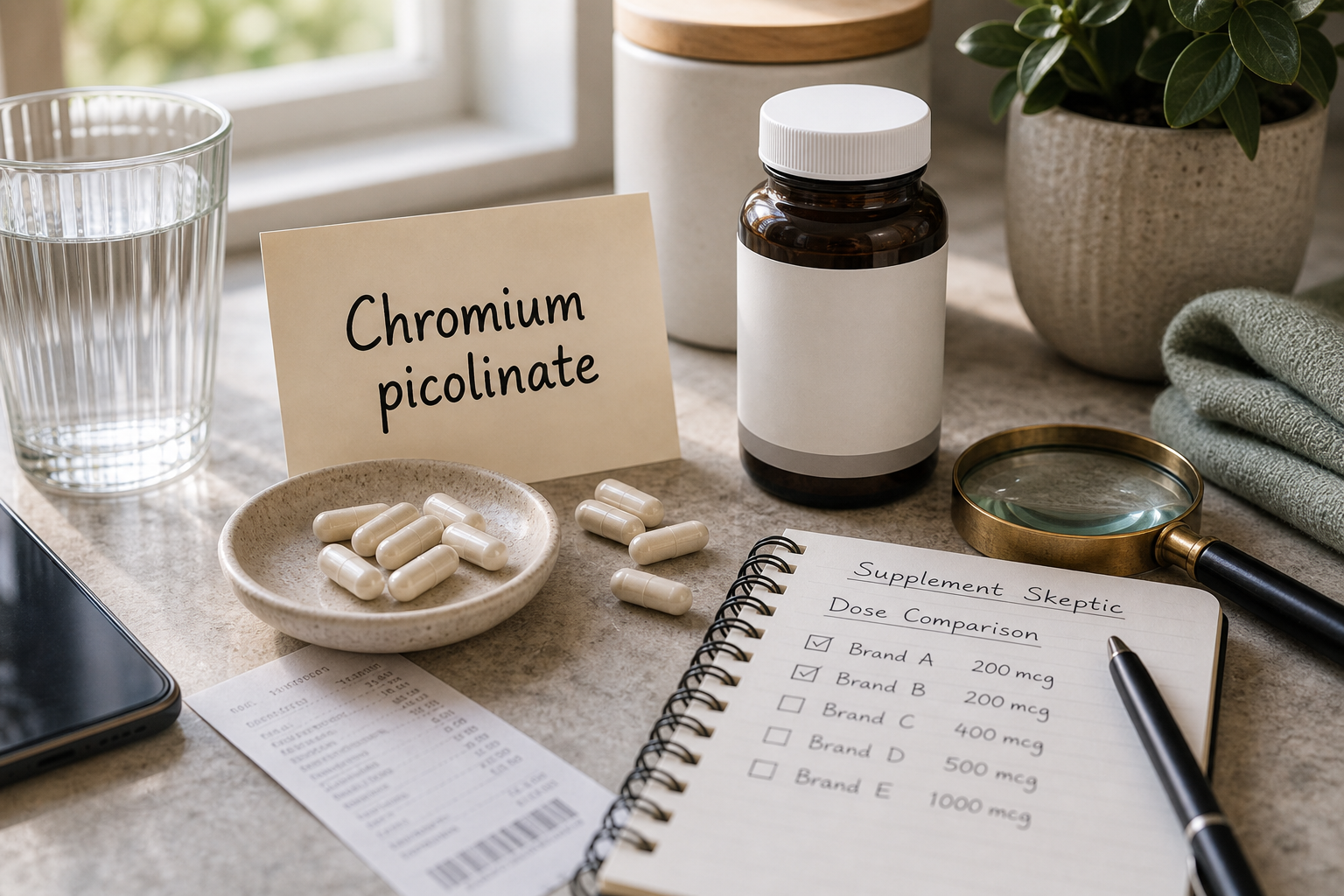
Trials reporting glycemic effects in adults with type 2 diabetes used 200–1,000 mcg of elemental chromium per day, most commonly 200 mcg or 400 mcg.
Trials reporting weight or craving signals used a similar range, often at the higher end (600–1,000 mcg).
Daily value (35 mcg) is approximately one-tenth of the lowest dose that has produced a measurable effect in a published trial.
A "metabolism blend" that lists chromium at 20 or 35 mcg has almost certainly chosen the dose to satisfy a label claim, not to produce an effect.
Safety profile
Chromium picolinate is well tolerated at studied doses up to 1,000 mcg/day. Most reported adverse events are mild gastrointestinal upset.
Anyone on insulin or sulfonylureas should treat chromium as additive — it can lower blood glucose and increase hypoglycemic risk.
Long-term high-dose chromium picolinate has been studied for theoretical concerns about chromosomal effects in cell culture. Human in-vivo evidence has not borne out a clinically meaningful risk at normal supplement doses.
Renal impairment: chromium is renally cleared. Use cautiously in chronic kidney disease.
This is general information, not medical advice. Anyone on prescription medication, pregnant or breastfeeding, or managing a chronic condition should bring an ingredient like Chromium picolinate to their clinician before starting it.
Supplements on this site that contain chromium picolinate
The following reviewed products list chromium picolinate on the label, mention it in the ingredient discussion, or are built around the ingredient category. Verdicts are independent of whether the ingredient is present — a product can include chromium picolinate and still be a "Skeptical" or "Avoid."
General
Sonu's Diabetes: Sweet offer w a new ID. Higher ROAS Delights in 2025
A $38 digital diabetes guide with a 60-day refund window. The sales page is written for affiliates, not buyers — read inside the refund window before deciding if it's worth keeping.
Dietary Supplements
CelluCare - New Breakthrough In Blood Sugar Science
An overpriced, under-disclosed blood sugar supplement with a subscription trap. The ingredient list is a black box — you can’t verify doses or safety, and the $194 price tag is mostly affiliate commission padding.
Dietary Supplements
Gluconite - Destroyer Blood Sugar Offer
A $116 nighttime blood sugar supplement with recurring billing, a proprietary blend that hides underdosing, and no independent clinical trials on the finished formula. The refund window is real, but the value isn't.
Dietary Supplements
GlucoBerry - BRAND NEW Blood Sugar Offer!!
A $100 blood sugar supplement with an aggressive upsell funnel. The label likely hides underdosed ingredients behind a proprietary blend, and the 180-day guarantee on the vendor site doesn't match ClickBank's 60-day refund. Read the label before buying — if you can find it.
Dietary Supplements
GlucoTrust (German Version)
A blood-sugar supplement sold on the promise of an untapped German market, not on ingredient transparency. At $123 a bottle with hidden doses, the math doesn't add up.
Remedies
Insufend
A $111 blood sugar supplement sold through a sales page that buries the ingredient list — that alone makes it a hard pass until the label is public. The refund window is real, but you're gambling $111 on a mystery formula.
Dietary Supplements
Java Burn Reviews 2026: Scam or Legit? We Tested the Metabolism Claims
Real ingredients, real proprietary blend, real pricing problem. Java Burn delivers a handful of metabolism-adjacent compounds at doses you can't verify, for 3–5× the cost of getting them individually from a commodity brand.
Dietary Supplements
MetaFlow - HOT New Blood Sugar Support Drops For 2026
A proprietary blood sugar drop with no disclosed doses, sold through an aggressive upsell funnel. The 60-day refund window is the only thing that keeps this from being a complete pass.
Dietary Supplements
SugarMute - Advanced Blood Sugar Support
Underdosed, overpriced, and pushed by affiliate hype. The refund guarantee is real but comes with fine print that makes it a hassle. I would not buy this.
Dietary Supplements
Tea Burn - Following in the footsteps of Java Burn - June 2024
A $146 tea-additive with unverified ingredients, a hidden subscription, and a 60-day refund that's hard to use if you don't read the fine print.
Dietary Supplements
BloodArmor™ – Powerful Blood Sugar & Circulation Support
A $153 supplement with no disclosed ingredient doses, a sales page that reads like an affiliate recruitment brochure, and zero independent evidence it does what it claims. I would not buy this.
Diets & Weight Loss
ElectroSlim | Trending Weight Loss Electrolyte Offer
A $70 electrolyte powder with a GLP-1 pitch that the ingredient label won't back up. You're paying for marketing, not a meaningful metabolic effect.
Dietary Supplements
InsuLeaf – Explosive Blood Sugar Offer | Huge Commissions | Scales!
A $162 blood sugar supplement with a 60-day refund, but the sales page hides the label, the price is steep for what's likely standard ingredients, and the marketing leans on fear, not facts.
Dietary Supplements
Metabo Drops - The Juice is Loose!
A $177 coffee additive with recurring billing, hidden doses, and no published clinical data on the final formula. The refund window is real — use it to read the label, not to hope for magic.
Dietary Supplements
RegenVive - Blood Sugar Support
A $165 blood sugar supplement with hidden ingredient doses and a refund policy that likely won't cover opened bottles. The star ingredient has some evidence, but you can't verify the dose, and the price is indefensible.
Dietary Supplements
LAVASLIM FR - Weight Loss Offer for FR Market!
A $62 bottle of hope in a capsule. The refund window is the only part of this offer that works as advertised.
Dietary Supplements
Trimology
A $179 supplement that borrows GLP-1 drug hype without the evidence to back it. The ingredients are real but underdosed; the refund policy has fine print. You can get the same actives for less elsewhere.
Men's Health
Alpha Fuel Pro - Industry Leading Male Health Offer
A mystery-pill men's health supplement sold through a high-commission affiliate network with no disclosed ingredient panel. At $124 a bottle, you're paying for the affiliate's yacht, not your testosterone.
Dietary Supplements
Gluco Extend
The 60-day refund window is the only safety net on a $182 bottle with no publicly disclosed label. Equivalent standalone ingredients cost a fraction of the price.
Dietary Supplements
NU NERVE - Best Nerve Pain Offer! Our VSL makes affiliates $$$$ daily!
No ingredient list, no clinical proof, and a $133 price tag that's all marketing — I would not buy this.
Dietary Supplements
Sugar Defender - Blood Sugar Support
A $149 supplement with no public ingredient label, aggressive recurring billing, and a sales page that prioritizes affiliate commissions over buyer transparency. The refund window exists but requires you to return the product at your expense. Skip it.
Dietary Supplements
GlycoMute - Advanced Blood Sugar Support
A $138 blood sugar pill with zero ingredient transparency. The 60-day refund window is real, but without knowing what's in the bottle, you're gambling, not supplementing.
Dietary Supplements
Leanotox - A Genuine Weight Loss Conversion Monster
A $3 trial bottle whose sales page is written for affiliates, not for your health. The ingredient label is hidden, and the price is a loss leader — expect upsells you didn't ask for.
Dietary Supplements
Metabo Flex - Gigantic Payouts
The vendor's own site is an affiliate recruitment page; the supplement's formula is undisclosed, and the recurring charge is the real profit center. I would not buy this.
Dietary Supplements
Sync - Sun’s Out, Guns Out!!
A $185 recurring supplement with no publicly disclosed ingredient list, sold on a 'sunlight loophole' marketing hook by a known network of serial supplement launchers. You're paying for a story, not a product you can vet.
Brain / focus
Earth Ritual Brain & Focus Formula
Earth Ritual Brain & Focus Formula uses recognizable cognitive-support ingredients in a broad multinutrient formula. The conditional read is simple: it may fit buyers who want an all-in-one brain-support capsule, while buyers seeking clinical-dose nootropic targeting should compare the full Supplement Facts panel first.
The skeptic's checklist
Before paying for a supplement that lists chromium picolinate on the label, the buyer should be able to answer yes to most of these:
- Form (picolinate). Picolinate is the best-absorbed form. "Chromium" with no form specified is a yellow flag.
- Dose ≥ 200 mcg. Anything below 200 mcg is at or near the daily value, not a therapeutic dose.
- Disclosed dose, not blend. Chromium hidden in a proprietary blend almost always means a sub-therapeutic dose.
- No claims of "insulin replacement". Chromium does not replace insulin or oral hypoglycemics. A label that implies otherwise is overreaching.