
Ingredient pillar · Weight management
Chlorogenic acid: what the evidence actually says
Green coffee bean extract is the most-cited "natural fat burner" in the affiliate supplement category. The mechanism is plausible, the trial quality is poor, and the dose inside a proprietary blend is almost never the dose that was studied.
- green coffee bean extract
- GCA
- CGA
What it is
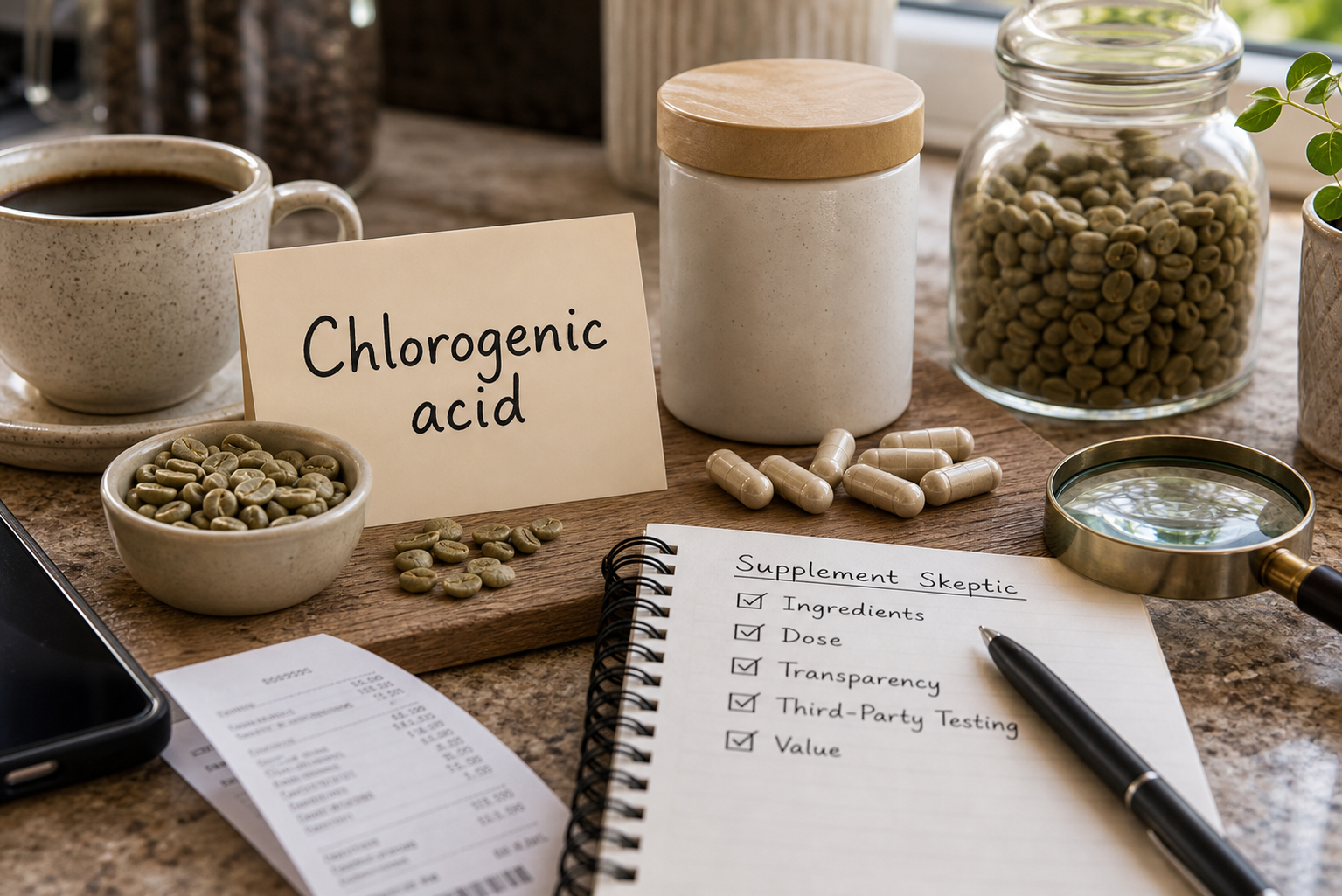
Chlorogenic acid (CGA) is a polyphenol — specifically an ester of caffeic acid and quinic acid — found in unroasted coffee beans, yerba mate, eggplant, and a handful of other plants.
Roasting destroys most of it, which is why supplement chlorogenic acid is sourced from green (unroasted) coffee beans rather than the cup of coffee on your counter.
On a label it shows up as "green coffee bean extract" with a percentage standardisation, usually 45% or 50% chlorogenic acids. A 400 mg capsule of "50% standardised green coffee bean extract" delivers roughly 200 mg of mixed chlorogenic acids.
What the marketing claims
The phrasing on a supplement label or sales page tends to recycle a few patterns. Chlorogenic acid usually shows up wearing one of these:
- "Burns fat by slowing carbohydrate absorption."
- "Boosts metabolism with a clinically studied compound."
- "Discovered by a Japanese (or Indonesian, or Swiss) researcher in [year]."
- "Supports healthy blood sugar."
What the published evidence actually says
The mechanism is real in the lab: chlorogenic acid inhibits glucose-6-phosphatase, which can reduce hepatic glucose output, and modestly slows intestinal glucose absorption.
Translating that to weight loss in humans is a different story. Several short small randomised controlled trials in overweight adults have reported modest weight reductions versus placebo over 8–12 weeks, typically in the range of 1–2.5 kg. The catch: most of the influential trials were sponsored by the ingredient supplier or the brand selling the finished product, sample sizes were small, and at least one of the most-cited results was retracted entirely.
Independent meta-analyses have walked back the enthusiasm. Effect sizes shrink as study quality rises, and at higher methodological thresholds the average effect on body weight is small and not consistently statistically significant.
Effects on fasting glucose and post-meal glucose excursions in healthy adults are similarly modest and inconsistent across trials.
There is no published clinical trial on any branded chlorogenic acid supplement in the affiliate category, only on the standardised raw extract at controlled doses.
Effective dose vs typical supplement dose
Trials reporting any weight or glycemic signal generally used somewhere between 180 mg and 400 mg of total chlorogenic acids per day, often split across meals, for at least 8 weeks.
A single 400 mg capsule of 50% standardised green coffee bean extract sits at the low end of that range. Two capsules a day, before meals, sits in the middle.
Inside a proprietary blend on a Java Burn-style label, the dose is undisclosed. Working backward from a typical 1,500–2,000 mg blend that also contains green tea, L-carnitine, L-theanine, and chromium, the chlorogenic acid share is almost always well below the 180 mg floor.
Safety profile
Generally well tolerated at studied doses. The most commonly reported side effects are mild headache and gastrointestinal upset, both more frequent at the upper end of the dose range.
Chlorogenic acid can transiently raise plasma homocysteine; if you have an existing cardiovascular risk profile and elevated homocysteine, that is worth a conversation with your clinician before adding a daily extract.
May modestly lower blood glucose. Anyone on insulin or sulfonylureas should treat green coffee extract as a hypoglycemic agent until proven otherwise.
Pregnancy and breastfeeding: no human safety data at supplement doses. Default to avoid.
This is general information, not medical advice. Anyone on prescription medication, pregnant or breastfeeding, or managing a chronic condition should bring an ingredient like Chlorogenic acid to their clinician before starting it.
Supplements on this site that contain chlorogenic acid
The following reviewed products list chlorogenic acid on the label, mention it in the ingredient discussion, or are built around the ingredient category. Verdicts are independent of whether the ingredient is present — a product can include chlorogenic acid and still be a "Skeptical" or "Avoid."
Dietary Supplements
Liv Pure
Liv Pure ships two of the most legitimate liver-support ingredients in the supplement world — silymarin and berberine — and then hides the actual milligram doses inside 'proprietary blends' that total 712 mg and 285 mg respectively. That's the central problem. The bones of the formula are defensible. The dosing is unverifiable. At $69 a bottle ($49 in the bulk pack) you are paying premium-tier pricing for sub-clinical or potentially clinical doses you have no way to confirm. The rating reflects the gap between what the ingredient list suggests is possible and what the label actually proves you're getting.
Dietary Supplements
Java Burn Reviews 2026: Scam or Legit? We Tested the Metabolism Claims
Real ingredients, real proprietary blend, real pricing problem. Java Burn delivers a handful of metabolism-adjacent compounds at doses you can't verify, for 3–5× the cost of getting them individually from a commodity brand.
Dietary Supplements
Tea Burn - Following in the footsteps of Java Burn - June 2024
A $146 tea-additive with unverified ingredients, a hidden subscription, and a 60-day refund that's hard to use if you don't read the fine print.
Dietary Supplements
Java Brain - The 1000lb Gorilla in Neuro
An overpriced coffee nootropic with an undisclosed formula, sold through an affiliate recruitment pitch rather than evidence of efficacy. The 60-day refund window is real, but the subscription trap and $140 price tag make this a hard pass.
The skeptic's checklist
Before paying for a supplement that lists chlorogenic acid on the label, the buyer should be able to answer yes to most of these:
- Standardisation %. A real label states the chlorogenic acid percentage. "Green coffee bean extract" with no percentage is almost certainly a low-potency raw powder.
- Mg of chlorogenic acid disclosed. You want the actual mg of chlorogenic acid, not just the mg of the extract. 400 mg of extract at 50% is 200 mg of CGA.
- No proprietary blend. If chlorogenic acid is buried inside a "metabolism blend," you cannot verify the dose. Move on.
- Decaffeinated extract. Standardised green coffee bean extract should be largely decaffeinated. If the label is silent, assume residual caffeine and read accordingly.
- Third-party tested. NSF, USP, or Informed Sport on the label. Absent that, you are trusting the seller's self-attestation.