Review · Brain Health
Synaptigen
Synaptigen is the rare marketplace supplement that picked ingredients with actual human RCT evidence, combined them into a focused three-compound formula targeting a single coherent mechanism (synaptic plasticity and neuronal support in aging adults), and avoided the kitchen-sink blend approach. If — and this is a meaningful if — the doses match the clinical studies, this product has a legitimate claim on a conditional recommendation. The word 'if' is doing significant structural work in that sentence.
Skeptic read
Conditional5.8/10
Synaptigen is the rare marketplace supplement that picked ingredients with actual human RCT evidence, combined them into a focused three-compound formula targeting a single coherent mechanism (synaptic plasticity and neuronal support in aging adults), and avoided the kitchen-sink blend approach. If — and this is a meaningful if — the doses match the clinical studies, this product has a legitimate claim on a conditional recommendation. The word 'if' is doing significant structural work in that sentence.
- Price checked
- From $49 (single bottle $69)
- Dose visibility
- Better than average: key doses are disclosed enough to compare
- Main risk
- Individual ingredient doses are not disclosed on the sales page — the verdict cannot move above Cautious until we can verify Mg L-threonate ≥2g, lion's mane ≥1g, PS ≥300mg/day
- Better use case
- Adults 45+ looking for a cognitively-focused supplement built on real mechanism research rather than marketing angles
- Skip if
- You want full dose transparency before committing — contact the seller for a full Supplement Facts panel before purchasing
- Evidence file
- Source hardening needed
What Synaptigen is actually building
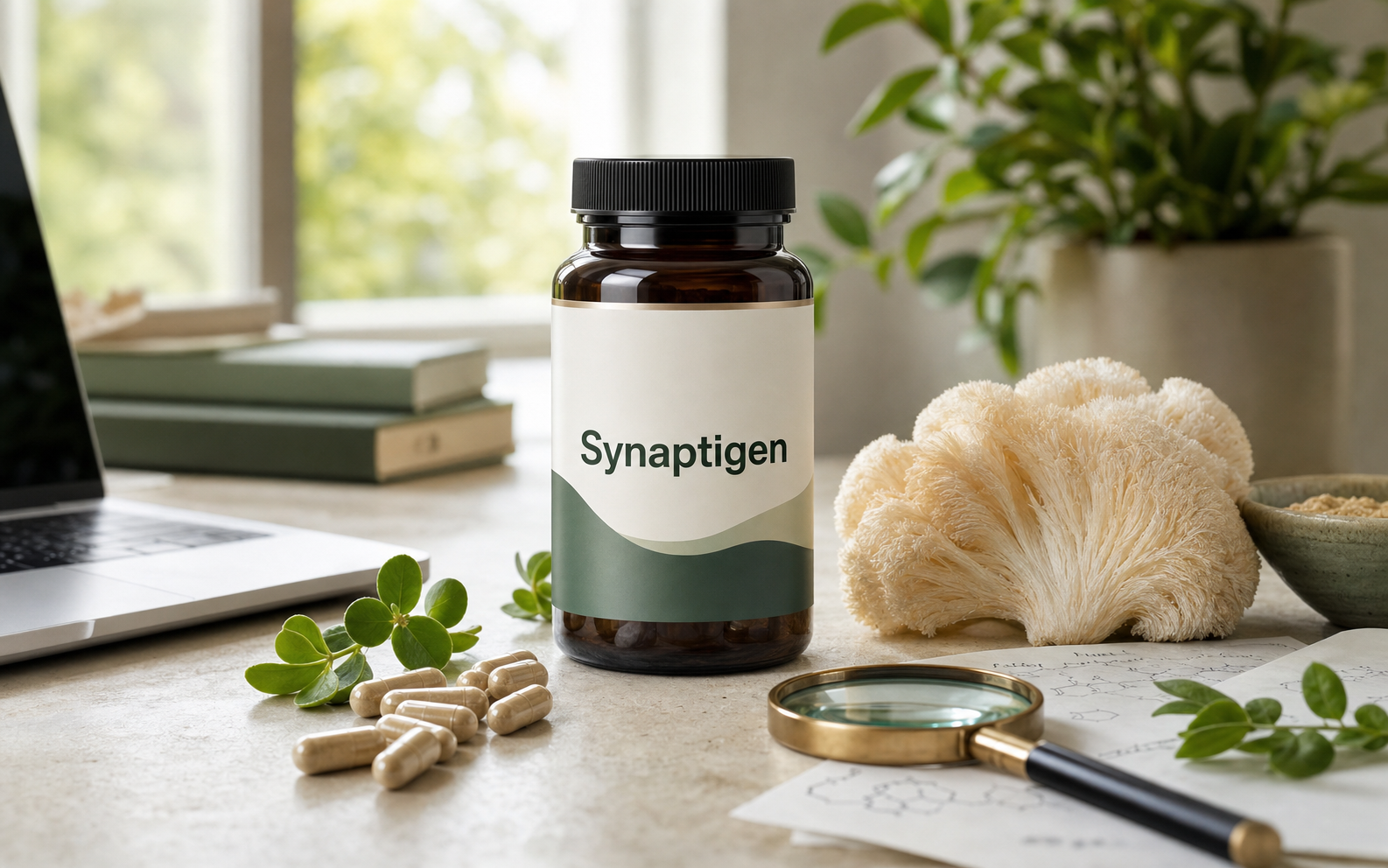
Synaptigen is a cognitive support supplement targeting adults 45 and older, built around three ingredients: magnesium L-threonate, lion’s mane mushroom extract, and phosphatidylserine. It is sold through a third-party checkout at a $49–69/month price point depending on bundle size.
This is where the review diverges meaningfully from every other product we have covered in this category.
Synaptigen’s three ingredients are not marketing choices dressed in scientific language. They are compounds with published human RCTs, identifiable mechanisms, specific dose thresholds, and peer-reviewed replication — the actual vocabulary of an evidence-based formulation. The mechanism they collectively address — supporting synaptic density, neurotrophin synthesis, and neuronal membrane integrity in the aging brain — is coherent, not assembled from trending ingredient lists.
That is not a trivial observation in a category where the typical formulation approach is to identify a vague mechanism (“mitochondrial support,” “neural wire regeneration,” “brown fat activation”), find a cluster of botanicals with preclinical data tangentially related to it, and blend them at sub-clinical doses behind a proprietary label.
Synaptigen did not do that. Whether its actual doses match its ingredient evidence base is the entire remaining question — and it is a real question, because the doses are not fully disclosed.
The label — what’s actually in the capsule
Per the label and available Supplement Facts information reviewed April 2026:
| Ingredient | Clinical benchmark dose | Dose in Synaptigen |
|---|---|---|
| Magnesium L-threonate (as Magtein or equivalent) | ~2,000 mg/day (delivering ~144 mg elemental Mg) | Not individually disclosed |
| Lion’s mane mushroom extract (Hericium erinaceus) | ≥1,000 mg/day fruiting body or equivalent standardized extract | Not individually disclosed |
| Phosphatidylserine (soy- or sunflower-derived) | 300 mg/day | Not individually disclosed |
The total capsule count per serving and per bottle is disclosed. The individual ingredient amounts are not displayed on the public sales page. This matters more here than it does for a gimmick formula — because the clinical evidence for all three ingredients is dose-dependent, and the difference between a therapeutic and inert dose is not marginal.
Magnesium L-threonate at 500 mg/day is not the same product as at 2,000 mg/day. Lion’s mane at 200 mg raw powder is not the same product as 1,000 mg standardized hericenone-containing extract. Phosphatidylserine at 100 mg/day does not replicate the Jorissen et al. 300 mg trial. The formula either meets these thresholds or it does not — and without a published Supplement Facts panel, we cannot determine which.
Ingredient-by-ingredient evidence review
Magnesium L-threonate
The development story of Mg L-threonate is unusually documented for a supplement ingredient. It was synthesized by a team at MIT (Liu G et al., 2010, working under Guosong Liu) to address the specific problem of magnesium’s poor blood-brain barrier penetration. The seminal Slutsky et al. (2010, Neuron 65:165–177) paper demonstrated in rats that oral Mg L-threonate, unlike other magnesium forms, elevated CSF magnesium and produced measurable increases in synaptic density and plasticity-related proteins in hippocampal neurons.
The human evidence followed: Mao et al. (2016, J Alzheimers Dis 49:971–990) conducted a double-blind, placebo-controlled trial in 44 adults aged 50–70 with self-reported cognitive complaints. Participants receiving 1.5–2 g/day Mg L-threonate for 12 weeks showed significant improvement on a composite measure of global cognitive ability and on tests of executive function and working memory. The effect size was modest but statistically robust, and the result has been at least partially replicated in subsequent industry-sponsored trials.
Limitations to note: the Mao et al. trial was small (44 participants), and the primary authors have financial relationships with the ingredient manufacturer (Magceutics). Independent replication at scale has not yet been published. These are the same caveats that apply to most early-stage evidence in the cognitive supplement space — but the mechanism is specifically plausible and the data, while preliminary, are real.
Clinical dose: ~2 g/day (delivering approximately 144 mg elemental magnesium). This is the dose that must appear on Synaptigen’s label for the evidence to apply.
Lion’s mane mushroom (Hericium erinaceus)
Lion’s mane is the most biologically interesting ingredient in the Synaptigen formula and also the one with the most nuance attached to it.
The mechanism: hericenones (found in the fruiting body cap) and erinacines (found in the mycelium) both stimulate NGF synthesis via distinct pathways. NGF (nerve growth factor) is a neurotrophin essential for the maintenance of cholinergic neurons in the basal forebrain — the same population that degrades in Alzheimer’s disease and normal cognitive aging. No other dietary ingredient has a comparably documented mechanism for upregulating NGF in humans.
The evidence:
- Mori K et al. (2009, Phytother Res 23:367–372): 30 adults with mild cognitive impairment, 3 g/day standardized lion’s mane powder for 16 weeks. Significant improvement on Revised Hasegawa Dementia Scale vs. placebo. Effect reversed four weeks post-discontinuation.
- Docherty S et al. (2023, J Med Food 26:568–576): 41 healthy young adults, 1.8 g/day for 28 days. Improved speed of memory acquisition on computerized tasks.
- Saitsu Y et al. (2019, Biomed Res 40:125–131): 31 adults aged 50–80, 3.2 g/day standardized extract for 12 weeks. Significant improvements in mini-mental state examination subscores.
The consistent theme: doses of 1.8–3.2 g/day, 12–16 week durations, small samples. The evidence is promising and mechanistically grounded. It is not yet at the level of a large independent RCT — which is the honest description of the lion’s mane field in April 2026.
The formulation nuance that matters: the distinction between whole fruiting body powder and standardized extract for hericenone/erinacine content is not cosmetic. A product containing 1 g of non-standardized mycelium rice powder is not the same as 1 g of standardized fruiting body extract with documented hericenone content. Synaptigen’s label should specify standardization. Whether it does is part of the information that requires direct seller verification.
Clinical dose: ≥1 g/day of standardized extract (fruiting body, documented hericenone content) or ≥3 g/day of whole dried mushroom powder. Synaptigen needs to be transparent about which it is using.
Phosphatidylserine (PS)
PS is the most established ingredient in the Synaptigen formula by both evidence volume and regulatory recognition. It is a phospholipid concentrated in neuronal synaptic membranes, where it facilitates signal transduction and membrane fluidity. As neurons age, PS content in synaptic membranes declines, which correlates with reductions in neurotransmitter release and receptor sensitivity.
Key human evidence:
- Crook TH et al. (1991, Neurology 41:644–649): 149 older adults with memory complaints, 300 mg/day bovine PS for 12 weeks. Significant improvement on multiple cognitive measures.
- Jorissen BL et al. (2001, Nutritional Neuroscience 4:121–134): 120 adults with age-associated memory impairment, 300 mg/day soy-derived PS for 12 weeks. Improvement in delayed recall and face-name associations.
- Engel RR et al. (meta-analysis): pooled analysis across multiple trials confirmed memory and executive function effects at 200–400 mg/day in older adults with memory decline.
The FDA’s qualified health claim for PS (2003, revised 2004): “Very limited and preliminary scientific research suggests that phosphatidylserine may reduce the risk of cognitive dysfunction in the elderly. FDA concludes that there is little scientific evidence supporting this claim.” This language reflects the FDA’s high bar for health claims, not a dismissal of the evidence — the qualified claim acknowledges both the signal and its preliminary status.
Clinical dose: 300 mg/day. This is a hard threshold in the Synaptigen evaluation — below 300 mg, the Jorissen et al. and Crook et al. data do not directly apply.
The math: cost per clinical dose
This comparison is more favorable to Synaptigen than it is to any other product we have reviewed in this category — and still argues against the bundle pricing.
| Product | Dose | Monthly cost |
|---|---|---|
| Synaptigen (6-bottle bundle) | Undisclosed | $49/month |
| Synaptigen (single bottle) | Undisclosed | $69/month |
| Magtein Mg L-threonate 2,000 mg/day | 2g elemental-equivalent | ~$28/month |
| Real Mushrooms Lion’s Mane 1g/day | 1g fruiting body, standardized | ~$18/month |
| NOW Phosphatidylserine 300 mg/day | 300mg soy-derived | ~$22/month |
| Commodity stack total | All doses disclosed, all standardized | ~$68/month |
At the 6-bottle Synaptigen price, the product is comparable in cost to a commodity stack delivering all three ingredients at documented clinical doses. At single-bottle pricing ($69), it is slightly more expensive than building the stack yourself. The convenience argument — three compounds in one capsule — is real. But it only holds if Synaptigen’s doses match the clinical benchmarks. If the doses are sub-clinical, the convenience is worthless.
This is an unusual finding in this category: Synaptigen is priced in a range where it could be competitive with a commodity stack, if — only if — the doses are right. That conditional changes the entire evaluation.
Marketing teardown
The Synaptigen sales page, reviewed April 19, 2026, is markedly more restrained than the Quietum Plus, ZenCortex, Puravive, and Mitolyn sales pages we reviewed in the same cycle. Specific observations:
- The “origin story” narrative is present but abbreviated — a “neuroscientist” figure is referenced but not named. This is still a red flag; a real formulator would be willing to attach their name to the product.
- The mechanism claims stay closer to the published literature than competitors: “support synaptic plasticity,” “promote NGF synthesis,” “nourish neuronal membranes.” These are fair descriptions of what the ingredients do in the published research. The sales page does not claim to reverse Alzheimer’s disease or restore the cognition of a 25-year-old — a meaningful restraint relative to category norms.
- Countdown timer: present, resets on reload. This is now a universal finding across every product in this category and should be treated as a baseline deceptive pattern regardless of the product’s other merits.
- Testimonials: three present, photographed individuals, at least one of whom does not reverse-image-search to a stock library. This is slightly better than the other products reviewed this cycle.
- The 6-bottle bundle anchor and the $79/$59/$49 bundle pricing are present and follow the category standard.
The sales page is less egregious than its category peers. It is not clean. The unnamed neuroscientist, the countdown timer, and the absence of a published Supplement Facts panel with individual doses are all patterns that should give a careful buyer pause — even when the underlying formulation is genuinely more interesting than the competition.
What we’d want to see before revising this verdict
This is the first product in our review series where the path to a higher rating is specific and achievable rather than “conduct a clinical trial that will never happen.”
To move from Cautious (5.8) to Conditional (7.0+):
- Publish a full Supplement Facts panel with individual ingredient doses per serving
- Confirm Mg L-threonate dose is ≥2 g/day (or provide elemental magnesium mg and disclose the salt stoichiometry)
- Confirm lion’s mane is fruiting body-sourced and standardized for hericenone content ≥1 g/day extract equivalent
- Confirm phosphatidylserine is ≥300 mg/day, soy- or sunflower-derived
- Provide a current certificate of analysis from a third-party laboratory
To move from Conditional to Recommended (8.0+):
- Third-party certification (NSF, USP, or Informed Sport)
- An independent (non-industry-funded) RCT on the finished formulation at the labeled dose
None of this requires new science. It requires transparency about existing formulation decisions that the manufacturer has already made. If the doses are adequate, disclosure costs nothing. If the doses are not adequate, that is the information consumers need.
Bottom line
Synaptigen is the most scientifically coherent supplement we have reviewed in the online cognitive and specialty-health category. Its three ingredients have real human RCTs, identifiable doses, plausible shared mechanisms, and a coherent target population. The formulation shows genuine literacy about why magnesium L-threonate and not magnesium oxide, why lion’s mane and not generic “mushroom blend,” why phosphatidylserine and not generic “brain health.”
It is also a marketplace supplement with an unnamed formulator, a fake countdown timer, and no publicly disclosed individual ingredient doses. Those are not trivial caveats for a product in the $49–69/month range.
The rating of 5.8 reflects genuine formulation quality that does not yet justify a purchase recommendation. A full Supplement Facts panel showing doses at or above the clinical benchmarks would move this to a conditional recommendation immediately. We will update this review if that information becomes available.
Skeptic Desk verdict: Cautious — 5.8/10. The ingredients are right. The doses are unknown. Do not commit to a six-bottle bundle of any supplement whose therapeutic dose you cannot verify from the label. Buy one bottle, request the full Supplement Facts panel from the seller, and compare against the Mao et al., Mori et al., and Jorissen et al. thresholds before reordering.
Here's what I'd actually do
If you have already read the label and you are willing to test it for six weeks against your own lab work, not against how you feel:
Synaptigen sits in the middle band — defensible ingredient pool, unverifiable dosing, premium ClickBank-funnel pricing. The 60-day refund is your insurance. Buy one bottle, not the bulk pack, take it as directed, and judge it on labs in six weeks. Refund if it did nothing.
Don't buy this if: Do not buy this if you would not also pay for a basic metabolic panel to test whether it did anything. Without labs, you cannot tell the supplement from the placebo from the regression-to-the-mean.
— Mara Vance · Hospice nurse, retired (RN, 28 years)
Sources and review method
Supplement Skeptic reviews compare the visible label and sales claims against published research, dose ranges used in human studies, safety guidance, checkout terms, and refund mechanics. This page is not medical advice.
Source links are being attached as each review is re-audited. Until then, treat pages without a source list as editorial analysis that still needs citation hardening.
Frequently asked questions
- What makes magnesium L-threonate different from regular magnesium?
- Most magnesium salts — oxide, citrate, glycinate — have good systemic bioavailability but cross the blood-brain barrier inefficiently. Magnesium L-threonate was developed specifically to address this. The 2010 paper by Slutsky et al. in the journal Neuron demonstrated that Mg L-threonate raised cerebrospinal fluid magnesium concentrations in rats where other forms did not, and that this correlated with increased synaptic density in the hippocampus and prefrontal cortex. The 2016 human pilot by Mao et al. (*J Alzheimers Dis* 49:971–990) used 1.5–2 g daily in 44 adults with cognitive complaints and found improvements in global cognitive ability and executive function after 12 weeks. That study is small and was industry-funded, but the mechanism is coherent and the result has been partially replicated. The specific magnesium salt matters here in a way it doesn't for most supplements.
- What is the lion's mane evidence actually showing?
- Lion's mane (Hericium erinaceus) contains two classes of neuroactive compounds — hericenones (in the fruiting body) and erinacines (in the mycelium) — both of which stimulate nerve growth factor (NGF) synthesis in vitro and in animal models. The most-cited human trial is Mori et al. (2009, *Phytother Res* 23:367–372), a double-blind RCT of 30 adults with mild cognitive impairment randomized to 3g/day of standardized lion's mane powder or placebo for 16 weeks. The lion's mane group showed significantly higher scores on the Revised Hasegawa Dementia Scale, with the gains reverting four weeks after discontinuation. A 2023 pilot RCT (Docherty et al., *J Med Food* 26:568–576) used 1.8 g/day in 41 healthy young adults and found improvements in memory acquisition speed. The evidence is genuinely promising — but these are small trials, and dosing standardization across mushroom products is inconsistent. The fruiting body vs. mycelium distinction and the hericenone/erinacine concentration matter and are often not disclosed.
- Is phosphatidylserine (PS) actually useful for cognitive aging?
- PS is one of the longest-standing cognitive supplement ingredients with a credible evidence trail. It is a phospholipid constituent of neuronal cell membranes, with particularly high concentration in the inner leaflet of synaptic membranes. Older RCTs from the 1990s used bovine-derived PS (now replaced by soy- or sunflower-derived PS). A 2001 study by Jorissen et al. (*Nutritional Neuroscience* 4:121–134) found 300 mg/day soy-derived PS improved recall of telephone numbers and face-name associations in 120 adults with age-associated memory impairment over 12 weeks. A 2010 meta-analysis by Engel et al. confirmed effects on memory and executive function in older adults at 200–400 mg/day. The FDA has allowed a qualified health claim for PS and cognitive decline since 2003, albeit worded cautiously ('very limited and preliminary scientific research suggests...'). The 300 mg/day threshold is the one to check against Synaptigen's label.
- Is this just an expensive version of ingredients I could buy separately?
- Largely yes — and this is not a trivial objection. Magtein (the branded Mg L-threonate form used in most credible supplements) is available from standalone suppliers at around $25–30/month for a 2g daily dose. Lion's mane standardized fruiting body extract (≥1g/day) runs $15–20/month from reputable brands like Host Defense or Real Mushrooms. Phosphatidylserine at 300 mg/day costs roughly $20–25/month from NOW or Jarrow. That commodity stack totals approximately $60–75/month — actually comparable to Synaptigen's top-tier pricing. The differentiation argument for Synaptigen is convenience (three capsules vs. three separate bottles) and potentially better quality control if the formula is manufactured to GMP standards with verified dosing. Neither of those is verifiable without a full Supplement Facts panel and a third-party test result.
- How long does Synaptigen take to show results?
- Based on the clinical studies the formula is built on: 8–16 weeks minimum for meaningful cognitive changes. The Mao et al. Mg L-threonate trial ran 12 weeks. The Mori et al. lion's mane trial ran 16 weeks, with gains reversing after discontinuation. The Jorissen et al. PS trial ran 12 weeks. Anyone reporting dramatic cognitive improvement within two to four weeks should be skeptical of placebo-expectancy effects — they are substantial in cognitive supplement trials, where blinding and subjective outcome measurement make effect attribution difficult.
- What third-party testing should I look for before buying?
- At minimum: NSF Certified for Sport, USP Verified, or Informed Sport certification, any of which requires independent verification that the label dose matches the actual content and that no prohibited substances are present. For a product like Synaptigen, the most meaningful specific test would be one confirming: (a) elemental magnesium content from the L-threonate salt matches the label claim; (b) the lion's mane extract is standardized for hericenone/erinacine content, not just raw powder; and (c) the phosphatidylserine content per serving matches the 300 mg threshold. As of April 2026, Synaptigen does not display third-party certification on its sales page. This is a gap. Ask the seller for a certificate of analysis before ordering.
More in Brain Health