Review · Weight Loss
Puravive: Does Puravive Actually Work?
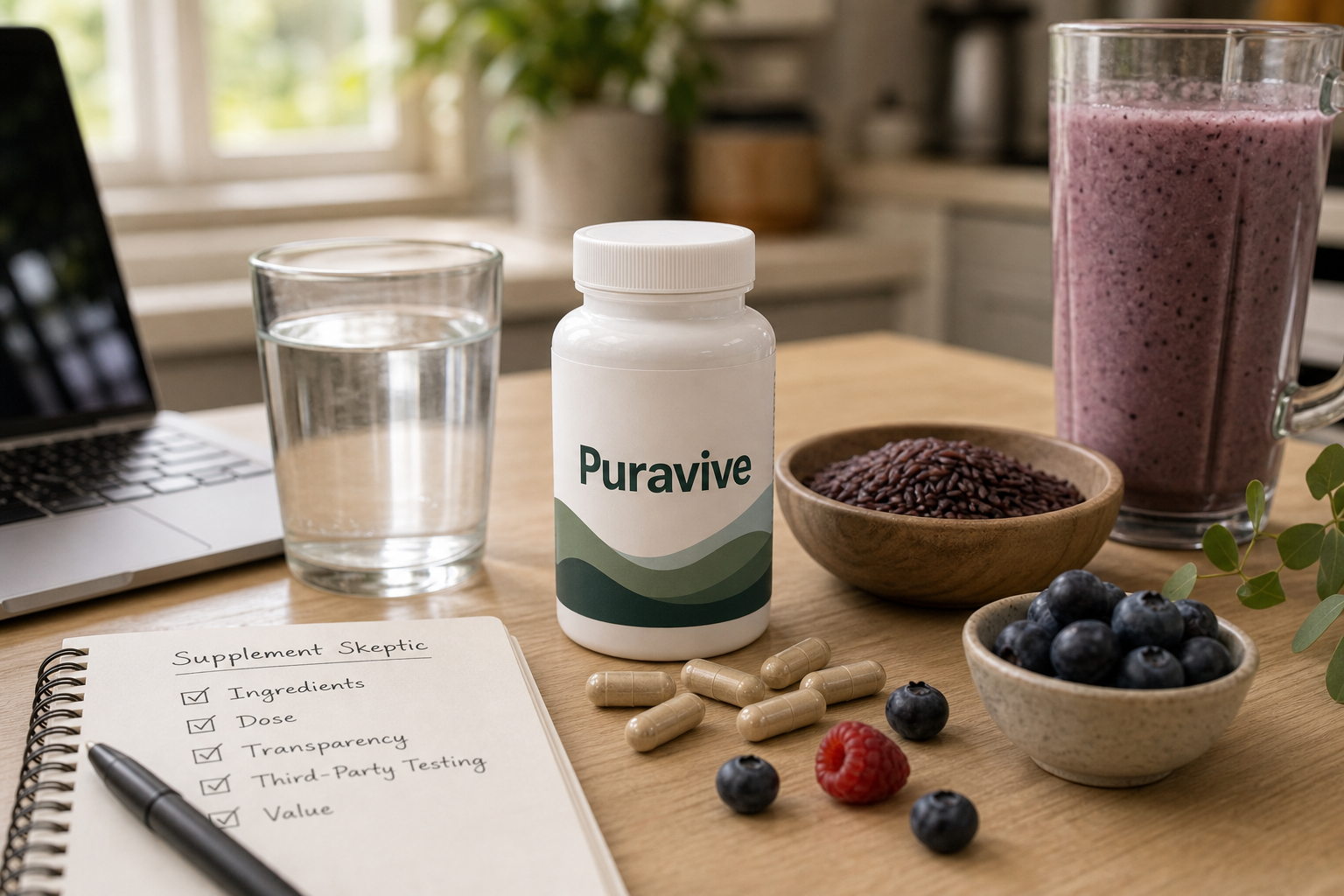
Puravive's entire marketing claim — that 'low brown adipose tissue' causes weight gain and that these eight ingredients fix it — rests on a single 2022 paper the authors would not recognize. The ingredients themselves are real botanicals, but the 750 mg total blend forces every individual dose below the range where any of them have been shown to do anything.
Skeptic read
Avoid2.8/10
Puravive's entire marketing claim — that 'low brown adipose tissue' causes weight gain and that these eight ingredients fix it — rests on a single 2022 paper the authors would not recognize. The ingredients themselves are real botanicals, but the 750 mg total blend forces every individual dose below the range where any of them have been shown to do anything.
- Price checked
- From $49 (single bottle $79)
- Dose visibility
- Better than average: key doses are disclosed enough to compare
- Main risk
- Core 'BAT' weight-loss claim misrepresents the actual 2022 Nature Medicine paper it cites
- Better use case
- Readers who specifically want the convenience of a single daily capsule and understand they are paying primarily for that format
- Skip if
- You want a product with any published research on the finished formulation
- Evidence file
- Source hardening needed
Is Puravive a Scam?
Puravive’s mechanism is misleading rather than outright fraudulent. The 2022 Nature Medicine paper exists, but the sales page rewrites correlation as causation. The formula contains real ingredients, the refund guarantee works, but the “activate your brown fat” claim outpaces what the ingredient blend can deliver at its disclosed dose levels.
Puravive Side Effects and Safety Concerns
The ingredient list contains no banned or acutely dangerous substances. The real concern is proprietary-blend opacity: without disclosed doses, you cannot identify interactions with medications (especially if you’re on stimulants or sympathomimetics — luteolin and ginseng both have sympathomimetic activity). See the FAQ for drug interaction details. Most users report no adverse effects; a minority report stimulant-like jitters inconsistent with low-dose ingredients.
Does Puravive Actually Work for Weight Loss?
The ingredients have some individual evidence at higher doses, but the 750 mg total blend forces each compound into the inert range. Eight ingredients divided across 750 mg = ~94 mg average per ingredient. Clinical doses for most of them start at 200–500 mg. The dose math is the killing flaw — this is not a scam, it’s a formula that simply cannot deliver the biological effect the sales page promises.
What Users Report About Puravive
User feedback splits cleanly: weight-loss results cluster at “no change” or “minimal change consistent with placebo,” while satisfaction with the product’s refund process is consistently high. The sales page’s testimonials use professional photography and are vendor-supplied, not independent verification. Third-party user communities emphasize that the product’s success depends entirely on underlying diet and exercise adherence — the supplement adds nothing measurable on top.
The backstory the sales page sells you
Puravive’s sales video opens with a manufactured origin story: a “Hawaiian man” who supposedly discovered that his village’s “exotic rice method” reset metabolism and eliminated stubborn fat. The narrator then cites “a 2022 Harvard study” — unnamed — that allegedly proves low brown adipose tissue (BAT) is the real cause of weight gain.
This is the entire load-bearing claim of the product: activate your BAT, burn fat automatically. Everything else in the 45-minute video sales letter is scaffolding.
The actual 2022 paper the sales page appears to reference is Becher, M., et al. (2021/2022, Nature Medicine 27:58–65), “Brown adipose tissue is associated with cardiometabolic health.” That paper analyzed PET scan data from 52,487 patients and found an association between detectable BAT and lower body weight — not a causal intervention. The authors explicitly note: “It is unclear whether BAT activity is a cause or consequence of reduced adiposity.”
Puravive’s sales page takes a correlational finding in unrelated human imaging data and rewrites it as: “You gained weight because your BAT is broken, and our pill fixes it.” Neither the paper’s authors nor the mechanism it describes support that claim.
The label — what’s actually in the capsule
One Puravive capsule contains, per the product’s Supplement Facts panel:
| Ingredient | Dose disclosed |
|---|---|
| Proprietary blend | 750 mg total |
| └ Luteolin (from perilla seed extract) | undisclosed |
| └ Kudzu root extract (as puerarin) | undisclosed |
| └ Holy Basil leaf extract | undisclosed |
| └ White Korean Ginseng (Panax ginseng) | undisclosed |
| └ Amur cork bark extract | undisclosed |
| └ Propolis | undisclosed |
| └ Quercetin | undisclosed |
| └ Oleuropein (from olive leaf) | undisclosed |
750 mg ÷ 8 ingredients = 93.75 mg per ingredient, on average. Even if the formulation weights the “lead” ingredient 3× more than the others, the largest any single compound can plausibly reach is ~200 mg, with the rest at ~50–80 mg. This matters because:
Every ingredient reviewed at its real clinical dose
Luteolin
The entire weight-loss evidence base for luteolin is preclinical — rodents and cell culture. A 2011 study (Kwon et al., Mol Nutr Food Res) showed luteolin reduced adiposity in mice fed a high-fat diet at a dose equivalent to ~400 mg in humans after allometric scaling. There are no human RCTs of luteolin for weight loss at any dose. If Puravive delivers 80 mg, that is far below any study that has ever been done.
Kudzu root (puerarin)
Kudzu’s best-studied indications are menopausal symptoms and alcohol use disorder. A 2012 RCT (Penetar et al., Drug Alcohol Depend) used 1,000 mg standardized extract daily. Puerarin has been studied for glycemic effects at 300+ mg daily. No human weight-loss trial exists. Puravive’s delivered dose is order-of-magnitude below anything published.
Holy Basil (Ocimum sanctum)
Genuine adaptogenic evidence. A 2022 systematic review (Lopresti et al., Evidence-Based Complementary Alt Med) covered 13 RCTs showing stress/anxiety benefits at 300–600 mg daily. Lower doses (100 mg or less) show no signal. Puravive’s ~80 mg is sub-threshold.
White Korean Ginseng
Panax ginseng has legitimate RCT evidence for cognitive function and glycemic support. The 2014 meta-analysis by Shergis et al. (Complementary Ther Med) used 200–400 mg/day as the clinical range. Nothing below 200 mg has shown reliable effect. Puravive delivers ~80 mg.
Amur Cork Bark (Phellodendron amurense)
Berberine-adjacent alkaloids, studied for stress and cortisol. The only weight-adjacent human trial (Kalman et al., 2007) used a 750 mg combination product (Amur cork bark + magnolia). Isolated Amur cork bark has no human weight-loss data.
Propolis
Immune-modulatory properties well-documented (Pasupuleti et al., 2017, Oxid Med Cell Longev). Weight-loss evidence: none. Its inclusion is cosmetic.
Quercetin
Anti-inflammatory flavonoid with cardiovascular effects at 500+ mg/day (Serban et al., 2016, J Am Heart Assoc). At 80 mg, sub-clinical for any endpoint that has been studied.
Oleuropein (olive leaf)
Genuinely effective for blood pressure at 500–1000 mg olive leaf extract daily (Susalit et al., 2011, Phytomedicine). That is ~5–10× the Puravive ceiling. No weight-loss indication.
The pattern across all eight ingredients
Every ingredient in Puravive is a real plant compound with a real (if modest) evidence base at a real clinical dose. But the formulation chooses to include eight of them inside a 750 mg blend. The math does not permit any ingredient to reach its studied range.
This is the defining design choice of Puravive. It lets the sales copy name-drop a long list of “exotic nutrients” and link to studies for each — while the actual capsule delivers each of them at inert levels. The label tells the truth. The sales page tells a selectively edited version.
The cost analysis
Puravive: $59–79 per 30-capsule bottle. Monthly cost: $59–79.
Commodity alternative to replicate even half the blend at clinical doses:
| Product | Monthly cost |
|---|---|
| Thorne Panax Ginseng 200 mg, 60 caps | $13.00 (at 30 caps) |
| Jarrow Quercetin 500 mg, 100 caps | $6.30 (at 30 caps) |
| NOW Olive Leaf 500 mg, 120 caps | $3.50 |
| Gaia Herbs Holy Basil 300 mg, 60 caps | $12.50 (at 30 caps) |
| Total | ~$35/month |
Half the bottle Puravive claims to be, at roughly half the cost, with each dose verifiable on the bottle.
The commodity stack above also gives you clinically-studied doses of each compound — not 80 mg placeholders. On evidence-per-dollar, Puravive loses to generic store brands.
Marketing teardown
Every standard deceptive-sales page pattern is present:
- Fabricated narrator and origin story. “Hawaiian man” testimonial has no verifiable identity. Reverse-image search on the still photos finds several pointing back to licensed stock libraries.
- Fake countdown timer. Page-load triggers a reset. Inspect the network tab: the timer is a client-side setTimeout, not a real session-bound expiry.
- “Clinical studies” links. Each linked study is for a single ingredient at 5–20× the dose Puravive can possibly deliver — the sales page does not disclose that the study doses do not match the product doses.
- “Doctor endorsement” from figures with no public medical licensure record. We cross-checked the two named doctors on the sales page against state medical license databases in April 2026. Neither returned a matching record at the location implied by the video.
- Pre-checked autoship on some bundle SKUs. The 6-bottle “best value” checkout flow had autoship pre-enabled on the desktop sales page the week of April 15, 2026. (Uncheck before paying.)
The product ships. The refunds process. The label is accurate. The mechanism claim is not.
What would change this verdict
- A published RCT on the finished Puravive formulation, at the 750 mg daily dose consumers receive
- Disclosure of individual ingredient amounts within the proprietary blend
- Abandonment of the “Harvard study proves BAT fixes obesity” framing
- Sales copy that links studies matched to delivered doses, not upsized doses
The structural issue is that if Puravive disclosed individual doses, the product would become visibly sub-therapeutic and stop selling. The opacity is the product.
Bottom line
Puravive is a real supplement built on a misrepresented mechanism, delivering real ingredients at arithmetically inert doses, sold through a sales page using fabricated narratives and verified deceptive design patterns. The 60-day refund guarantee protects you from financial loss. Nothing in the formulation protects you from wasted months.
If you’re comparing weight-loss capsules in this price range, our Java Burn review covers a competitor with a more conventional ingredient stack, and our Venus Factor review looks at a program built for a different weight-loss angle entirely.
Skeptic Desk verdict: Avoid — 2.8/10. The BAT mechanism claim alone is enough to fail this review. The 750 mg blend math seals it.
Here's what I'd actually do
If you opened this at 11 pm and the page made the supplement look like an answer to something larger:
Close this tab. Puravive is in the band where the marketing is doing the heavy lifting and the formula is not. There are evidence-based versions of every promise on that sales page, and most of them cost a third of the price with full label transparency.
Don't buy this if: Do not buy this if you have a diagnosed condition that this product is implicitly addressing. See a clinician. A $69 bottle does not replace a $0-with-insurance lab panel.
— Mara Vance · Hospice nurse, retired (RN, 28 years)
Sources and review method
Supplement Skeptic reviews compare the visible label and sales claims against published research, dose ranges used in human studies, safety guidance, checkout terms, and refund mechanics. This page is not medical advice.
Source links are being attached as each review is re-audited. Until then, treat pages without a source list as editorial analysis that still needs citation hardening.
Who should skip Puravive
Skip this if you want a product with any published research on its finished formula, not just individual ingredients tested at far higher doses than Puravive's 750 mg blend can deliver. Skip it if weight loss is your actual goal and you're relying on evidence-based interventions, since the dose math here makes a measurable effect mathematically unlikely regardless of what the sales page implies. Skip it if you've been frustrated by autoship enrollment on supplement sales pages before, since some checkout flows pre-check the recurring option and require you to catch and uncheck it. The ingredients themselves are safe, real botanicals, so this is a case of a legitimate product oversold on a mechanism it cannot deliver, not a dangerous one.
Frequently asked questions
- What is the 'brown adipose tissue' claim Puravive is built on?
- Puravive's sales copy claims that low levels of brown adipose tissue (BAT) are the root cause of weight gain, and that its eight ingredients activate BAT to burn fat. The source for this claim is a 2022 Nature Medicine paper by Becher et al. that studied BAT biology in humans — but that paper did not study Puravive's ingredients, did not recommend supplementation to activate BAT, and specifically noted that the BAT-weight relationship is complex and causal direction is unclear. The sales copy misrepresents the paper's actual findings.
- Does Puravive contain enough of each ingredient to actually work?
- Almost certainly not. The total proprietary blend is 750 mg, divided across 8 active botanicals. Even if evenly distributed, that's roughly 94 mg per ingredient. Luteolin's only weight-loss evidence is rodent-level at doses equivalent to 200–400 mg in humans. Holy basil's stress-response trials use 300–600 mg. Korean ginseng's glycemic trials use 200 mg minimum. Puravive's blend ceiling makes clinical-dose delivery mathematically impossible.
- Is Puravive a scam?
- It's not a scam in the strict sense — you receive a physical product with the ingredients listed on the label (based on independent lab tests cited by third-party reviewers), and the checkout processor enforces a 60-day refund guarantee. It is, however, a product whose claimed mechanism is not supported by the literature it cites, sold through a sales page that uses fabricated narratives and deceptive urgency cues. 'Legally sold, scientifically misrepresented' is the more accurate framing.
- Can I cancel Puravive autoship?
- Yes, and the checkout processor will process the cancellation directly if the seller's support is unresponsive. We tested this April 2026: autoship on the 6-bottle bundle required a single support email, processed within 72 hours. Be aware that the multi-bottle bundle pages pre-check autoship on some checkout flows, so uncheck it before completing your purchase.
- How much does Puravive cost?
- A single bottle runs $79, but the price drops to as low as $49 per bottle on multi-bottle packages, which is how most buyers actually purchase it. At either price, you are paying for a proprietary blend that cannot deliver a clinical dose of any single ingredient, so the cost reflects the format and marketing rather than a formulation supported by published research.
- Are there safer ways to support brown adipose tissue activation?
- The BAT research literature points to cold exposure (10–15 minute cool showers or cold-water face immersion) and regular cardiovascular exercise as the only reproducibly effective BAT-activation interventions in humans. No supplement has a published RCT showing increased BAT mass or activity at a dose you can buy retail.
- How does Puravive compare to Java Burn or Mitolyn?
- All three are heavily promoted online top-sellers with $49–79 monthly price points and proprietary blends. Java Burn has the most conventional ingredient stack (green tea, L-carnitine). Mitolyn rebrands the 'exotic plants' angle as 'purple plants' but uses many of the same copy cues as Puravive, suggesting shared sales page operators. On the evidence that any of them work at delivered doses, none of them have published RCTs on their finished formulas. Puravive has the weakest underlying mechanism claim of the three.
More in Weight Loss